
As over $1 trillion in capital floods into the artificial intelligence (AI) sector globally, market attention is inevitably returning to the most core metric of business logic: return on investment (ROI).
A recent global executive survey report by top consulting firm Bain has thrown cold water on the fiery AI investment boom: after cumulative enterprise AI spending has exceeded $1 trillion, the actual cost savings from automation are generally far below expectations.
The survey covered 951 global companies with annual revenues exceeding $100 million, spanning nine major industries: retail, technology, advanced manufacturing, healthcare, consumer products, energy, financial services, telecom/media/entertainment, and insurance. The results showed that among companies able to quantify their AI cost savings, the largest group (40%) achieved cost reductions of only 10% or less, falling far short of initial grand expectations.
Even more alarming: 44% of large enterprises are using "unrealized previous-round AI savings" to justify funding for the next round of AI investment—Bain characterizes this as "a circular bet with a structural flaw." Meanwhile, a concurrent Gartner report predicts that over 40% of Agentic AI projects will be halted by the end of 2027. Bain succinctly summarizes the current situation: "Technology works, but value hasn't arrived."
These signals mean that the valuation logic of AI concept stocks is facing severe questioning—current high valuations are built on "projected values" rather than "actual values." Once the market starts calculating ROI seriously, the risk of valuation restructuring cannot be ignored.
40% of enterprises see AI cost savings of less than 10%, a severe divergence between expectation and reality
This survey, completed by Bain in April, revealed a reality that should make executives "uncomfortable": among companies able to measure AI cost savings, the largest group (40%) achieved cost reductions of only 10% or less. Yet these companies' investments in AI technology often far exceed this savings margin.
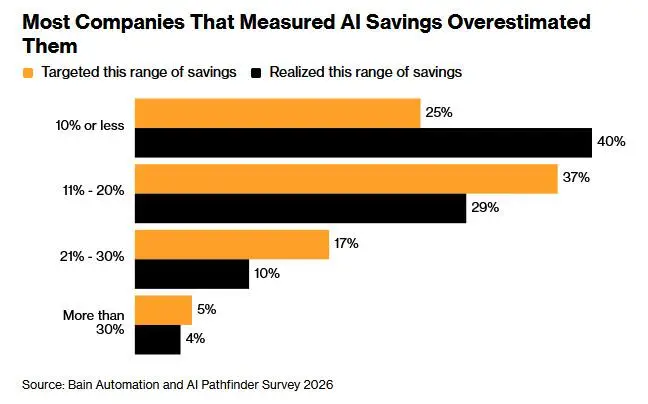
Bain stated bluntly in the report that these underwhelming results "should make executives uncomfortable"—because many of them approved continuously increasing AI budgets on the grounds of "expected savings." The core issue is: the actual, visible savings are minimal.
This is not the first evidence of AI underperforming expectations. An MIT research report released last year similarly showed that 95% of enterprise AI pilot projects fail, primarily due to "tools' inability to learn, poor integration, or mismatch with actual workflows."
"Circular bet": Using unrealized returns to endorse the next round of investment
The most concerning finding in the Bain report is a fundamental flaw in the decision-making logic of enterprise AI investment: 44% of large enterprises are using the "savings" generated from the previous round of AI investment as the funding basis for the next round—even though those savings have not been realized at all.
Bain issued a clear warning: "The prior round of investment failed to deliver on its promise, and the pool of savings available for allocation is much smaller than anticipated. The business case for the current round of investment is sized based on projected values, not actuals."
The report further points out that this approach of "self-rolling financing for the next round from past returns" appears on the surface to be strict financial discipline, but "is essentially a circular bet with a structural flaw." Bain's final conclusion is concise yet deafening: "Technology works, but value hasn't arrived."
The data dilemma: Billions spent on data modernization, yet AI's "famine" persists
The Bain report also identified the primary reason for poor AI project performance, and it is surprisingly fundamental: companies cannot reliably access their own data.
"Despite a decade of global investment in data modernization totaling hundreds of billions of dollars, the primary reason AI projects underperform remains companies' inability to reliably access their own data," Bain wrote in the report.
Notably, the survey also found a counterintuitive phenomenon: among companies that achieved their savings targets, the proportion encountering obstacles in data structure and accessibility was actually higher than those that missed their targets—but the former reported fewer organizational-level challenges such as budget shortfalls or priority conflicts.
Regarding this, Bain's prescription is that companies should not wait until all data is organized before feeding it into AI models; instead, they should start with currently available data, and then use AI to help map out the structured path for the rest of the data.
Gartner warns: Over 40% of Agentic AI projects will be aborted before 2027
Echoing the Bain report is concurrent research released by Gartner. Gartner predicts that over 40% of Agentic AI projects will be canceled by the end of 2027, due to escalating costs, unclear business value, and a lack of risk management mechanisms.
Gartner Senior Principal Analyst Anushree Verma noted: "Currently, most Agentic AI projects are still in the early experimental or proof-of-concept stage, primarily driven by market hype and often misapplied. This blinds companies to the true costs and complexities of deploying AI agents at scale, causing projects to stall at the production deployment stage."
Gartner recommends that Agentic AI applications should be strictly limited to scenarios that generate clear value or quantifiable ROI, emphasizing that integrating AI agents into legacy systems is technically highly complex, often disrupting existing workflows and incurring high transformation costs. Verma further cautioned: "To extract real value from Agentic AI, companies must focus on enterprise-level productivity enhancement, rather than just individual task-level augmentation."
The Bain report ultimately lands on a conclusion that should shame the entire industry: in this technological wave that has absorbed over $1 trillion in capital, almost no companies have actually conducted effective ROI analysis.
"Companies that do not use actual returns from automation—rather than expected returns—to validate their reinvestment logic are compounding risk, not managing it," Bain warned in the report.
The current high valuations of AI-related companies are largely built on optimistic projections of future returns, rather than verified actual performance—this is exactly the same as the enterprise AI investment decision-making logic criticized by Bain: valuation pricing relies on "projected values" rather than "actual values."
As token costs soar, companies are gradually waking up from the "grand promises" of Agentic AI and starting to pull back.

This also explains why AI giants like OpenAI and Anthropic, which permanently extrapolate short-term revenue bursts, are rushing to go public before the market re-evaluates and calculates the true ROI.
 微信扫一扫打赏
  支付宝扫一扫打赏
Comments (0)