
This article is from the WeChat official account: Dumou, Editor: Liu Nandou, Author: Yunduan Yalong
"Now the trophy is right in front of my eyes, I must consider whether this is the only opportunity of my life."
Defeating the defending champions and battling their way out of the Western Conference, the Spurs ultimately had to swallow a bitter defeat at home as the final buzzer of Game 5 sounded at the Frost Bank Center, surrendering the championship to the new kings, the New York Knicks, with a 4-1 series score.
The last time the New York Knicks won a championship, the NBA had not yet established the three-point line, The Godfather had just won the Oscar for Best Picture, Americans were beginning to withdraw from the Vietnam War, the tumultuous Watergate scandal was unfolding, martial arts legend Bruce Lee passed away in Hong Kong, and Guo Degang and Takeshi Kaneshiro were born that year.
After a long wait, the Knicks' championship has almost secured its place as the best North American sports story of the year. On the other side, Wembanyama may have just begun his legendary career; in the future, people might discuss this year's story just as they talk about Jordan losing to the Bad Boys Pistons or Shaquille O'Neal being defeated by Hakeem Olajuwon in the Finals.
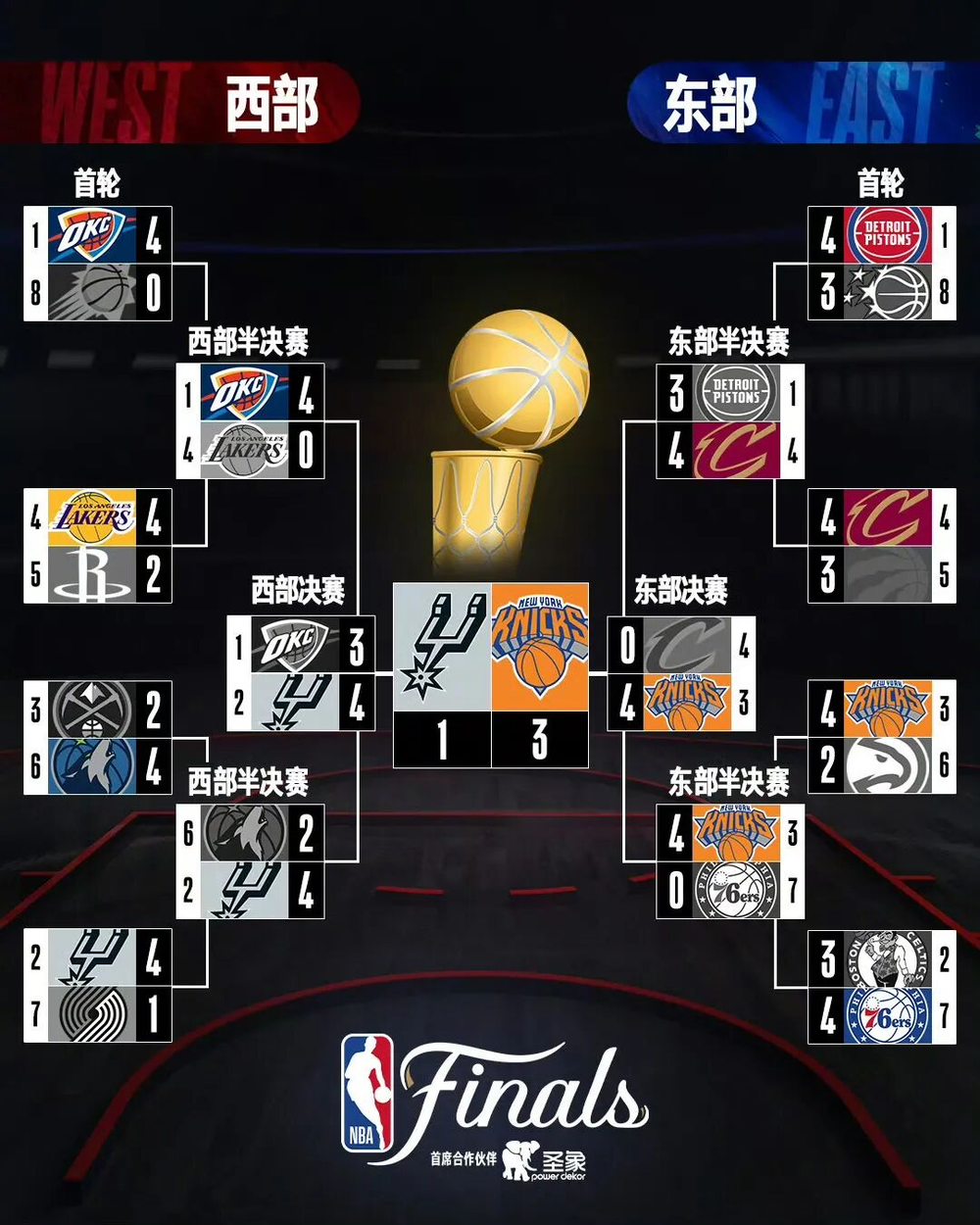
A great story brings massive commercial success. After hitting a ratings low last year, the NBA welcomed its most-watched Finals in nearly two decades. Even looking at the entire year, this NBA season has been exceptionally successful, achieving the best viewership data in North America and globally over the past twenty years, from the regular season and playoffs to the ultimate Finals.
Ever since Michael Jordan and David Stern propelled the NBA overseas in the 1990s, the league—once the underachiever among North America's four major leagues—has now become a truly global pop culture phenomenon. This is closely related to the NBA's proactive push for globalization, continuous self-innovation, and embrace of new media.
By aggressively pushing itself into global and local markets, the NBA inevitably faces cultural conflicts between North America and the rest of the world. However, the popularity of this year's Finals also proves that sports still provide a moment of temporary carnival and empathy for an increasingly fractured world.
1. Superstars Drive Ratings Surge
The Finals' viewership has been visibly explosive.
According to U.S. media Underdog NBA, Game 3 of the Finals was the highest-rated NBA Finals Game 3 since the 1998 series against the Jazz. Reportedly, the game averaged 23.8 million viewers, peaking at 26.3 million.
According to U.S. reporter Brett Siegel, ABC statistics showed that Game 1 of the 2026 NBA Finals averaged nearly 17 million viewers. This number represents a 90% increase from last year and is also the highest-rated NBA Finals Game 1 since 2018.
Compared to last year, this is a major rebound. Last year's NBA Finals Game 1 between the Thunder and the Pacers was the lowest-rated Finals game since 1988, excluding the 2020 and 2021 bubble Finals restricted by the pandemic. It was also only the second time in the Nielsen ratings era that the viewer count for both Game 1 and Game 2 failed to break the 9 million mark.
Even before the Finals began, media outlets declared this the highest-rated NBA playoffs in 28 years, averaging 5.3 million viewers across ABC, ESPN, NBC, Peacock, and Prime Video. Among them, Game 2 of the Western Conference Finals between the Spurs and Thunder became the highest-rated Game 2 in the history of the conference finals. NBC Sports statistics showed it averaged 10.1 million viewers on Wednesday night local time.
The regular season was no slouch either. NBA.com shows that in the U.S., 170 million people watched NBA regular-season games across platforms like ABC/ESPN, Amazon Prime Video, NBC/Peacock, and NBA TV—the highest in 24 years, an 86% increase from the previous season. According to Videocites, the NBA garnered a record 228 billion views on social media this season, a 13% year-over-year increase.
The emergence of superstars is the primary reason for the NBA's ratings recovery. Undoubtedly, the NBA is an art of star-making; as a highly commercialized sports league, superstars are the most important protagonists in this sports reality show.
In 2023, U.S. media compiled statistics showing that since 2015, a total of 27 NBA games had audiences exceeding 14 million. Golden State Warriors star Stephen Curry played in all 27, a phenomenon the media dubbed the "Steph Curry Effect."
From Jordan and Kobe to Curry, the NBA needs a ratings-carrying superstar every decade. Today, a new generation of players like Wembanyama, Shai Gilgeous-Alexander, and Anthony Edwards are being tasked with taking the baton.
The Associated Press believes that the star power of Wembanyama and Jalen Brunson helped this year's NBA Finals get off to a massive start in the ratings, something not seen since the last Finals showdown between LeBron James and Stephen Curry eight years ago.
The sustainability of star-making stems from the rise in the NBA's commercial value. In Forbes' list of the world's highest-paid athletes last year, three NBA players made the top ten. Stephen Curry ranked second with $156 million, surpassing NFL star Dak Prescott ($137 million) in fourth place. This inevitably leads athletic talents in North America's impoverished neighborhoods, who hope to achieve class mobility through sports leagues, to prioritize basketball over football.
The explosion of international players has brought even more star-making spectacles. At the start of this season, the NBA officially announced a record 135 international players on opening night rosters, representing 43 countries across six continents. After Canadian player Shai Gilgeous-Alexander won the MVP this year, the NBA MVP has now been monopolized by international players for eight consecutive years.
2. From the East Coast to the Rust Belt
The second crucial factor dominating NBA ratings is the city. The NBA has tightly bound urban culture with game outcomes, turning basketball into a nationwide carnival.
North American sports analysts attributed the decline in last year's Finals ratings to the disappearance of superteams and the difficulty of selling small-market teams. Changes in the NBA's salary cap structure made it harder for big-market teams to poach superstars from small markets. Ultimately, the two Finals teams—Indianapolis and Oklahoma City—were both notorious small markets, two of the seven smallest TV broadcast markets for NBA teams.
This year's Finals participants have completely flipped the script. The New York Knicks returned to the Finals after 27 years, becoming a major North American sports story this year. Located in the largest metropolitan area in the U.S., the Knicks have long maintained a top-tier franchise valuation despite a prolonged championship drought and years of lows. According to Forbes' 2025-26 season valuations, the Knicks are valued at approximately $9.75 billion, ranking third in the NBA.
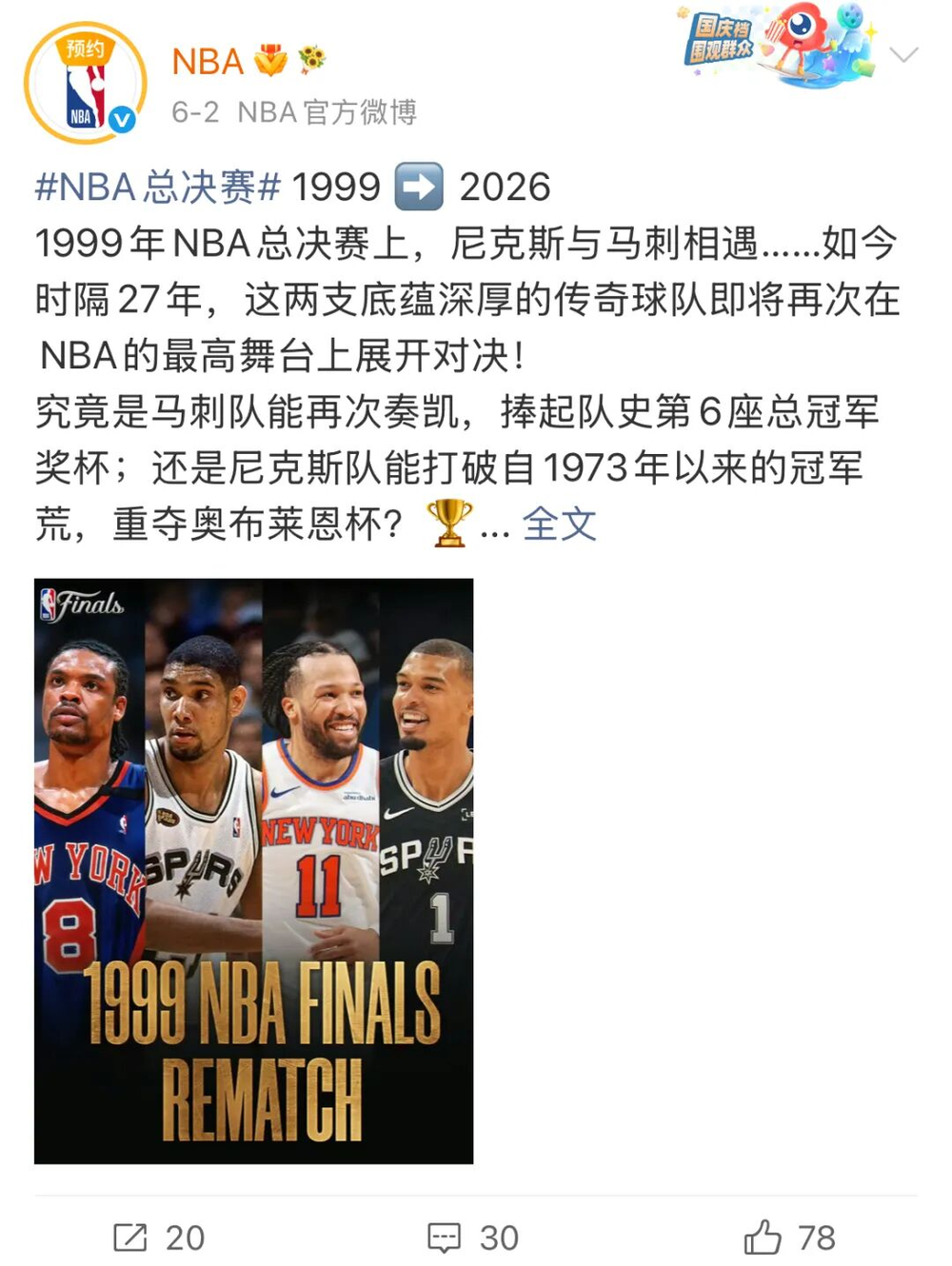
New York is also the NBA's most crucial media market; the headquarters of almost all major American sports media are in New York. Therefore, when the Knicks made the Finals, national media naturally dedicated more reporting resources.
This also marks the Spurs' first return to the Finals stage since winning the championship against the Miami Heat in 2014. Although San Antonio isn't a large city, the team won five NBA championships between 1999 and 2017 led by Tim Duncan and head coach Gregg Popovich, and made the playoffs for 22 consecutive years, thus accumulating a massive fan base.
A clash of titans brought the most immediate change: skyrocketing ticket prices. According to pre-game monitoring by North American ticketing systems, Games 3 and 4 of the Finals held at Madison Square Garden officially became the most expensive Finals tickets in NBA history. The minimum entry prices for those two games reached $3,745 and $3,464, respectively.
According to a market analysis previously released by Ticket Club, the average asking price for the seven games of the Knicks-Spurs series was nearly $8,000, more than four times the highest average ticket price for an NBA Finals since records began in 2012. The soaring prices even became a political issue; U.S. President Trump was asked by the media before Game 3 about the astronomical ticket prices for the Finals in New York, noting that ordinary Americans couldn't possibly afford these sporting events.
Ticket Club spokesperson Sean Burns believes that New York this year is a historically significant market. "The world's largest basketball market hasn't hosted the Finals in decades. The demand is unprecedented, and the current asking prices are simply incredible."
Beyond the metropolitan effect, changes in the broadcasting system have also brought back more viewers. In 2024, the NBA and broadcasters reached an 11-year, $76 billion broadcasting contract. NBC and Amazon became new regular-season broadcast partners, while ESPN retained the NBA Finals broadcast rights. This is the first year the media rights agreement has taken effect, and the increased number of over-the-air television broadcasts brought by this partnership has greatly benefited the NBA.
Compared to expensive streaming services, television broadcasts have allowed the NBA to regain a massive audience. Using domestic commercial logic, the NBA's success is due to both the return of wealthy franchises like those in Beijing, Shanghai, and Guangzhou, and the influx of users from lower-tier markets. A week and a half into the playoffs, 8 of the 10 highest-rated NBA playoff games were broadcast on NBC, with the remaining 2 on ABC. As of Sunday, 14 games had been broadcast on over-the-air television, compared to only 6 during the same period last year.
As Trump responded regarding the astronomical ticket prices: "I know, but they can watch it on TV. Watching on TV is half-free, I guess, but that's the way life is. You win some, you lose some, and right now, if this team wasn't having tremendous success, you'd be able to easily buy tickets to go. But that's the way life is, isn't it?"
3. An Increasingly International NBA
Before the Finals began, NBA Commissioner Adam Silver was asked about the progress of the NBA European League he has been actively promoting, stating that the NBA European League is expected to officially launch in the 2027-28 season. According to Silver, the NBA European League will consist of 16 teams, including 12 permanent franchises, with the remaining 4 spots to be bid on at the end of June.
This is undoubtedly a major milestone in the NBA's internationalization. Looking back at the league's international history, the 1992 Barcelona Dream Team was the first explosive turning point for the NBA's overseas influence. Afterward, David Stern marketed NBA broadcasting rights globally and promoted overseas games, gradually turning the NBA into a worldwide basketball carnival.
When the NBA Paris Game took place on January 23 last year, it became the highest-rated NBA regular-season game in French television history at the time. It also became the most-viewed game on the league's social media accounts in the history of NBA overseas games (over 218 million views). Among the participants in that Paris game was the French player who shone brightly this year: Victor Wembanyama.
International players are now indispensable participants in the NBA and a crucial reason for the continued success of the league's star-making strategy—perhaps exceeding Stern's original vision. Across all tracked global markets, total live viewing hours of NBA games via linear and streaming platforms (excluding NBA League Pass) exceeded 1.3 billion hours, a 93% year-over-year increase.
In the most important and delicate overseas market, the Chinese market has also shown signs of recovery this season.
Dumou mentioned in an article last year that, unlike North American audiences, domestic viewers hadn't bought into the NBA's new wave of stardom. After Yao Ming and Yi Jianlian, the prolonged absence of Chinese players establishing themselves in the NBA diminished the general public's interest in this overseas league.
During last year's NBA Finals, on the 24-hour trending list of the NBA section on Hupu on the evening of June 19, only one of the top ten discussed posts was related to the Finals; the rest revolved around past-generation stars and teams. However, on the evening of Game 4 of this year's Finals, six of the top ten discussed posts on Hupu's NBA section were about that day's game.
Official interactions between the NBA and the Chinese market have also increased significantly this season. In October 2025, after being temporarily interrupted by the Morey incident, the NBA China Games finally returned in Macao after a six-year hiatus. LeBron James, a representative of the previous generation of stars, also published an article in the People's Daily in September of last year, although he later denied writing it after returning to the U.S.
More importantly, after many years, a Chinese player has finally entered the NBA through the draft again. Yang Hansen became the first Chinese player to enter the NBA through the draft since 2016, and the highest-drafted Chinese player since Yi Jianlian was selected 6th overall in 2007.
When foreign media covered the Summer League following the draft, they considered Chinese rookie Yang Hansen the biggest star of the NBA's summer. NBA Deputy Commissioner Mark Tatum revealed that, solely in terms of Chinese viewership, Yang Hansen's Summer League games drew more viewers than the NBA Finals.
Even when Yang Hansen struggled during the regular season and was assigned to the Rip City Remix, the Portland Trail Blazers' G League affiliate, his G League debut set historic viewership records in mainland China. Statistics show that the game attracted a staggering 36.3 million unique viewers, with total views of related video content reaching an astonishing 44.7 million.
Of course, Yang Hansen's influence stopped at the regular season, but this year's playoffs remained incredibly hot on domestic social media—the Finals garnered 1.19 billion views on Douyin's main topic, and the Western Conference Finals were even more exaggerated at 1.9 billion. In contrast, last year's Finals between the Thunder and Pacers only managed 600 million views.
The reason isn't hard to understand: Wembanyama's superstar qualities appeal not only to the global market but especially to China. His trip to the Shaolin Temple last year earned him the nickname "Monk" in the eyes of Chinese fans, deeply strengthening his emotional connection with them. In today's NBA, he has clearly become the most beloved star among Chinese fans, second only to players of Chinese descent.
On the other hand, the reigning champions' franchise star, Shai Gilgeous-Alexander, hasn't enjoyed such luck. His foul-drawing playing style, amplified by short videos, has continuously solidified his impression among casual fans, making his mainstream popularity almost unprecedentedly poor.
When two superstars with such stark contrasts—like a "demon pill" and a "spirit pearl"—met in the Western Conference Finals, an earth-shattering battle of narratives unfolded. The slogan "justice must prevail" ignited renewed passion among many older fans who hadn't watched the NBA in years.
Outside the NBA, the basketball worlds of China and North America are forming closer, more multi-dimensional connections at a grassroots level. According to draft expert Wang Jian, among Asian players in the NCAA Division I for the 2026-27 season, mainland China reached 11 players, hitting double digits for the first time in history.
Commercial cooperation between the two major markets has grown even more. On June 2, Li-Ning officially announced a long-term partnership with Stephen Curry and the Curry Brand, reportedly a 10-year contract worth over $400 million. In the global sports market forged in the previous era, China and the U.S. have long formed close ties.
4. Is Sports Still a Universal Value?
Former IOC President Juan Antonio Samaranch once shared his insight on sports: "There are five universal languages in the world: money, war, art, sex, and sports, and sports can integrate the first four." Today, on a global scale, the NBA is becoming a universal language of basketball.
According to an ESPN report, during the Paris Olympics, observers were surprised when Wembanyama celebrated a crucial scoring play in the group stage with an English expletive.
"Let's F**king Go!" Wembanyama shouted after hitting the game-winning shot in France's overtime victory over Japan.
"It's a basketball player's instinct," Wembanyama told reporters when asked why he didn't use French at that moment. "I feel like whether in Mongolia, Australia, or the North Pole, players would say this."
In a way, the NBA is also providing some bridging opportunities for a politically divided America.
Last year, some North American commentators believed that the rising populist sentiment was affecting NBA ratings because the NBA is often seen as closer to progressivism and distant from Trump and his MAGA followers. During his term, Trump did not host any NBA championship teams, a stark contrast to Democrat President Obama, who loved the NBA.
This year, the situation reversed. Trump called himself a "huge fan" of the Knicks and their owner James Dolan, stating he would attend at least one game the following week, making him the first sitting president to attend an NBA Finals game in person.
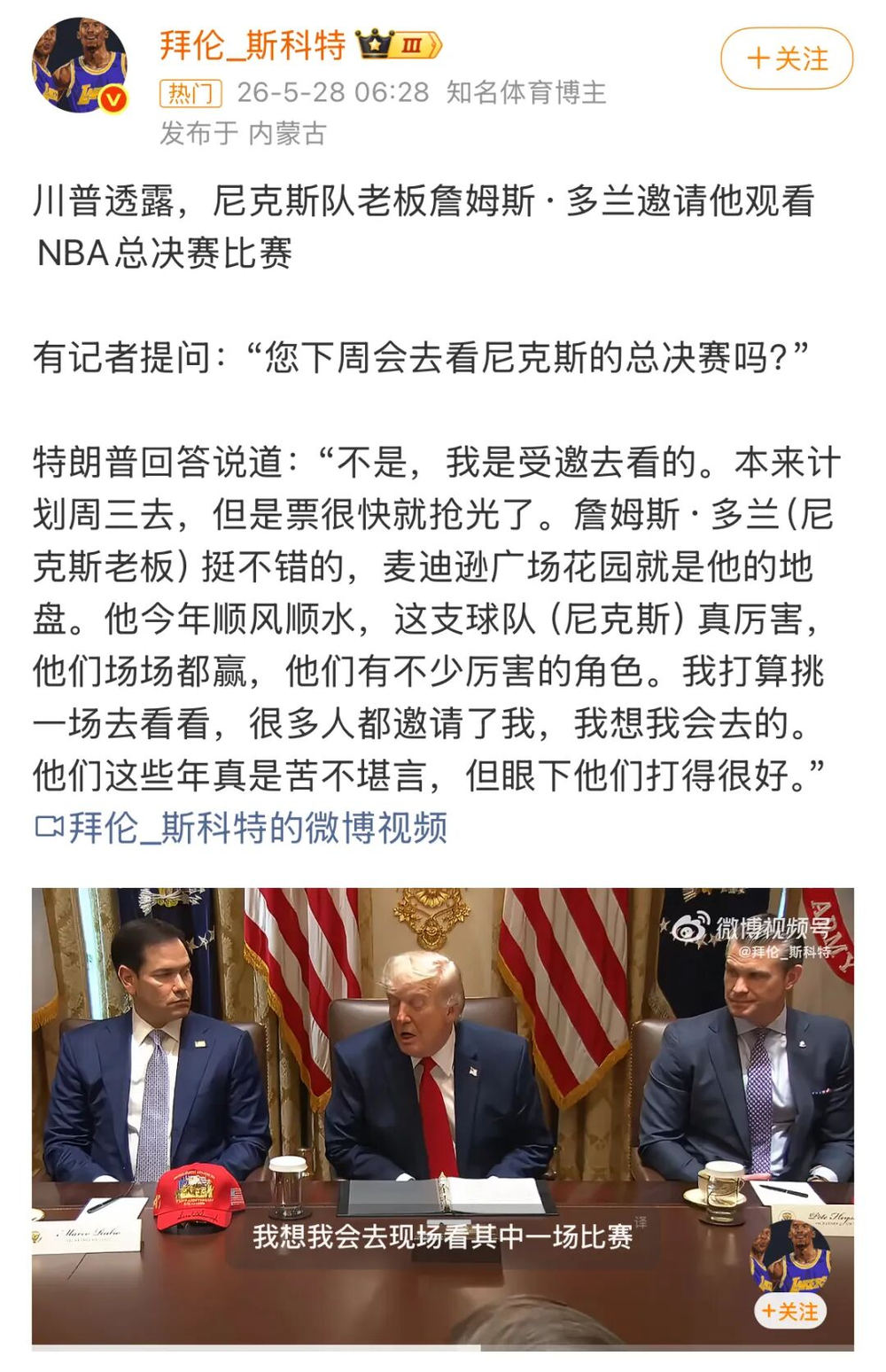
While dealing with the U.S.-Iran conflict, congressional disputes, and the upcoming midterm elections, Trump mentioned he watched the Knicks beat the San Antonio Spurs to take a 1-0 series lead in Game 1. He also used his signature rhetoric to describe his impression of Wembanyama: "I said, how do you guard this guy? He's 7-foot-5 and shoots well, right? But they always find a way."
Appearing alongside Trump at the Knicks game was Zohran Mamdani, representing another America—the Mayor of New York City. The mayor's office stated that Mamdani would purchase a ticket with his own money. Described as a progressive left-wing populist, Mamdani is New York's first Muslim mayor, a member of the Democratic Socialists of America (DSA), and one of the political stars born from North America's younger generation embracing radical left-wing ideology following the Occupy Wall Street movement.
The media believes Silver is trying to send a message: even in times of severe political division, sports can play a unifying role. "We can emphasize what we have in common rather than our differences... We saw that in New York, and I think President Trump has a very New York identity, and I'm glad to have another New Yorker wanting to join in the passion and joy of the Knicks."
Of course, sports cannot mask too much dissonance. Just as after Curry officially signed with Li-Ning, patriotic American netizens on Twitter were still flooding the comments with curses. And when Trump showed up at the Democratic stronghold of New York's home court, he was met with more boos than cheers. Sports provide a bridge and an opportunity for dialogue, but whether people are willing to enter this Tower of Babel remains a test for people around the world.
 微信扫一扫打赏
  支付宝扫一扫打赏
Comments (0)