
Here's some good news: you don't need to worry too much about losing your job to AI just yet.
Because after doing the math, your boss might find that you offer better value for money.
In March of this year, Jensen Huang's remark—"I would be deeply uncomfortable if a $500,000 engineer didn't consume at least $250,000 worth of tokens annually"—took the absurdity of this world to a whole new level.
Companies started encouraging employees to consume as many tokens as possible, even incorporating token consumption into their KPIs.
Two months ago, an employee at a major domestic tech company posted on Xiaohongshu, revealing their department's token consumption leaderboard for March. They claimed that whether an employee passes probation, their year-end performance bonus, and promotions would all be tied to their token consumption data.

Things are just as crazy abroad.
Silicon Valley tech companies have fostered an internal culture of "Tokenmaxxing" (Token Maximization). Take Meta, for example: employees built a "Claudeonomics" dashboard to track the token consumption of about 85,000 employees across the company. When the data was pulled, it showed the entire company burned through over 60 trillion tokens in just 30 days.
Disney, which theoretically isn't very tech-focused, also launched an AI Adoption Dashboard on its intranet to track employees' AI usage.
Gradually, this trend went off the rails. Token consumption even became a social threshold—if you didn't use enough, you couldn't get into their circles.
Everyone got carried away in this race.
It seemed that from the very beginning, everyone assumed AI was a perfect tool for reducing costs and boosting efficiency. So, regardless of the consequences, they just went all in with their eyes closed.
But when the bill arrived, they realized things weren't quite what they seemed... Reducing costs and boosting efficiency turned into reducing costs and becoming a joke.

Recently, according to Bloomberg, Uber implemented a new rule: when employees use various AI agent coding tools (like Anthropic's Claude Code or Cursor), the monthly spending cap per person per tool is $1,500.
The key isn't the amount, but the fact that Uber proactively set a limit.
After all, last December, to keep everyone on trend, Uber generously rolled out Claude Code to about 5,000 engineers across the company and even created an internal leaderboard to track usage.
The original intention was for everyone to fully embrace the trend. But before they could even warm up to it, Uber's CTO revealed that the company had burned through its annual Claude Code budget in just four months.
So Uber had to take emergency measures, manually pulling the brakes. Only special business cases that go through layers of approval can exceed the $1,500 limit.
Meanwhile, Microsoft couldn't sit still either.
They are busy revoking Claude Code licenses from employees in the E+D (Experiences and Devices) division. By June 30, everyone must switch to Microsoft's own darling, GitHub Copilot CLI.
Although the official line is integration—and migrating to GitHub Copilot still allows the use of Claude models—The Verge reported that sources cited financial considerations as a factor.
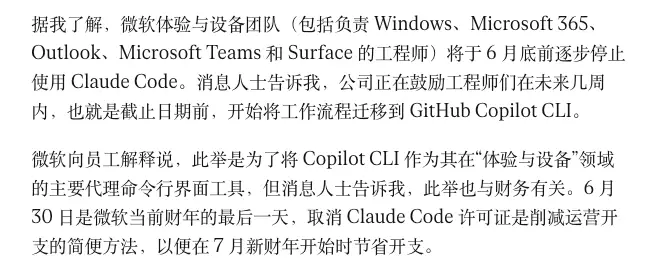
Because after June 30, Microsoft starts its new fiscal year.
And besides Microsoft and Uber, foreign media outlet Axios dropped an even bigger bombshell. A company burned through $500 million in a single month because it didn't set a usage cap on employees' Claude licenses.
Although no specific company was named, the sheer volume of token consumption led outsiders to point fingers directly at the Magnificent Seven of Silicon Valley.
Coincidentally, the day after the Axios report came out, Amazon shut down an internal AI leaderboard called "Kirorank," with executives urging, "Don't use AI just for the sake of using AI."
It's hard not to suspect that Amazon was the one that burned $500 million in a month. After all, Amazon had been quite aggressive previously, requiring over 80% of its developers to use AI weekly, which led employees to engage in all sorts of meaningless, convoluted actions.
This is a classic case of Goodhart's Law: when a measure becomes a target, it ceases to be a good measure.
Fortunately, this farce of token worship didn't last too long.
Once the bills came out, everyone snapped out of it and pondered a more fundamental question: Is burning all this money actually worth it?
It's undeniable that companies initially letting employees burn tokens freely had an experimental aspect to it.
After all, no one knew exactly how much value AI could bring. If real results could be seen, investing some money wouldn't be a big deal.
But the reality is often that tokens flow away like water from a tap, yet no actual business value is seen, or it's very hard to find a standard to measure that value.
Even Uber COO Andrew Macdonald stated in an interview that it's difficult to find any correlation between "higher token consumption" and "shipping new features."

In other words, token consumption cannot be directly equated with actual output value.
AI reading and understanding your requirements, then thinking and generating the content you want—all of this consumes tokens. This means that any interaction incurs consumption, but the output isn't necessarily all useful content.
Understanding this, looking back at treating "token consumption" as a leaderboard to climb seems a bit weird.
It's like writing articles in an editorial department: if word count were the primary evaluation metric, I could just keep rambling like this, churning out meaningless nonsense to pad the word count.
To meet their KPIs, employees could easily skip real work and spend all day finding ways to make AI run useless, lengthy code, or have AI do tasks that humans could do faster.
When the data is pulled at the end, everyone's token consumption would be off the charts, looking incredibly advanced, but in reality, no substantive business would have progressed.
miHoYo previously ran a multi-agent collaboration project. For 13 hours, these Agents did absolutely nothing of substance, just constantly calling each other and chatting away, burning 2 million RMB in a single night.

And it's not just at the corporate level; in developer and general user circles, showing off how many tokens you consumed also became a trending fad for a while. It was as if the bigger the number, the stronger your abilities and the more geeky you were.
But honestly, while I've seen how many tokens they burned, I haven't really seen the results.
Previously, OpenClaw developer Peter Steinberger posted a bill showing his team burned $1.3 million in a month, and he was also questioned by netizens about not delivering anything.
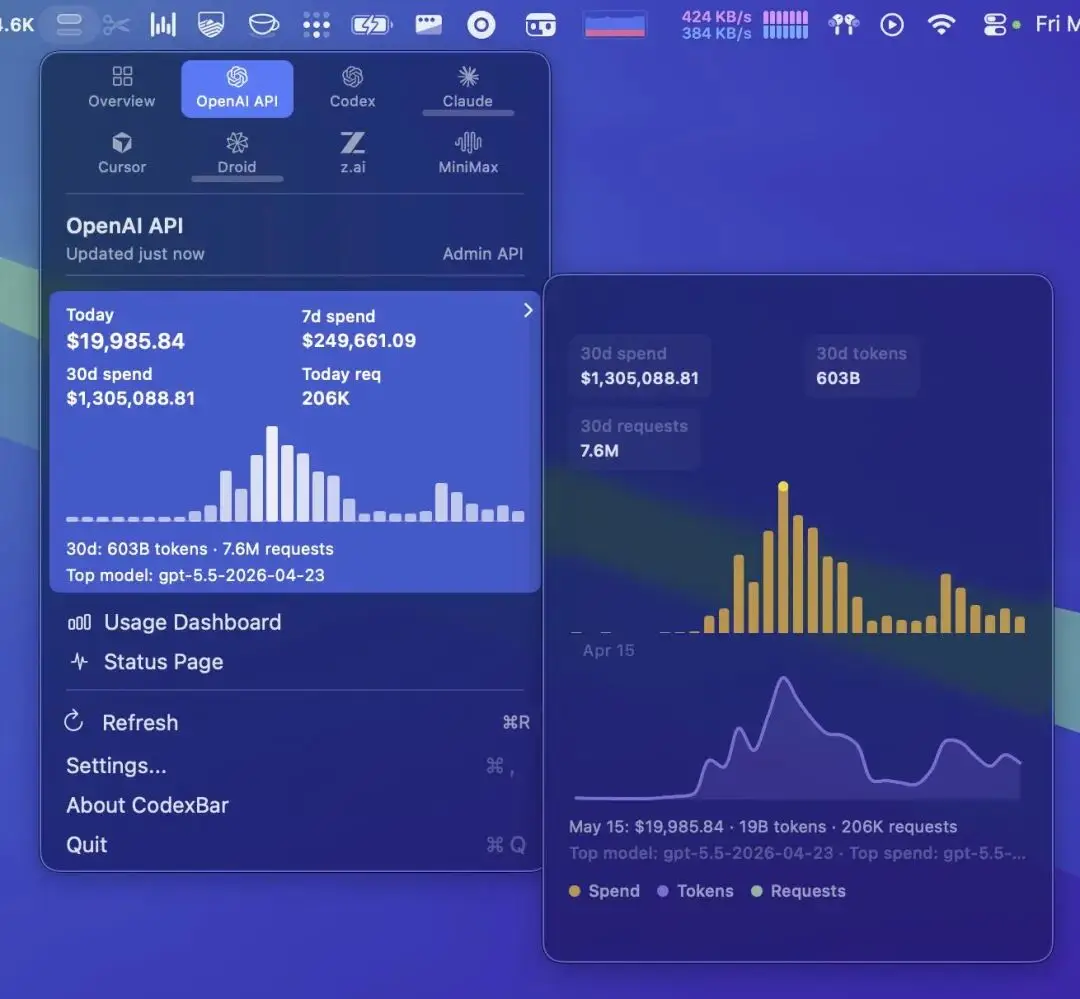
Although Peter responded that these costs were all used for OpenClaw, I thought about it, and OpenClaw doesn't seem to have updated with any mind-blowing features either...
The awkwardness of current token consumption lies here: it can only prove that the large model is putting in effort, but it can't prove how much good work you actually did with it.
It's like how people once questioned whether GDP was objective enough in reflecting true economic conditions, and economists later gradually figured out another set of supplementary measurement standards.
Therefore, before clarifying the relationship between token consumption and output, or before finding an accurate metric to quantify the actual output value of AI, blindly having employees use AI is purely giving money away to large model providers.
Taking a step back, even if it's not an extreme case like miHoYo's, the math still doesn't add up.
Because AI cannot completely replace humans at this stage; at best, it's a supporting role. So the true cost of a company adopting AI should be "employee salary + AI computing cost."
The actual workflow often becomes: the employee submits a prompt, AI generates some initially usable stuff, and then the employee keeps retrying and correcting errors. During this process, tokens are constantly burning, and it might end up being much more expensive than just hiring two interns.
When you do the final math, it's really hard to say whether laying off staff or using AI saves more money.
Goldman Sachs predicts that by 2030, global token consumption will grow 24 times compared to 2026, reaching 120 quadrillion per month.
Previously, everyone thought AI could replace highly repetitive, low-end jobs. But from a cost perspective, low-end jobs are actually safer now.

Overall, voices of reason are gradually emerging in the industry, no longer blindly pursuing token consumption.
Domestic giants like Tencent are reportedly already limiting employees' token usage quotas. After the initial experiments, everyone is gradually realizing that token usage needs to consider actual output more carefully.
At the same time, the pricing logic of some SaaS companies is also changing.
For example, the marketing platform Hubspot changed its pricing model starting in April, shifting from charging per token to charging based on actual results.
A while ago, I attended an event in Suzhou where Wang Dong, Vice President of Kingsoft Office, made a point I think is worth pondering: Enterprise-level AI implementation needs to find "double-high scenarios"—high value and high difficulty.
Simply put, good steel should be used on the blade.
Ultimately, this farce of token worship came and went quickly, but I still feel a bit conflicted.
Because tokens are so expensive, people online joke: "Making wage slaves work overtime might not cost you overtime pay, but making AI work overtime means you can't skip a single penny."
When the day comes that capitalists find hiring humans is more cost-effective than AI, I wonder if that's a tragedy for us?
Source: Chapingjun
 微信扫一扫打赏
  支付宝扫一扫打赏
Comments (0)