
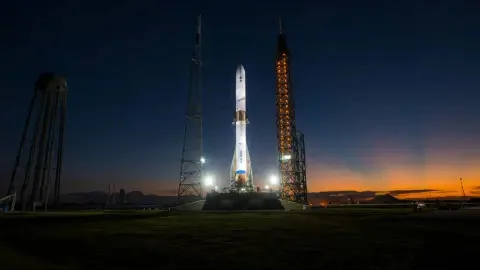
@Steed的围脖:On the evening of May 28, Eastern Time (morning of today, Beijing Time), Blue Origin's New Glenn rocket exploded during a static fire test at its Florida launch site. Shortly after the seven BE-4 engines ignited, the first stage disintegrated on the launch pad, and the liquid methane fuel created a massive fireball that engulfed the entire LC-36A pad. This might be the most violent explosion humans have created on a launch pad since the Soviet N1 rocket blew up in 1969.
No one was injured. But the rocket is gone, and the launch pad is essentially destroyed.
Sources indicate that the launch pad's infrastructure is severely damaged. At least one lightning tower is likely beyond repair, and the transporter erector used to raise the rocket may also be scrapped. In 2016, SpaceX's Falcon 9 exploded on the launch pad; that was only a medium-lift rocket, and rebuilding the SLC-40 pad took over a year. New Glenn is a super-heavy rocket, and the scale of the debris it left behind is much larger.
The cruelest part is the timing.
Blue Origin was founded in 2000. For the subsequent quarter-century, the company was long viewed by the outside world as a space billionaire's toy that spent money slowly and delivered results even slower. The emergence of New Glenn completely reversed this impression. In its previous three launches, the first stage functioned normally every time. In April this year, the company completed the first recovery and reuse of a New Glenn first stage, instantly propelling itself into the top tier of global aerospace companies. Although the third flight lost its payload due to an upper-stage issue, Blue Origin returned to the launch pad in less than two months. Prior to this launch, the inventory held two first-stage boosters and about six upper stages, with a monthly launch cadence seemingly within reach.
The first stage that blew up on Thursday was nicknamed "No, It's Necessary." It was a brand-new booster that hadn't even had the chance to begin its first flight.
The failure occurred in the engine section; the specific cause is unknown. Bezos said on social media: Tough day, but what needs to be rebuilt will be rebuilt, and what needs to fly will fly.
But right now, even where the rockets will take off from has become a problem.
Blue Origin had just started building a second launch pad, LC-36B, next door, but the project is still in its early stages. One possible path is: rather than repairing the devastated LC-36A, it might be better to go all out and rush the completion of LC-36B. Even so, it is almost impossible for New Glenn to fly again this year; returning to flight in the first half of 2027 would be considered fast.
The bigger chain reaction points to the Moon.
Just two days before the explosion, NASA announced it had selected the New Glenn rocket to deliver two lunar rovers to the Moon's surface in 2028. Blue Origin is developing its own cargo lander, Blue Moon Mark 1, for this purpose. It was originally scheduled to ride New Glenn on its first flight to the Moon this autumn, followed by another flight next year to deliver NASA's VIPER rover. These timelines are now entirely up in the air.
Further down the line is Blue Moon Mark 2, a large crewed lander. It requires the upgraded 9×4 version of the New Glenn rocket, which expands the first stage from 7 to 9 engines. There are very few active super-heavy rockets capable of lunar-level missions: NASA's own Space Launch System is too expensive and slow, flying less than once a year; SpaceX's Starship is still in the test flight certification phase. NASA has placed Mark 2 and Starship side-by-side as the two pillars for future regular crewed lunar landings.
But the 9×4 version has yet to undergo test flights, and its progress is completely tied to the recovery of the New Glenn platform and its launch pad. Without one pillar, the entire lunar base plan loses its redundancy. A reasonable guess is that the company might simply pour all its resources into the 9×4 and the new launch pad, skipping the recovery cycle of the 7×2 version.
Bezos has poured tens of billions of dollars into Blue Origin. The company's biggest safety net is not its technical reserves, but its owner's bank account. NASA equally desperately needs Blue Origin to get back on its feet as soon as possible.
The only good news on Thursday night: the Amazon low-Earth orbit internet satellites scheduled to be carried hadn't been loaded onto the rocket yet and were safely sitting in the adjacent integration facility.
~~~~~~
Figure 1: Blue Origin's New Glenn rocket stands on the launch pad at Cape Canaveral Space Force Station, Florida. Credit: Blue Origin
 微信扫一扫打赏
  支付宝扫一扫打赏
Comments (0)