
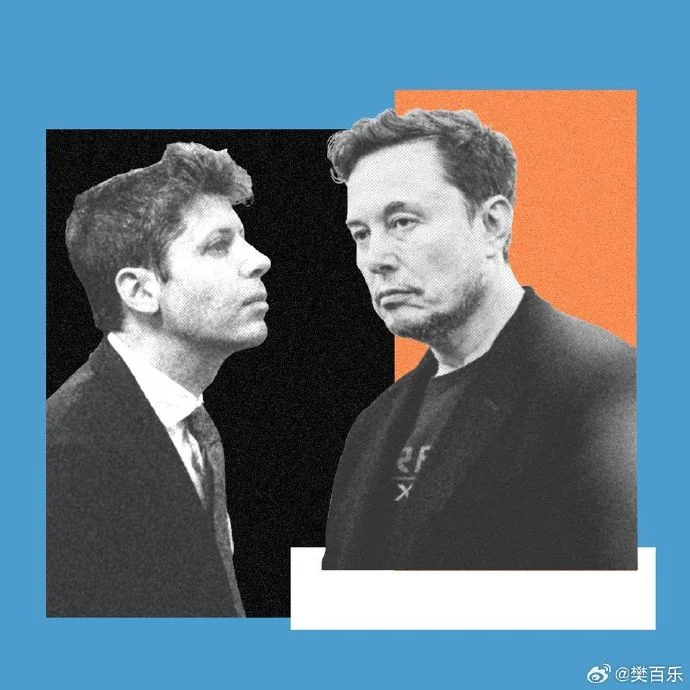
@Fan Baile: Just how bizarre is Elon Musk's lawsuit against OpenAI (and co-founders like Sam Altman, plus Microsoft)?
1. Not long ago, the first-instance verdict of Musk's lawsuit against OpenAI was announced, and Musk lost. This case was filled with drama and absurdity from the causes of action to jury selection and witness testimonies, and it pushed this sense of bizarreness to a climax with its O. Henry-style ending.
2. Why did Musk sue the whole OpenAI family?
3. In 2015, Musk and Altman co-founded OpenAI. As the primary financier, Musk promised to invest a total of 1 billion USD in installments. Moreover, since AI is such a grand endeavor, it couldn't be controlled by evil capital like Google; creating OpenAI was about establishing a moral compass for the world and securing a future for the people, so it couldn't be structured as a corporation. Thus, OpenAI was established as a non-profit organization from the very beginning.
4. Of course, during the process, everyone quickly realized that AI burns through cash so fast, and a non-profit can only accept donations, which is bad for fundraising. In 2017, Musk actually took the initiative to discuss with the management team whether they should set up a for-profit company to raise money. Musk even generously suggested: "I have a plan—why don't we merge the entirety of OpenAI into Tesla, and I'll manage it well on everyone's behalf?" The OpenAI management team, moved to tears, responded: "Big bro, you're so generous! We may be poor, but we're not stupid. We politely decline."
5. After failing to reach an agreement, Musk officially left OpenAI's board of directors in 2018, having invested a total of about 40 million USD.
6. Later, OpenAI indeed created a for-profit subsidiary under the non-profit entity, which received massive investments, including from Microsoft (Microsoft has invested over 13 billion USD in cash and computing power over the years). Then came the familiar plot: ChatGPT burst onto the scene, and the AI world arms race began.
7. The former co-founder Musk couldn't sit still. In 2024, he sued OpenAI, its executives, and Microsoft. Musk said with profound grief: Altman and others were blinded by greed, betraying OpenAI's original mission (non-profit + open source) to line their own pockets; and Microsoft was not blameless in the process of corrupting the revolutionary cadres. It's worth mentioning that in 2023, Musk started his own venture, founding xAI (and recently merging it into SpaceX in preparation for an IPO).
8. In summary, Musk filed multiple claims in the US Federal Court for the Northern District of California: terminate OpenAI's for-profit company, permanently maintain its pure non-profit status; make the for-profit company return 150 billion USD to the parent non-profit organization; and kick Altman and OpenAI President Brockman out of OpenAI.
9. Yes, 150 billion USD. When Chinese lawyers saw this claim, their first reaction was: How much would the court filing fee be?! In US litigation, the court fees collected are generally not tied to the value of the claim, so they are basically negligible. Of course, to prevent malicious frivolous lawsuits, if a lawsuit is completely baseless, the plaintiff could face hefty fines.
10. This case adopted a very special trial mechanism: a nine-person jury was selected, but the jury only had an "advisory role" regarding the judge's decision; the final say still belonged to the judge.
11. Most cases we see in American TV dramas either feature a jury making the verdict with the judge providing guidance, or a judge presiding over the trial alone. Why was OpenAI so special? Because, in this case, Musk's claims (return of unjust enrichment, dissolution of the company, removal of personnel) were not purely monetary compensation, but "equitable relief." In US civil litigation, only purely compensatory claims mandate a jury trial.
12. The process of selecting these nine jurors was also quite dramatic. An important standard for selecting jurors in the US is that they cannot have preconceived biases about the case, or even prior knowledge of it. Back during the O.J. Simpson trial, Simpson's lawyer was ruthless, asking right off the bat: "Did you see the news footage of the police chasing Simpson's car?" The problem was, it was a nationally sensational event; even Clinton had seen that footage. If this standard were strictly applied, no one would qualify for the jury. So the judge at the time said it was a special circumstance and couldn't be used as an exclusion standard.
13. Similarly, in the OpenAI case, Musk's lawyer frequently asked candidates if they liked Musk. Many answered that they found him quite annoying. But the presiding Judge Rogers believed there was nothing to be done; many people in our country indeed dislike him. However, the general public is reasonable and can separate one issue from another, still capable of upholding judicial fairness.
14. The nine people ultimately selected for the jury included a painter, a nurse, an arms dealer company employee, a psychiatrist, and retirees.
15. The truly exciting part was the witness testimony phase.
16. Musk appeared in person, mostly repeating his usual spiel: "AI is terrifying! It can't be allowed to fall into the hands of bad people! We want Star Trek, we don't want Terminator! Humanity will die! Humanity will literally die!" The judge's response was essentially: If you hadn't founded xAI yourself, I might have almost believed these heartfelt words.
17. During subsequent testimonies, it was discovered that Musk's inconsistent behavior wasn't limited to just founding xAI.
18. Former OpenAI director Ms. Zilis is a very special presence. Not only did she serve on OpenAI's board for a long time, but she is also the mother of four of Musk's many children. Even after Musk fell out with OpenAI in 2018, Zilis stayed at OpenAI for several more years. To some extent, this was because Altman needed an intermediary with Musk. Altman even consulted her on how to respond after Musk furiously texted him. Her advice was simple: You can reply after a while, or call, but never reply to a text immediately.
19. But it turned out she was Musk's mole within OpenAI. Musk even secretly poached talent from OpenAI to his own company while he was still on OpenAI's board (in an email to a Tesla executive, he wrote: "OpenAI will probably hate me if they find out, but this just has to be done."). On matters like Microsoft investing in OpenAI and continuing to poach staff from OpenAI, Ms. Zilis maintained private communications with Musk. When she got pregnant, she proactively informed the board but didn't reveal who the father was. The OpenAI president only found out from news reports that it was Musk's child, and since Musk had already founded xAI, he asked Zilis to leave.
20. Musk also admitted that Grok had distilled OpenAI's large model. When OpenAI's lawyer asked him in court if this was true, he said: "This is a common practice in our AI industry." After testifying, Musk followed Trump to Beijing, even though, theoretically, the judge had the right to recall him to continue his testimony at any time during those days.
21. By the way, the leader of OpenAI's all-star legal team this time was William Savitt, who had previously defeated Musk once. In 2022, Musk impulsively made a tender offer to acquire Twitter for 44 billion USD but later tried to back out. It was this lawyer, Savitt, who represented Twitter and forced Musk to follow through on his reckless boast and hardheadedly complete the acquisition.
22. Of course, heaven spares no one; Altman's situation wasn't much better.
23. His reputation at OpenAI is also hard to describe in a few words. He has been repeatedly accused of abandoning AI safety controls and his sense of responsibility to humanity in pursuit of profit, and of lying multiple times. He was even briefly ousted by an internal coup but quickly made a comeback, purging the board members who had betrayed him.
24. Shortly before this trial began, The New Yorker published an in-depth article titled "Should We Trust Sam Altman?". Musk paid to boost the article's visibility on X.
25. During the trial, Musk's lawyer repeatedly cross-examined Altman: "Have you always told the truth in your life?" "I definitely haven't at times." "Have you ever lied to your business partners?" "I don't think so." "Do they think so?" "Then ask them." "Have you been called a liar by many people multiple times?" "I've heard such rumors."
26. Interestingly, both sides paid high fees to hire corporate and charity law scholars as expert witnesses to argue whether "OpenAI's 'non-profit parent + for-profit subsidiary' structure was appropriate or not." Several witnesses likely charged hundreds of thousands of dollars for their involvement in this case.
27. Musk's witnesses described the structure as the relationship between "a museum and its souvenir shop." Sure, it's fine for a museum to open a for-profit shop underneath to cover expenses; but now this black-hearted museum is selling Picasso paintings in the shop too, and the public can no longer enjoy them for free.
28. OpenAI's lawyers and witnesses refuted this analogy. Actually, I was thinking that to make it easier for Chinese readers to understand, you could imagine the story of when Shaolin Temple almost split and went public back in the day.
29. Another person tortured by Musk's lawyers was OpenAI's other co-founder and president, Greg Brockman. During this trial, the public learned for the first time that the current market value of this guy's stock had reached 30 billion USD. The lawyer asked him: Since you insist on doing AI to benefit all of humanity, why not consider donating your tens of billions? He responded: Please don't morally kidnap me; this is all my "hard-earned blood and sweat money."
30. The entire trial lasted two or three weeks. OpenAI's people and Microsoft's rebuttal logic was very clear: "This isn't Musk acting as a champion of justice; this is the story of a bitter ex-boyfriend crying sour grapes trying to ruin his ex-girlfriend's wedding. He knew about OpenAI's for-profit needs back in 2017 and even proposed it himself. So why did he only remember to sue now? Simple: because our model is awesome, and because we're going public. Look, he's panicking; if he can't have it, he wants to destroy it. Those who know, know."
31. The nine jurors clearly bought this logic. It took them only two and a half hours to unanimously rule: "Given that Musk knew about the existence of the alleged breach of contract very early on but didn't sue until 2024, it exceeds the three-year statute of limitations." Technically, this ruling was only advisory for the judge, but the judge adopted it almost immediately and announced the closure of the case.
32. Yep, that's it.
33. Musk's lawyer told reporters right outside the courtroom that they would appeal. But the actual win or loss of this case was almost predetermined. Its purpose was more about using massive exposure to showcase the immense wealth and hypocrisy in OpenAI's world, throwing a wrench into the gears of OpenAI's intensive IPO preparations, and paving the way for SpaceX's similarly intensive IPO. Of course, for the spectators, the realization was that even the lofty, esoteric world of AI is nothing more than a capital feast where everyone's a villain, right?
 微信扫一扫打赏
  支付宝扫一扫打赏
Comments (0)