
This article is from the WeChat public account: 人到中年的叶子, Author: 人到中年的叶子
Every year during the May Day holiday, I return to my hometown, and this year is no exception.
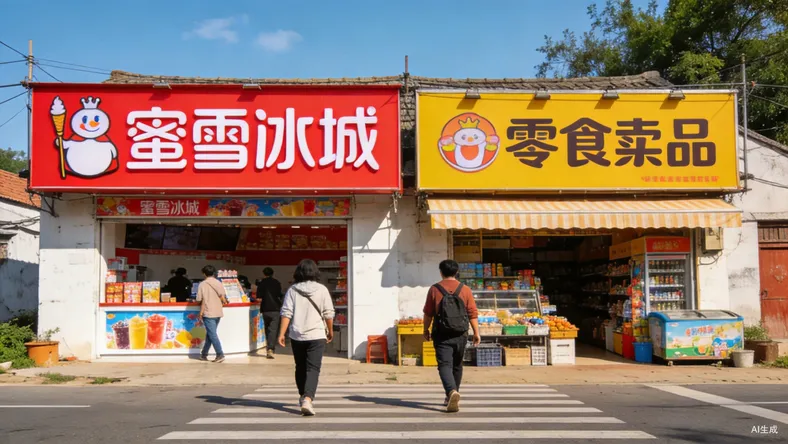
As the car passed through the township, the big red sign of "Mixue Ice Cream & Tea" at the intersection was very conspicuous. It wasn't there last year, so it seems to be a newly opened store; this brand has truly "sunk to the bottom." I didn't get a chance to buy anything at Mixue, so I asked my nephew's kid how much the items inside cost. The fourth-grader answered me very clearly: the cheapest are just over two yuan (I guess that's the lemonade), and some new products are around ten or twenty yuan.
Last year, it seemed like Luckin Coffee in the county town wasn't very popular, but looking at Meituan delivery this year, three stores have already opened. My brother told me during a chat that when he feels sleepy at the factory, he drinks coffee or strong tea, but I forgot to ask him which kind of coffee he drinks. Perhaps, before long, the villagers will also be drinking Luckin. Faced with "affordability" and young people's desire to "follow the trend," the so-called "coffee culture" doesn't mean much; consumerism is never a profound proposition.
Right next to the Mixue store is a shop with the sign "Hao Xiang Lai," also in big red letters, looking very festive. I momentarily confused it with "Hao Xiang Ni," a jujube brand, thinking they were the same. Later, I learned that this is also a chain brand with over ten thousand stores, benchmarked against "Zhao Yiming Snacks." However, my family said that while the snacks look cheap, they are actually quite expensive once weighed.
Regardless, the bosses of these chain brands have all set their sights on the village's purchasing power. As for whether they will succeed, only time will tell.
The Fully Booked Restaurant
For the past two years, every time I went home, I would treat my parents to a meal at a county town restaurant. The original plan was the same this year, but whether to save me money or because he thought it was too far, my dad kept complaining it was too much trouble and flatly refused to go. In the end, my nephew treated us, and we had a gathering at a restaurant in the township.
The restaurant entrance was full of cars, many with out-of-town plates, seemingly all villagers returning home for the May Day holiday. The elevator went straight to the third floor, and as soon as we walked in, we were stunned by the dozens of banquet tables in the hall, thinking we had walked into the wrong place. It turned out an engagement ceremony was being held there. Our private room was next to the elevator, in a room further inside.
During the meal, I heard from my family that this restaurant is the top choice for engagements, weddings, and one-month baby celebrations for several surrounding villages. During the May Day holiday, there are large banquets every day. A neighbor from the village reportedly had to postpone his son's engagement ceremony to the end of the month because the restaurant's schedule was too full.
I was still marveling at how, in my impression, villagers used to host flowing banquets and cook big pot dishes at home for engagements and weddings. The topic had already shifted to elementary school math about "88,000 yuan for the engagement, 188,000 for the wedding, and how much the five types of gold, house, and car add up to." If a family has one son, they need four to five hundred thousand yuan; two sons mean seven to eight hundred thousand. The conclusion was that either the child is capable—finding a partner on their own without requiring a bride price—or the parents are capable—having saved up enough money. Otherwise, the son can only remain a bachelor.
The "Burden-Free" Cousin
By coincidence, the cousin at the dinner table happened to have two sons, the older in his twenties and the younger around seventeen or eighteen. Both sons are currently doing odd jobs at a factory in a neighboring village, earning little but spending a lot. Later, I heard that the family of four has a bad reputation for borrowing money everywhere among neighbors and relatives. The cousin and his wife especially work and farm sporadically, but the cousin occasionally gambles, and the wife spends money lavishly. At the dinner that day, the wife had makeup on and had her nails done. What's more outrageous is that the next day, she bought clothes worth hundreds of yuan and borrowed the few dozen yuan she was short from family members.
Hearing more about their deeds later, I actually got a bit angry. How could there be such irresponsible parents? The second son isn't even 18 yet and has to work odd jobs, earning barely enough to squander, and he has also learned from his parents to lie and borrow money everywhere. The eldest son, because he has no money to get married, has gone from one girlfriend to another. The family has done everything they should—well-intentioned reminders and harsh criticisms have both occurred—but as my brother put it, "After all, we share the same surname; we have to maintain appearances."
Yes, everyone is an adult, and choosing a lifestyle isn't a momentary lapse of judgment. I don't know if this counts as high-level open-mindedness or sheer shamelessness? Anyway, the couple was talking and laughing cheerfully at the table. When the topic of children's bride prices came up, my cousin said bluntly: "Where am I going to get that much money? Let them rely on their own abilities. Drink up, drink up..."
Brands are eyeing the consumption potential here, parents are worrying about the pressure of bride prices, while people like my cousin seem immune. The stories of the village continue to unfold amidst the noise and the silence.
 微信扫一扫打赏
  支付宝扫一扫打赏
Comments (0)