
This article is from the WeChat official account: Youthology, Editor: Sharon, Author: Zhu Lingyu
On May 4th, an explosion occurred at the Guandu Fireworks Factory in Liuyang, sparking public debate over whether the fireworks industry should be preserved or abolished. One side advocates for an outright ban, prioritizing lives; the other insists it cannot be easily abandoned, as it affects the livelihoods of tens of thousands. Behind the controversy lies a difficult trade-off between livelihood and life-and-death.
We interviewed three rural youths from Liuyang who grew up accompanied by fireworks. One watched a relative die in an accident; another worked as a "little helper" in the workshop since childhood, with three generations of their family woven into the same survival fabric of "firecrackers"; a third carried the expectations of their parents to "study hard and never make firecrackers," growing up alienated from this collective memory.
For Liuyang, fireworks have kept some children from becoming left-behind children and enabled many poor families to build houses; but at the same time, they have firmly bound generation after generation between the risks of danger and the need to escape poverty.
For these young people, fireworks are not consumer goods in the distant night sky, but the livelihoods that support their families, the daily rhythm of the village, and silent joys and sorrows. The indelible smell of sulfur on their parents' clothes, the road from the village entrance to the factory, the fortune of having their parents come home every day during childhood—these are also the fates they are repeatedly told to leave behind as they grow up.
A Generation Supported by Fireworks
On the day of the Guandu explosion, the WeChat group for truck drivers like Liu Yan'an's father was buzzing with discussions about the accident. People in the group kept asking: "Where is Huasheng Fireworks? Who has delivered goods there?" Her father just sighed softly: "They're going to inspect strictly now."
Soon, he stopped working. This family, which had relied on transporting sulfur to put two children through college, had just earned a bit of stability from the fireworks industry, only to be hit by the post-explosion shutdown.
The road to her grandmother's house follows the Liuyang River, with green mountains standing like screens on both sides. Along the road, fireworks paper tubes delivered by individual households are often laid out to dry—white ones, row after row, the glue still wet. Those paper tubes come from roadside family workshops; the cutting, rolling, bundling, and drying are all done at home. Without touching gunpowder, this is the fragmented work at the very bottom of Liuyang's fireworks supply chain.
When she was a child, Liu Yan'an would look up and see a row of blue tin sheds along the mountain ridge, stretching out "like the Great Wall." She asked her father, "What is that?" Her father said, "That's a fireworks factory."
Liu Yan'an's home is in a village group by the Liuyang River. There is only one fireworks factory in the village, less than a ten-minute walk away. The factory is nestled in a mountain hollow. Entering through the main gate is the administrative building; further in are the warehouses; beyond that are the workshops, with the gunpowder area isolated at the top of the ridge. Connecting the warehouse and the workshops is a fifty-meter-long slope. Five workshops are scattered along the slope: bundling paper tubes at the top, pressing clay bases in the middle, and colored paper packaging at the bottom.
Liu Yan'an is part of a generation propped up by "fireworks."
In her early years, her father sold fruit, set up stalls, sold ice pops, transported cement, and hauled bricks. Eventually, because the fireworks industry was stable, he started transporting sulfur—one of the raw materials for fireworks. For as long as she could remember, her grandmother and mother worked in the factory. After her grandfather turned sixty, he could no longer buy insurance, so he could only farm and cook at home, occasionally going to the factory to help her grandmother.
Liu Yan'an was born in 2002. Due to breast issues, her mother couldn't breastfeed, and formula costing dozens of yuan a can was a significant expense. Her father drove a truck, but freight fees were often delayed for months, and every week he had to bite the bullet and ask the boss for an advance.
Out of financial necessity, her mother went to the fireworks factory right after her maternity leave, pasting paper tubes in the workshop at the bottom of the slope. Two empty paper tubes were rolled together, pierced with a forked awl, inserted with a fuse, and then tightly wrapped with tape. The glue was as thick as soaked lotus root starch and yellowish. Her mother's hands were often allergic, peeling and terribly itchy, covered with dense red rashes on her palms and the backs of her hands. She applied dermatitis cream tube after tube, but it never fully cured the condition.
Her grandmother pressed clay bases on the slope. The paper tubes were vertically inserted into iron plates in a 6x6 array, mud was spread over them, and a machine pressed them down. Once a plate was done, it was stacked neatly, waiting for the person in the next process to collect it.
From elementary school, Liu Yan'an helped out in the factory. While her grandmother operated the machine, she would guard the iron plates and insert fuses. The fuses were short, less than ten centimeters, like fine incense sticks. Children in the same workshop often competed to see who could insert them faster. After finishing, they would stamp marks with red dye on the edge of the plate—some drew circles, some vertical lines, some crosses—using the marks to claim piece-rate wages. With piece-rate pay, the more you did, the more you earned. Sometimes, if her mother was slow, she would bring some home to work on. After dinner, Liu Yan'an and her younger sister would help paste them while watching TV.
After elementary school, she still occasionally went to help during holidays. Her grandmother brought food, and she ate with her; after meals, she would slide down from the top of the slope on discarded cardboard. During lunch breaks, she would sleep directly on the packaging paper on the slope. Safety production slogans were painted on the slope, but back then, no one cared if children entered the workshops; the boss's own kids also played in the factory.
Every evening, the factory conducted random inspections of the fireworks. At dusk, the inspector would take products to the riverbank to ignite them, checking the fuse burn rate and whether they exploded after launching. At the moment of ignition, all workshop personnel had to evacuate. Someone would stand on the slope and shout to the children: "Hurry up and leave!" They would then walk fifty meters along the river. Since the sky wasn't completely dark yet, the colors of the fireworks weren't vivid. The people by the river would watch until they dispersed, then go home for dinner.
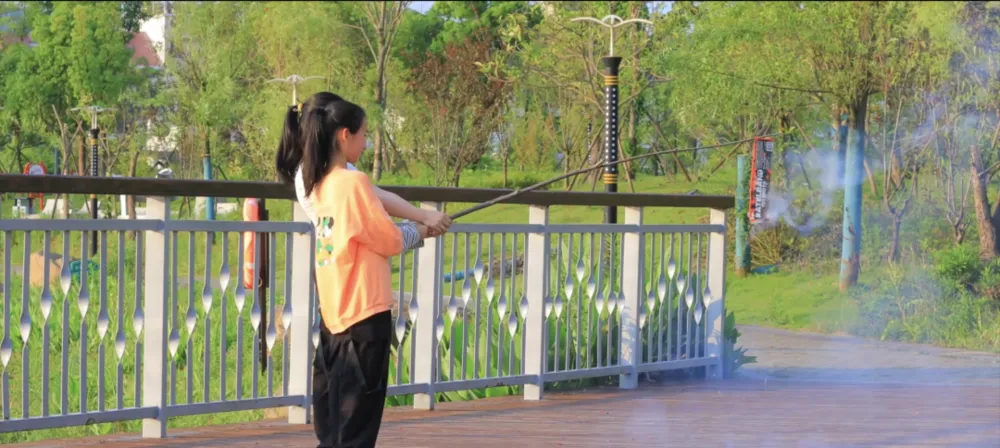
Many of Liu Yan'an's relatives also work in fireworks factories.
Liu Yan'an's great-aunt is in her sixties. Because her son was imprisoned for drug trafficking and divorced, she raises her grandson alone and lives in hardship. Out of sympathy, the factory let her in to bundle paper tubes. Her youngest aunt only has a primary school education; she wanted to find a job in the city, but supermarkets and fruit shops required operating scales and computers, which she couldn't do, so she went to the fireworks factory. Her eldest aunt and uncle worked in a paper mill making fireworks packaging paper; later, when the mill's business declined, they went to the city to work as residential cleaners.
Her grand-uncle dealt with saltpeter and sulfur his whole life. Even knowing the high risks, he stuck with it for decades. Later, as industry regulations tightened, workers had to obtain special operation certificates to be on duty. In his fifties with little education, he couldn't pass the exam and had to be persuaded to retire from the factory.
Her grandmother also worked in the fireworks factory until she was 60 before stepping down. Even after retiring, she couldn't stay idle and took odd jobs home from the factory—rolling the outer packaging paper for sparklers. One bundle of 100 sticks earned ten yuan. The elderly couple running the village convenience store, in their 70s, still sat behind the counter every day tying small sandbags for parachute fireworks—scooping a spoonful of sand onto paper, wrapping it up, and securing it with tape.
Her father's sulfur transport truck was replaced four times: from a three-wheeled tractor to a agricultural vehicle with a bucket, then to a truck and cabinet truck with welded iron pillars, and finally to a certified hazardous materials transport vehicle. This hazardous materials transport vehicle, including insurance and registration fees, cost nearly 170,000 yuan, all saved penny by penny from years of driving.
From the sulfur factory to the fireworks factory, a round trip was forty to fifty kilometers. He made two trips a day, returning home only after dark. Thanks to this truck, the family's life gradually improved. Her parents eventually bought a house in the city and put her and her sister through college.
Xiaobai's home in southern Liuyang was one of the few families in the village that didn't make fireworks. Her father neglected his family responsibilities, and her mother went away to work, making her a left-behind child raised by her grandmother. "If you don't make fireworks, you're poor." She remembers having to borrow rice from neighbors as a child and debtors coming to their door during the Chinese New Year. In the village, there weren't many left-behind children because most people made fireworks, and parents were around.
In the second or third grade, Xiaobai also started doing odd jobs at the fireworks factory. It was relatively safe packaging work. On weekends and winter or summer vacations, the neighbor's kids would all go together. It was eight hours a day, paid by the piece. Packaging the outer skin of a bundle of firework tubes paid twenty or thirty cents; in a day, one could earn about ten yuan. The money was handed over to the family, with a little left for pocket money. Once, while working for a village fireworks workshop, the employer's young grandson was naughty and constantly made trouble, speaking disrespectfully to her. That was the first time she clearly felt: "Poverty deprives people of dignity."
Ce'an's parents also worked in the village fireworks factory. When she was little, she rolled firecracker tubes at home. A large roll of paper was spread out, wider than a person, and when the machine rolled over it, the paper became a cylinder. She sat beside it, gathering the rolled tubes one by one, wrapping rope around them a few times, pulling tight, and tying a knot. The bundled tubes were stacked together, pieced together like discs—red, cylindrical shells that, once filled with gunpowder and fuses, would become the firecrackers set off for the New Year.
During New Years, holidays, and red and white weddings, firecrackers always had to be set off in the driveway at home. The family would gather around the fire, looking up at the bursting flames. Ce'an remembers the excitement of childhood: what color, what pattern, how big the burst was—she had to see it all clearly. The more novel the style, the prettier it seemed. There were two fireworks factories in the village; the people commuting morning and night were mostly middle-aged women. They would leave on electric scooters before dawn, reaching the factory in minutes. They hurried home only after it was completely dark, their headlights drawing thin, fragmented streams of light on the winding mountain roads.
These were her only collective memories. Her parents never mentioned factory affairs when they came home—what work they did, how much they earned, whether they were tired, or whether they were scared—they said nothing about it. As she grew older, she gradually realized that even though she had watched fireworks since childhood, they seemed incredibly distant.
"Afraid of Death, but More Afraid of Poverty"
Growing up, Liu Yan'an heard rumors of explosions too many times. "Some factory exploded again, people died." When adults talked about this, their tone was as plain as discussing the weather; it happened once or twice a year. If someone was home and hadn't gone to work, and villagers asked, the answer was always: "Work is suspended, somewhere exploded and needs rectification." Or: "Crackdowns are strict these days, something happened somewhere." Many accidents never even made the news; the news just circulated in the village and then faded away.
During her college summer vacation, an accident also occurred at the sulfur factory where her father had long delivered goods. Liuyang has a high-temperature holiday in the summer; according to regulations, work must stop in July and August. But with pressing orders and insufficient stock, the boss decided to secretly resume operations. The iron gates were tightly shut, the workshops locked, looking completely quiet from the outside. Sulfur is inherently flammable, and with machines running continuously in the midsummer heat, the temperature became scalding to the touch. That day, a fire finally broke out.
The flames rapidly spread up the mountain forest, threatening the villages at the foot of the mountain. The village's former fireworks factory had long been converted into a warehouse, filled with finished and semi-finished fireworks. Had the fire reached it, the consequences would have been unimaginable. Fire trucks rushed over, and every able-bodied villager joined in, wielding branches to fight the fire furiously. The fire burned for two full days before it was completely extinguished. Fortunately, the accident caused no casualties.
Since 2016, nine publicly reported fireworks safety accidents in Liuyang have claimed at least 47 lives, while the Guandu explosion this time killed 37, left 1 missing, and hospitalized 51. This is a scale never before seen in Liuyang fireworks accidents.
Xiaobai's most profound memory of fireworks is a family tragedy.
One afternoon, she was buried in her homework when a sudden loud bang came from her second uncle's house next door, shattering the window glass. She dropped her pen and ran out, only to see her second uncle, engulfed in flames, stumbling out of the small fuse workshop, rolling frantically on the ground to extinguish the fire. After the fire was out, his charred, cracked flesh was exposed. He didn't cry out in pain or ask for water; he just tried with all his might to rush toward the utility room where pesticides were stored. He knew too well the torment of severe burns, and he knew even better that his impoverished family simply couldn't afford the exorbitant and prolonged medical bills. His family held him back tightly, but days after being sent to the hospital, the second uncle still couldn't be saved.
Xiaobai was still in elementary school then. In the villages of the southern township, living rooms, bedrooms, and backyards of every household used to be small workshops scattered with saltpeter ash, rolling fuses. Walking through the village, one would often see people with severe burn scars on their faces and hands. Someone's face got burned, and his wife left. Such things were all too common in the village. When she heard explosions as a child, she only felt scared. Back then, an explosion would happen in the village every few years—sometimes at this house, sometimes at that one. Many accidents just circulated under the big camphor tree at the village entrance for a few days before dissipating.
What her second uncle did was the most dangerous process in the entire fireworks supply chain. Everyone knew the extreme risks of this trade, but relying on a few acres of thin fields simply couldn't support a family's livelihood. With young children crying to be fed, they had no other way out but to engage in the fireworks trade. Her second uncle had been burned by gunpowder multiple times in his early years, leaving him disfigured, and this time, it ultimately meant a permanent parting of life and death.
After the second uncle's death, the family fell into a long silence. Her grandfather lost his wife in his early years and his son in his old age. He chewed up his grief and swallowed it, never mentioning his son's name in front of others until his dying day. The second aunt raised the children alone and couldn't find another way out; later, the family took in a live-in son-in-law, and the family continued making fireworks. The third and fourth uncles also kept doing it. The young cousin who witnessed this tragedy of his father became silent and withdrawn. When he grew up, he would rather do manual labor in the city than ever touch a fireworks-related business.
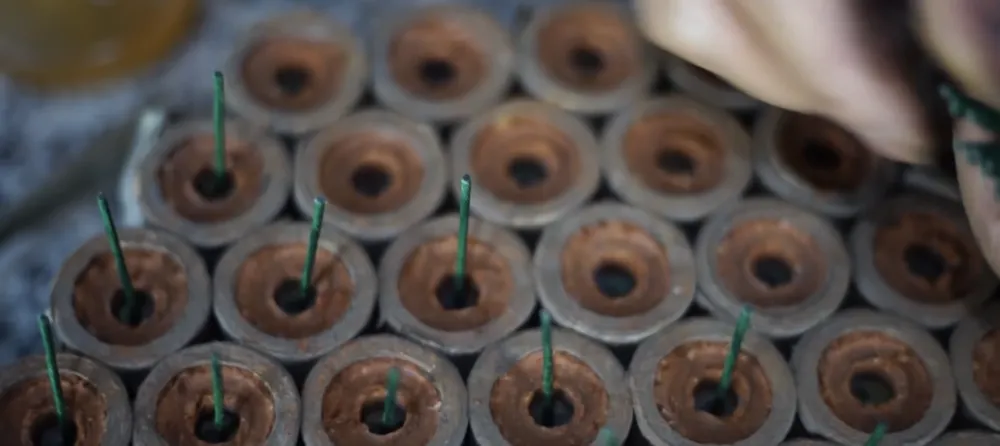
"Afraid of death, but more afraid of poverty."
A comment on Douyin that Liu Yan'an kept in her heart. Compared to going away to work, staying local and working in the factory has always been the top choice for villagers. If they leave, their children become left-behind; if they stay, burying themselves in fireworks, at least they can watch over the family. In their simple calculus, the probability of an accident might be only one in ten thousand, but if they can't earn their wages today, the family's rice jar will hit bottom tomorrow.
Ordinary workers in fireworks factories earn a few thousand yuan a month; when business is good, it can reach six or seven thousand. It's all piece-rate pay—you get what you make, at your own pace. If you're tired, you can rest; there's no clocking in, no getting yelled at by a team leader, and no being chased by machines. Asking for leave is also easy: whether it's for a child's parent-teacher meeting or an elderly parent's hospitalization, a word to the workshop director and you can go, even for ten days or half a month without being reprimanded.
The fireworks industry is one of the few livelihoods that doesn't demand educational credentials or strictly limit age; as long as you have able hands and feet and are willing to work hard, you can make a living. Its supply chain is incredibly long: digging mud, transporting mud, pressing mud, making paper, producing saltpeter, packaging—every link is interconnected and layered. "This industry supports too many people and too many families; it simply cannot be abandoned just like that," Liu Yan'an reflected.
Public reports show that in 2025, Liuyang's regional GDP was 189.8 billion yuan, and the total output value of the entire fireworks industry chain reached 50.58 billion yuan, accounting for more than a quarter. This traditional industry remains deeply embedded in the local economy and employment structure. The city currently has 431 fireworks and firecracker manufacturers, employing over 300,000 people, 90% of whom come from rural areas. Among the 1.45 million permanent residents, about one in five relies on the fireworks industry for survival.
Over the years, the changes in the villages have been visible to the naked eye. Every time she returns home, Xiaobai can clearly feel it: more villagers are buying cars, and children no longer worry about food and clothing. But the younger generation needs to get married, build or buy houses, and the older generation's physical strength is declining while their skills are limited; aside from continuing to make fireworks, they have almost no other way out. "The rural income structure is too single; farming and raising livestock can barely maintain the basic needs of the elderly, but it cannot support a family's entire expenses," Xiaobai reflected. For the low-education, middle-aged, and elderly demographic, the available employment space is already extremely narrow.
The parents poured half their lives into the fireworks industry, their only hope being to let the next generation escape this line of work. "If you don't study hard, you'll end up working in the fireworks factory." These three Liuyang youths heard this from childhood to adulthood.
Liu Yan'an's elders always had this attitude toward their children: "We will support however much education you can achieve." Even if a child didn't test into a high school, they would send them to a vocational school to study nursing or early childhood education; no one ever said, "Stop studying and come back to make fireworks." Her major is journalism, and she hopes to become a reporter or pass the civil service exam after graduation.
Ce'an knew her parents always kept quiet about their fireworks work, perhaps as a deliberate isolation and protection. "Just study hard," they would always instruct her. Now, she works at a tutoring agency in Changsha and, just like her parents, rarely talks about fireworks with people around her.
The young people from Xiaobai's hometown are also diverging. Those who studied and left never came back to touch fireworks. Some couldn't make it outside, came back, and found nothing else to do, so they continued making them. But their mindset isn't as desperate as their parents'; they take a few extra days off during the heat and play a bit more. Xiaobai now sits in an office building in Beijing, working in the internet industry.
Fireworks kept parents in their hometowns, yet made them stake all their hopes on their children leaving the fireworks industry.
Seeing Fireworks Again, "Makes Me Want to Cry"
After the accident, Liuyang's fireworks industry shut down entirely. Liu Yan'an's father has been idle at home, anxious about when work might resume. She is in graduate school, and her sister just started college; the family still has to support two college students. Her father considered changing careers to drive a taxi or a ride-hailing car, but he isn't familiar with city routes or good at using navigation, and the income is far less than transporting sulfur. Her mother left the fireworks factory a few years ago and went to a dishwashing factory, responsible for disinfecting and packaging tableware, earning a monthly salary of just over 3,000 yuan.
During the Qingming Festival, her father told her that some drivers in the group hadn't transported a single shipment since the start of the year. This year's business is much worse than previous years. In past years, factories opened before the Lantern Festival; this year, they only resumed work after the Lantern Festival. After the Lantern Festival, in March, due to the Two Sessions, they stopped again. Suffering through to May, Guandu exploded again, and the entire province halted production. Counting it up, the total operating days this year haven't even reached a full month. "No one wants accidents, but if the shutdown lasts too long, people will starve." She noticed that on social media, many fireworks practitioners were voicing similar dilemmas.
Xiaobai's mother is equally mired in anxiety. Village home workshops have long been banned, and villagers pooled money to build a fireworks factory with unified safety management. Like most middle-aged women in the village, her mother now works at this factory, doing marginal packaging work. "She is merely at the tail end of the supply chain; those who truly rely on fireworks to feed their families must be even more anxious," Xiaobai said.
Over the years, her third and fourth uncles saved up through fireworks and bought property in the city, but they carry mortgages of three to four hundred thousand yuan. Once they lose this job, they'll face mortgage defaults. "People don't want the industry to be banned with a blanket一刀切. Firstly, they fear losing their livelihoods; secondly, they can't find work better suited to them. Going away to work means wandering in a strange land, unable to care for the elderly and children."
Xiaobai's old phone is full of fireworks photos. When she encounters fireworks blooming in the night sky while traveling abroad, she can always recognize at a glance that most are from Liuyang. Olympic ceremonies, large-scale celebrations, and even Trump's inauguration—amidst the sky-filling splendor, Liuyang fireworks are always present. She always feels proud of her hometown. But behind this pride, the family tragedy from her childhood always surfaces, heavy and pressing on her heart. The childhood fears remain with her to this day; occasionally, she wakes up from a dream, and talking about it still makes her choke up and cry uncontrollably.
She once wrote a post on her WeChat Moments: When we look up at the blooming fireworks, please add a little gratitude, for someone is always bearing the weight for us.
Xiaobai has always felt that the fireworks industry's contributions far outweigh its hidden dangers, and that preserving it benefits this land more than abolishing it.
Since fireworks are a high-risk industry, they should be strictly regulated according to high-risk industry standards. Safety costs should be raised, and selling prices should follow suit. Doing this might shrink the industry, but it would reduce those horrific accidents. She resents campaign-style governance: only tightening regulations for a while after an accident occurs, with full production halts during strict control periods, delivering a massive blow to everyone. Safety shouldn't be a passing gust of rectification; it must be embedded in strict daily management every single day.
On the day of the Guandu explosion, the Liuyang fireworks show went ahead as scheduled. There was a chorus of criticism online, saying that lives were lost and yet they were still setting off fireworks. Liu Yan'an felt that many tourists made special trips and shouldn't be left disappointed. Some tourists complained online about the traffic and vowed never to come again, but she believes the area near the theater has done its best to widen the roads, flanked by residential compounds. Some even say, "Fireworks are fleeting, what's the point of watching a few seconds?" When others scold Liuyang fireworks, she always gets upset: "It's precisely because of fireworks that so many people come to Liuyang and know about Liuyang."
When accidents happen, people online scold the regulators and the management. In the Douyin comments, some suggest that workshop directors should require workers to wear helmets, fining them 200 yuan if they don't. But veteran masters who have worked for decades dismiss it: "You've never even been in a workshop, what do you know?" She knows netizens mean well, but helmets are stuffy and get in the way. Having worked for so many years without an incident, they just aren't willing to wear them.
In her father's line of work, there are also drivers who take risks by secretly transporting fireworks materials in ordinary trucks; if caught during strict inspections, they are detained for 7 days. Usually, when there's a vehicle inspection somewhere, the news spreads instantly in the driver group. "If an accident hasn't happened to them personally, they won't be as strict as an inspector, tacitly approving minor violations." She believes that those directly dealing with gunpowder will be shaken up this time. If relatives or fellow villagers still want to work in fireworks, she would advise them: don't rely on luck anymore.
Seeing fireworks again, her state of mind has long been different. Today's fireworks styles are constantly innovating, looking great no matter how you shoot them, but thinking of those enduring hardship amidst the smoke and fire always "makes me want to cry." What she talks about most with friends is a family in the news—a family of four, all gone. "I don't know if there were any children; if there were, what will happen to that child's future?"
She read a saying online: "The coming-of-age ceremony for a grown-up is a train ticket to Guangdong." But her and her sister's childhood meant waiting for their parents to come home every day, the whole family eating together in the main room; this stability made her feel deeply fortunate.
Her father transported sulfur year-round, his clothes always covered in sulfur dust. When her mother hand-washed the family's clothes, she would soak his clothes together, so the whole family's garments carried a faint smell of sulfur. When her sister went to middle school in the city, she came home one day and said aggrievedly: "Sis, my clothes always smell like sulfur." She was afraid of being gossiped about by classmates. Liu Yan'an just calmly replied: "Then either don't let Mom wash them, or don't spend the money Dad earns." Her sister fell silent and never brought it up again.
As a child, she would often sit at the doorway of the main room waiting for her father. The main room faced the Liuyang River; the road by the river was so narrow that two vehicles had to yield to each other, and there had been rollover accidents in the river. Sitting at the door, she would repeat in her heart: "Why isn't he back yet? Please don't get into a car crash, please don't." She never shared this anxiety, buried in her heart since childhood, with her parents.
As it grew dark and her father still hadn't arrived, she would call him. Whenever she asked, "Where are you?" he would always say, "Almost there." As soon as the words left his mouth, the sound of her mother stir-frying would ring out from the kitchen behind her. The wind blew from the river, brushing past the blue sheds on the ridge. As night fell, her father would always come back safely.
*At the request of the interviewees, Liu Yan'an, Ce'an, and Xiaobai are pseudonyms
*Images sourced from the Liuyang Fireworks Intangible Cultural Heritage Inheritance documentary series "Splendor"
 微信扫一扫打赏
  支付宝扫一扫打赏
Comments (0)