
Two major events have recently occurred in the South Korean semiconductor industry:
First, research institutions estimate that SK Hynix's operating profit this year will reach about 250 trillion won. An inquisitive investment bank calculated that SK Hynix employees could see an average bonus of 700 million won this year (approximately 3.2 million RMB).
Second, Kim Yong-beom, Director of Policy at the South Korean Presidential Secretariat, proposed that South Korea should return the excess profits generated by its domestic AI industry to the public.
According to Kim, South Korea's achievements in the AI era are not the result of individual companies' efforts, but are built on over half a century of the country's industrial foundation. Therefore, part of these fruits should rightfully benefit all citizens [1].
Kim Yong-beom himself is quite influential in South Korea's financial circles. He has been a senior economist at the World Bank, worked in venture capital, served five consecutive terms as CEO of the well-known South Korean investment firm Meritz, and is reportedly a key figure who saved the country's cryptocurrency industry in 2018.
The Director of Policy at the Presidential Secretariat is a special position. Although it lacks statutory administrative power, because it reports directly to the president, it can whisper in the president's ear and holds a certain influence over central decision-making.
After the article was published, the soaring South Korean stock market suddenly opened with a sharp drop. Led by the two heavyweight stocks, Samsung Electronics and SK Hynix, the KOSPI once fell more than 5% intraday. Director Kim's words are indeed worth their weight in gold.
Faced with such immense wealth, throughout history and across the globe, the distribution of interests has always been the problem that disrupts harmony. For today's average bonus of 3 million RMB, South Koreans have struggled for thirty years.
Worrying Not About Scarcity, But About Inequality
The average bonus of 3 million RMB has not actually been paid out yet; it was calculated based on SK Hynix's performance expectations for this year.
In the middle of last year, a labor dispute erupted at SK Hynix. The union demanded that the company distribute 10% of its operating profit as bonuses, while lifting the cap of "no more than 1000% of basic salary" for bonuses, for a period of ten years.
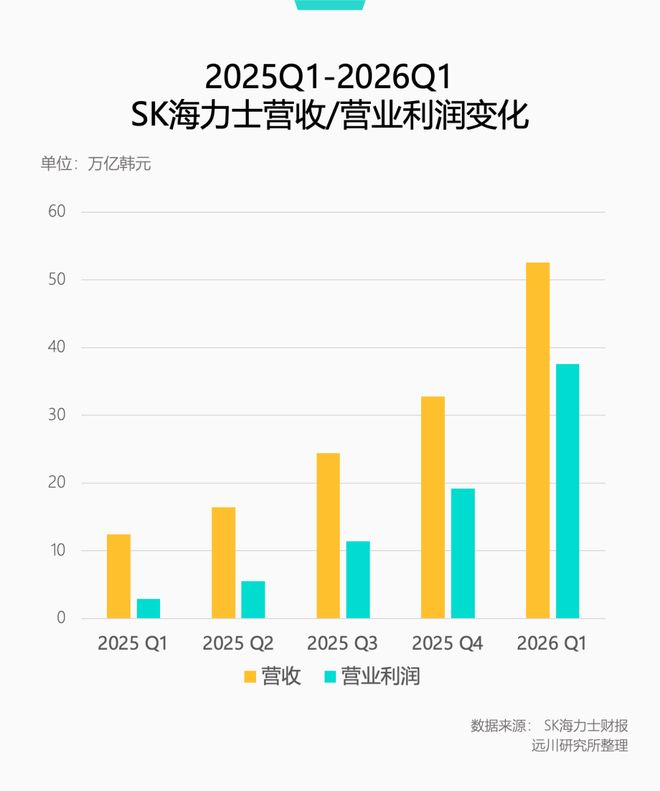
Ultimately, the working class achieved victory. At the year-end settlement, SK Hynix's operating profit for 2025 reached a staggering 47.2 trillion won, not only doubling from 2024 but also surpassing the total operating profit of all businesses of its big brother Samsung, equivalent to Iceland's GDP for a year.
In black and white, in February of this year, SK Hynix gave employees a year-end bonus equivalent to 2964% of their basic salary, with the average bonus amounting to approximately 674,000 RMB.
Unexpectedly, SK Hynix performed exceptionally well. In the first quarter of this year, the company's revenue exceeded 50 trillion won for the first time, and operating profit doubled from the previous quarter. Investment banks calculated the average 3 million RMB bonus based on annual operating profit forecasts.
Watching their counterparts count money until their hands cramp, Samsung employees next door are naturally filled with envy, jealousy, and resentment.
After SK Hynix distributed its bonuses in February, the Samsung union could no longer sit still. In March, under the mediation of the Central Labor Relations Commission, they held multiple rounds of negotiations with Samsung management, but the mediation was terminated due to significant disagreements.
In April, the Samsung union launched an informal brief strike, causing the night shift output of Samsung's memory chip factories to drop by 18% and foundry output to plummet by 58%.
Samsung union leader Choi Seung-ho revealed to South Korean media last month that in the first four months of this year, about 200 Samsung engineers had already jumped ship to SK Hynix [4]. The implicit threat was obvious.
By May, when SK Hynix's expected bonuses for the year were exposed, Samsung workers were even more red-eyed and initiated labor negotiations once again.
According to the bonus distribution standards proposed by the union, Samsung needs to distribute 15% of its operating profit as bonuses to employees and simultaneously abolish the 50% annual salary cap on bonuses.
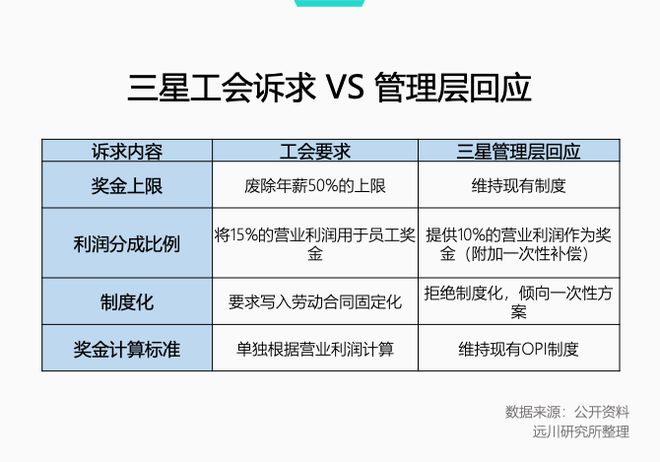
It's hard to say whether the "15%" metric proposed by the Samsung union wasn't influenced by SK Hynix's latest bonus distribution standards next door.
In 2025, Samsung's revenue reached a staggering 333.6 trillion won. Calculated based on South Korea's GDP of 1.87 trillion US dollars last year, Samsung's revenue alone accounted for 12.5% of the country's GDP. Its operating profit was 37.61 trillion won, a year-on-year increase of over 400%, equivalent to netting about 120 billion won (about 630 million RMB) the moment they open their eyes each day.
But even so, Samsung management refused to budge, stating they could provide 10% of operating profit as a bonus (matching SK Hynix's percentage), but only as a one-time scheme, and they would still maintain the cap that bonuses do not exceed 50% of wages.
Fellow capitalists at JPMorgan "kindly" did the math for Samsung: if 10%-15% of operating profit were distributed as bonuses and base salaries were increased by 5%, Samsung's labor costs would increase by 21 trillion to 39 trillion won on top of current forecasts.
In contrast, the sales losses caused by an 18-day strike would be "only" 4 trillion won [2].
Voting with their feet, Samsung management also knew how to cast their ballot; the eventual outcome was, unsurprisingly, a breakdown in talks.
Recently, Samsung union representative Choi Seung-ho announced that negotiations between the two sides had collapsed. Regarding the compensation plan proposed by the union, Samsung management stated they flatly refused to accept it.
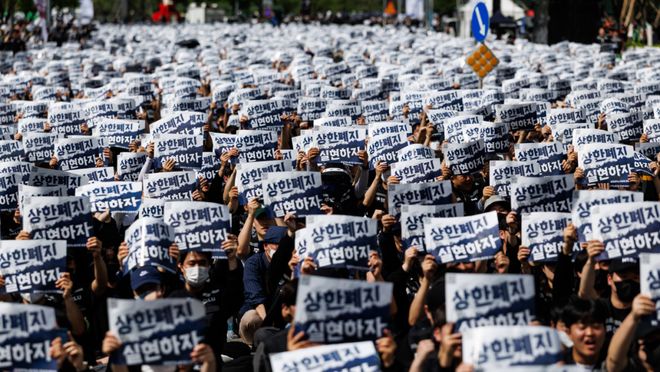
Over 30,000 Samsung employees protest in the streets demanding higher compensation; Image source: Getty Images
Next, the Samsung union will start an 18-day strike on the 21st. This will be the second large-scale strike in Samsung's history; the previous one was in 2024 with only about 5,000 participants, but this time it is expected to involve as many as 50,000 people.
Regardless of how the labor disputes progress from here, both Samsung and SK Hynix can finally hold their heads high.
For this moment today, South Koreans have endured 30 years of hardship.
The Troubles of Being Invincible
At the beginning of the year, market research firm TrendForce released the Q4 revenue ranking for DRAM (the largest memory category) from last year. Samsung and SK Hynix ranked first and second with shares of 36% and 32.1% respectively, combining for nearly 70% of the market.
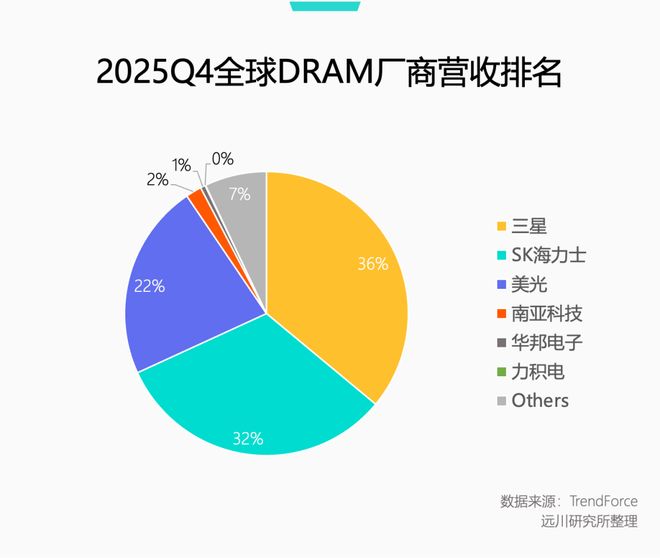
South Korea's victory in memory is the result of a long-term battle. Kim Yong-beom's statement that South Korea's achievements in the AI era are built on its own industrial foundation is no exaggeration.
Starting from the production of the first 16K DRAM in 1979, South Korea spent a decade narrowing the technological gap with Japanese giants, and another decade expanding its market share to surpass Japan and become number one in the world. In 2012, Elpida, the "last hope" of Japan's memory industry, declared bankruptcy, and South Korean manufacturers have had no rivals in memory ever since.
Over the past decade or so, South Korean manufacturers' global hegemony has been rock solid. At its peak, Samsung's market share in DRAM once exceeded 40%, and together with SK Hynix, they controlled 70% of global DRAM capacity for many years.
But for a long time, memory was actually a terrible business.
As an upstream necessity of the electronics industry, memory has two major characteristics: standardization and long capacity-building cycles.
"Standardization" means that memory chips of the same specifications and capacity from different manufacturers have identical product parameters. Smartphone manufacturers don't even specifically indicate whether the memory is from Samsung or SK Hynix.
This makes memory a quintessential "blue-collar industry," where price becomes the sole competitive factor. Frequent multi-party brawls and price wars ultimately benefit downstream buyers while hurting the manufacturers themselves. The market long saw revenue growth without profit growth.
As the world's number one and two, Samsung and SK Hynix saw their profit margins hover around 10%-20% for years.
The long capacity-building cycles add a flaw of extreme volatility to this "blue-collar industry."
An advanced memory factory takes at least 3 years from construction to reaching planned capacity, creating a time lag between capacity rollout and market demand. This leads to cyclical fluctuations where memory prices skyrocket and crash, dragging the manufacturers' performance along with them—two good years followed by two bad years.
The combination of the two factors led to frequent price wars in the memory market, and the situation of rising revenues without rising profits persisted for over two decades. Wild swings in performance became the norm. Even if SK Hynix wanted to pay bonuses, they didn't have the money.
In 2021, Samsung and SK Hynix stood at the peak of the cycle, hitting record revenues. By 2023, they plummeted from heaven to hell due to a crash in memory prices. Samsung's semiconductor division posted an operating loss of nearly 14 trillion won for the year, and SK Hynix's annual loss hit a record high of 7.7 trillion won.
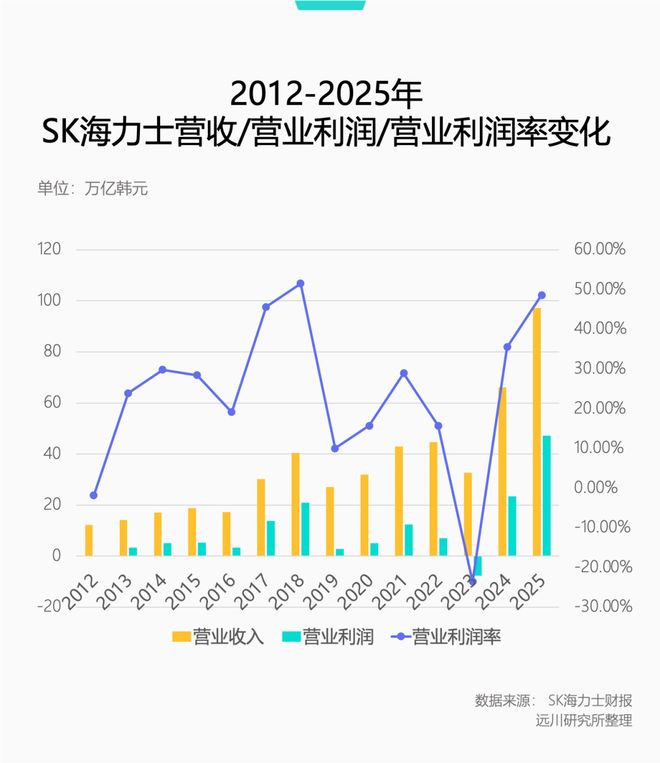
Without the South Korean government's wholehearted assistance over decades, Samsung and SK Hynix might have voluntarily or forcibly exited during some cyclical trough, just like many Japanese pioneers before them.
Just as South Koreans were holding this hot potato, struggling to maintain their hard-won world number one status, AI came to the rescue.
The explosive demand from AI data centers has fundamentally changed the supply and demand logic of memory, solidifying the foundation of South Korea's "invincibility" in this field.
On one hand, an AI server requires 8 times the DRAM capacity and 3 times the NAND capacity of a regular server, which is the main culprit behind the current supply shortage. According to Counterpoint Research, alleviating the shortage would require industry capacity to grow at 12% annually through 2027, but actual growth is only 7.5% [5].
In the past, memory produced wasn't necessarily sold (it depended on end-product demand). But today, at least for the next few years, as long as memory is produced, there is no worry about sales. In other words, it has shifted from a buyer's market to a seller's market.
On the other hand, the explosive demand for HBM has directly placed a lifeline of AI data centers into the hands of South Koreans.
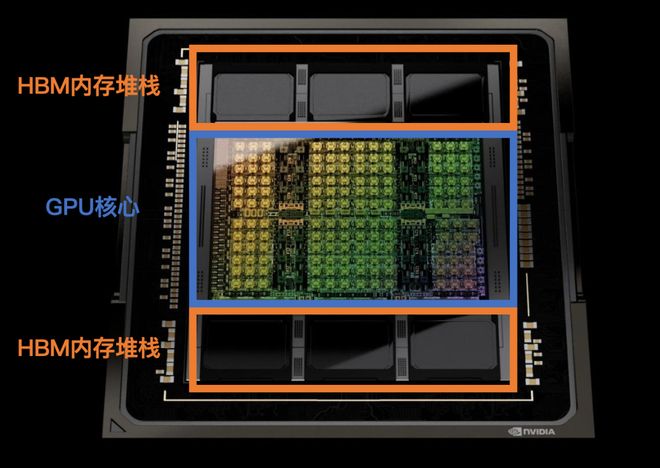
HBM in a GPU board
AI data centers cannot function without GPUs, and GPUs, to ensure data throughput and communication efficiency, cannot do without HBM.
Nvidia's entire GPU lineup uses HBM memory, gradually upgrading in specifications and performance from the A100 equipped with HBM2E to the B300 equipped with 12hi HBM3E. AMD's flagship product, the Instinct MI300X, also uses eight 12hi HBM3 stacks [6].
The technological barrier for traditional DRAM isn't particularly high; newcomers can't beat the giants not because they can't produce it, but because they can't produce it as cheaply. However, globally, only three manufacturers have successfully mass-produced HBM, and SK Hynix and Samsung possess the most mature and advanced technologies among them.
This gives SK Hynix and Samsung the leverage to name their price.
According to the latest estimates from Counterpoint Research, global AI data center demand for HBM will grow 35 times from 2024 to 2028 [7]. Yet, looking at the capacity expansion pace of Samsung, SK Hynix, and Micron, total HBM bit supply in 2025 will only grow by 84% year-on-year, with a projected growth of just 47% in 2026 [6].
This means HBM will be in severe shortage for the next few years, and Samsung and SK Hynix can continue lying down and counting their money for a long time. According to previous disclosures, their HBM capacity through 2026 is already sold out or fully booked.
According to South Korean customs import and export data as of May 10, the unit price of bare DRAM chips (including protected modules) has reached 89,498 USD/kg, a staggering year-on-year increase of nearly 500%, while HBM surged 165.5% year-on-year to reach 78,752 USD/kg [8].
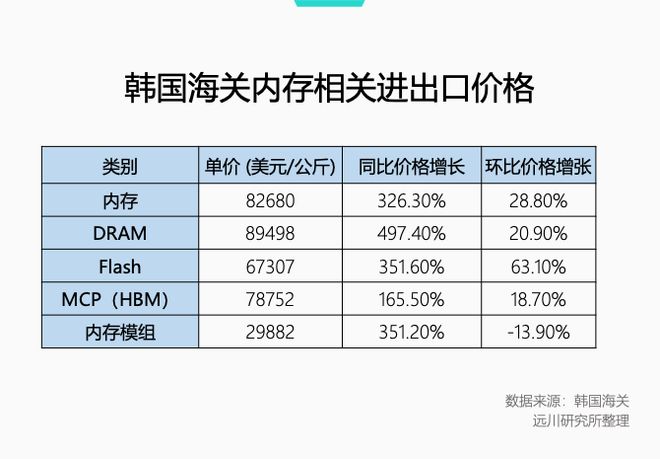
For comparison, the price of gold during the same period was 76,150–78,000 USD per kilogram (converted at the international gold price of 4,700–4,800 USD/ounce in May 2026).
As Kim Yong-beom stated in his article, South Korea is bidding farewell to the traditional sense of a "cyclical export-oriented economy" that fluctuates with global economic conditions. By mastering structurally scarce resources and continuously capturing excess profits, South Korea is demonstrating a "transition toward an economic structure approaching technological monopoly."
In this sense, memory being more expensive than gold is perfectly reasonable.
Epilogue
Around SK Hynix's high bonuses, bizarre news keeps emerging in South Korea.
Among the most eye-catching are reports that SK Hynix employees have become highly sought after in the matchmaking market, with jackets featuring the company logo becoming the best outfit for blind dates; another is that housing prices around the SK Hynix campus and along the commuting routes to the company have skyrocketed.
Whether these rumors are true or not, they all convey one fact: life at SK Hynix has truly improved.
This is also the ultimate goal of marshaling all strength and resources, putting in immense hard work and sweat, and pursuing industrial upgrading: to allow industrial workers to live a more dignified life.
SK Hynix has achieved this, and many other companies achieved it long ago. As the old saying goes:

Source: Yuanchuan Technology Review
 微信扫一扫打赏
  支付宝扫一扫打赏
Comments (0)