
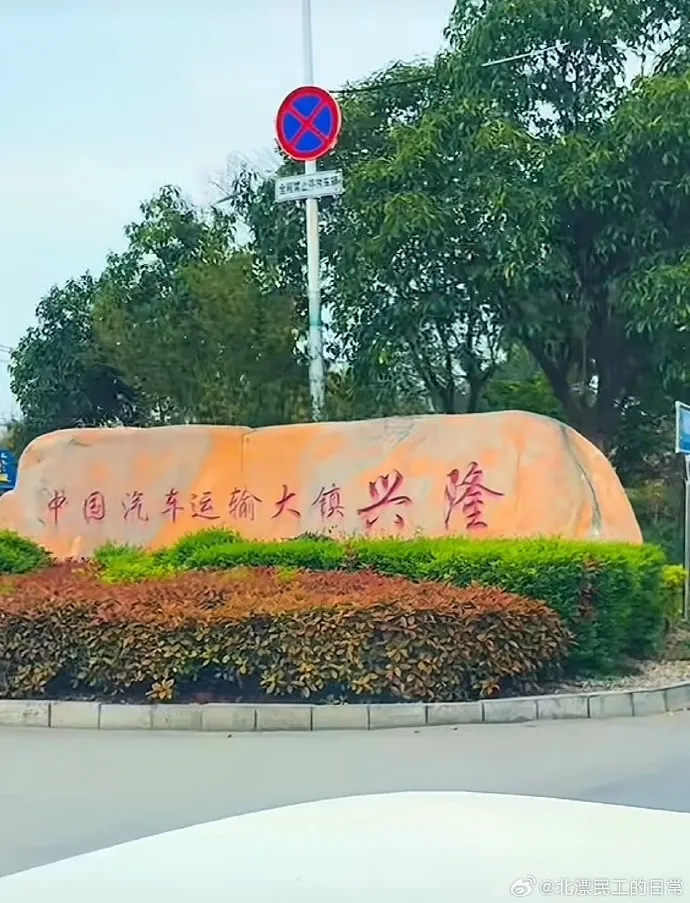
@DailyLifeOfABeijingDrifter: Mentioning the Beidou system, let me talk about the group of heavy truck drivers in my eyes.
My hometown is a major national transportation town, with roughly over 800 heavy trucks.
Since I was a kid, as long as a family ran a heavy truck, we knew their financial condition was decent. It can be said that heavy truck drivers constitute an important part of the middle-class group in my hometown.
A middle school classmate's father drove a truck and raised 5 children (who knows how much he paid in fines).
Heavy trucks come in many types, such as eight-wheelers and semi-trailer tractors. They basically cost hundreds of thousands of yuan each, but profits were very high in the early days. You could earn back the cost of the truck in two or three years, so many people joined the business, and our local area has formed a national industrial chain.
As for education level, the drivers' education is indeed not high. In the early years, most had a middle school education, and now high school graduates and vocational school students are the majority (I can only say the education level of the residents in our town is very average).
Are they uncultured? It depends on who you compare them with. White-collar workers in first-tier cities definitely think they are uncultured, but I think the folk customs in northwestern Hubei are not aggressive at all. The truck drivers from my hometown whom I know all have pretty good temperaments.
For example, my classmate's father is an experienced driver. Although he is big and tall, he is very mild-mannered. Sometimes when he's on the road and encounters bad people, he pretends to be fierce, but he's actually scared too.
Why scared?
A few years ago, when driving through certain mountainous areas, you might encounter highway robbers. They would force you to stop, smash your car window with steel bars, and rob you of your phone, cash, and even your cargo. There were no surveillance cameras on mountain roads, so it was your word against theirs if you died. In the early days, phones didn't have video recording capabilities, and there was even a whole village engaged in gray-area businesses. If you ran into them, you just ran into them; there was nothing you could do. Keeping your life was already a blessing.
There were also oil thieves who would siphon your fuel tank and backup fuel tank dry while you were parked.
This basically doesn't happen anymore these days because there are surveillance cameras everywhere, but it was rampant in the early years.
There are other headaches too, such as no one being there to unload the goods, logistics bosses delaying payments, and the local protectionism of traffic police in the early days...
Truck drivers generally suffer from prostatitis. They are generally heavy smokers + heavy betel nut chewers + sufferers of chronic stomach problems, and they love drinking Dongpeng Super Drink (the cap can be used as an ashtray)...
I don't oppose the regulations targeting drivers, because being in an unhealthy state for a long time is detrimental to safety.
The most terrifying thing is traffic accidents. In an accident, the truck being totaled is a minor issue; the person might be gone. Especially in the early years running mountain routes, with all kinds of cliffs and the poor emergency braking of large vehicles, one moment of carelessness and you'd go flying off, losing both your life and your wealth.
There's a detail that people who haven't been in contact with heavy trucks don't know: heavy trucks all use air brakes (high-pressure air braking), and when parking, there is a long hissing sound of air release.
So, do I envy the families of truck drivers? Not really. They are licking blood from a knife's edge—high risk, high reward.
However, veteran truck drivers will tell you that making money used to be easy, but it's not anymore. Because with the intervention of various freight platforms like Huolala, shipping rates have become very transparent, and overcapacity has emerged in this industry. Many people are facing a transition. For example, I have a relative who originally drove a heavy truck but went to the south to drive a cement mixer truck a few years ago. The route is relatively fixed and simple, following the construction projects. Except for still irregular meals and day-night reversals—having to work whenever a job comes up—their living conditions have actually improved a lot, after all, they no longer have to run long distances.
Looking back, the people in our local area are quite happy. Thanks to the developed transportation industry, even though we are inland, we never lacked fruits like coconuts, pineapples, bananas, grapefruits, and sugar oranges from childhood to adulthood. You have to know that when we were in college, some classmates from other areas ate a coconut for the first time only after arriving in Wuhan.
I see that most netizens have a critical attitude towards the group of truck drivers. Although I know this phenomenon does exist, as a small-town kid who has been in contact with many drivers since childhood, I feel a bit sad emotionally and easily put myself in the drivers' shoes.
The industry they engage in can be called highly dangerous, but the returns they get now have noticeably declined, and the risk compensation is insufficient.
They also encounter many unfair things and may have nowhere to speak out. I hope that rules will gradually be optimized in the future, so that while the industry becomes more regulated, everyone can be more satisfied.
 微信扫一扫打赏
  支付宝扫一扫打赏
Comments (0)