
This article is from the WeChat public account: Real Story Research Lab, Editor: Zhang Duo, Author: Yin Kai
After property management companies withdraw, garbage piles up like mountains in some communities, and elevators stop working. In one community, just six months after the property management left, housing prices have already dropped by 25%.
During this year's May Day holiday, multiple regions successively issued appeals calling on public officials to take the lead in paying property management fees, which quickly topped the trending searches. This is enough to show how serious the problem has become.
#01
Property management issues trap "everyone"
Sometimes, the low collection rate of property management fees is not the owners' fault.
In the first year after 90s-born Xiaomi moved into her new home, the property management withdrew. The developer had promised to give five years of property management fees for free, but this money was never actually paid to the property management company.
What was left behind was a mess: the greening rate failed to meet standards, facilities and equipment were incomplete, and upon delivery of the fully-furnished apartments, each household had at least a dozen or even over a hundred issues—water leaks, hollow floor tiles, and even toilets installed in the wrong position.
The property management was powerless to do anything about it, but the owners' anger was entirely directed at them.
Among the 1,000 households in the community, a large number received free fees, had not moved in, or refused to pay due to quality issues. The collection rate一度 dropped to only 20-30%. The property management also started slacking off, collecting garbage only once every two or three days, hallway cleaning almost completely stopped, and even rats appeared.
The owners went to argue with the property management every day, yet feared they would actually leave. They worried that the temporary management by the resettlement housing property would only collect garbage, and they worried that housing prices would plummet to slum levels.
The property management eventually left. When withdrawing, an employee directly told Xiaomi: "We lose too much money in this community."
This chain is quietly being replicated in countless communities across the country: developers leave behind problems, property management takes the blame, owners refuse to pay, and property management withdraws.
Sometimes, the problem goes beyond this—besides developers, property management, and owners, there is another role that should be cleaning up the mess: the homeowners' committee.
Theoretically, the homeowners' committee represents the interests of all owners. But in Xiao Li's community, the committee played the role of a troublemaker rather than a problem solver.
In Xiao Li's community, a new homeowners' committee took office at the end of last year and led the introduction of a new property management company.
Before moving in, they made grand promises, but the actual implementation fell far short of the commitments: the property management fee budget soared from about 4.64 million yuan in the bidding documents to over 5.7 million yuan, while the service standard dropped from the promised new Level 3 to the "old Level 3."
This property management company also had a "terrible track record" in other communities: in Community A, it used the public maintenance fund for fire safety repairs, with an initial estimate of 27.92 million yuan, which was cut to about 11 million yuan after owners complained to the media; Community B sued it in court, and after a three-year lawsuit, the second-instance judgment ruled that the property management must return 4.78 million yuan in public revenue plus interest.
To terminate the property management, a temporary owners' meeting must be held to vote and pass the decision. Owners need to collect 20% of signatures to initiate the process, then convene the temporary owners' meeting, vote to recall the homeowners' committee, terminate the property management contract, and re-select a new company.
Now that enough signatures have been gathered, the temporary meeting is being blocked by the homeowners' committee from being held. The sub-district office has also sent a letter demanding the committee to advance the convening of the temporary owners' meeting, but the committee still refuses to proceed.
Things also started to take a sinister turn—late at night, red banners declaring "firmly support the community homeowners' committee" were quietly pasted on the unit doors; an owner who opposed the committee had a funeral wreath hung on their front door.
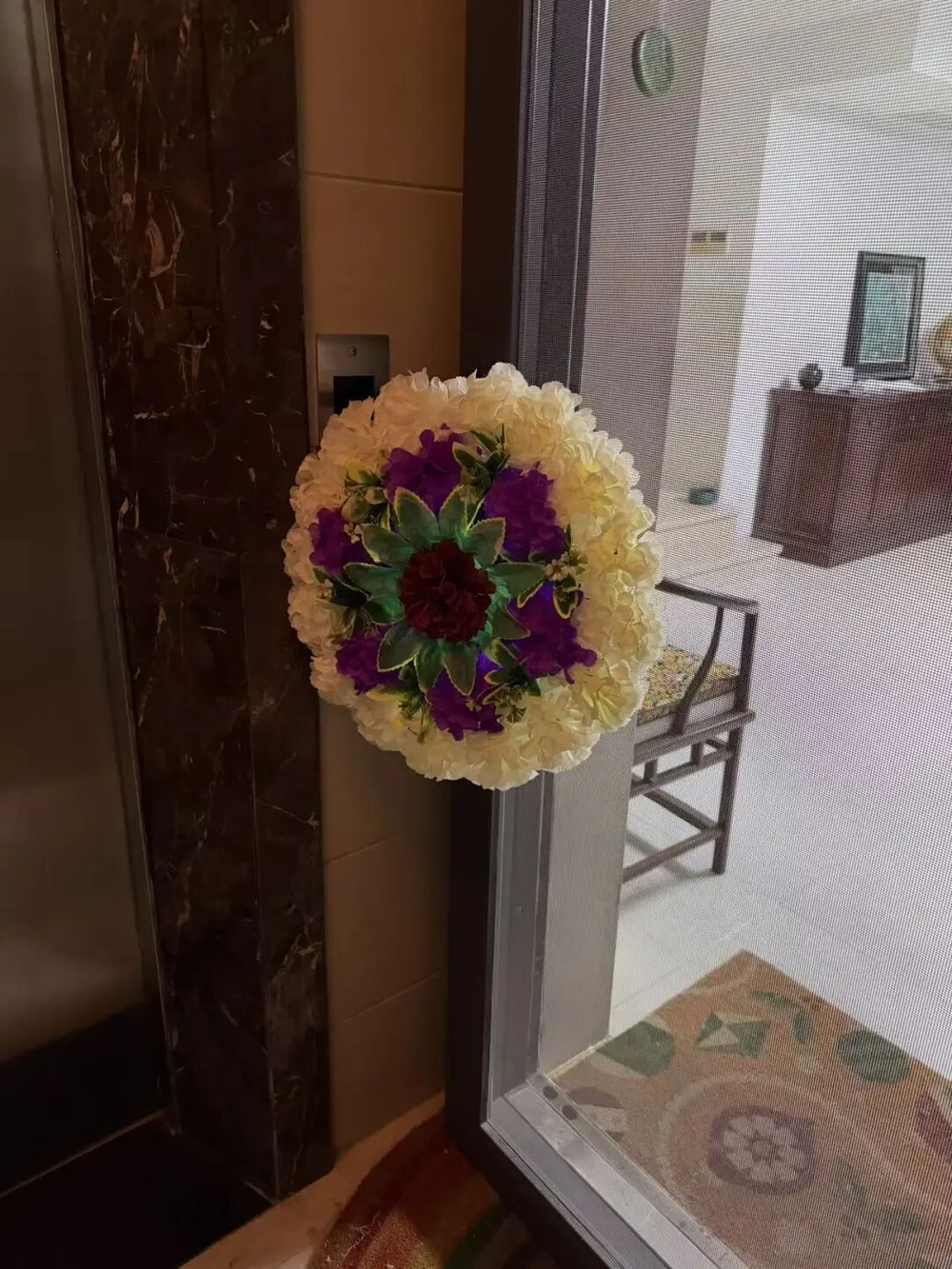
Photo | A funeral wreath hung on an owner's front door
"The wolves left, but the tigers and leopards came," Xiao Li said.
Developers, property management, homeowners' committees, and owners—no single party can untangle this knot alone. Refusing to pay property management fees is the lowest-cost form of resistance for owners; moving and changing homes is an exit option for a very few.
#02
How did this situation form?
According to data from the China Index Academy, from the beginning of 2025 to the end of March 2026, a total of 212 residential withdrawal projects were monitored nationwide. Unlike in previous years when property management companies were "fired," most withdrawal cases are now initiated proactively by the companies themselves.
The external explanations given by these proactively withdrawing companies are mostly similar: severe losses, with income failing to cover expenses.
Cases are spread across the country. In Xuzhou, Vanke Property withdrew from six communities at once, including Future City, Wanyue City Phases I-III, and Huafu Tiandi. The property management of Henglong City in Anji, Huzhou, stated that over two hundred households had never paid property management fees, and the collection rate since 2026 was only 16.5%. The withdrawal notice from the Jiayu Fenghua Yuan community in Yangzhou showed that the property management had suffered consecutive losses of over one million yuan for three years, and owners' cumulative arrears reached 3.2685 million yuan.
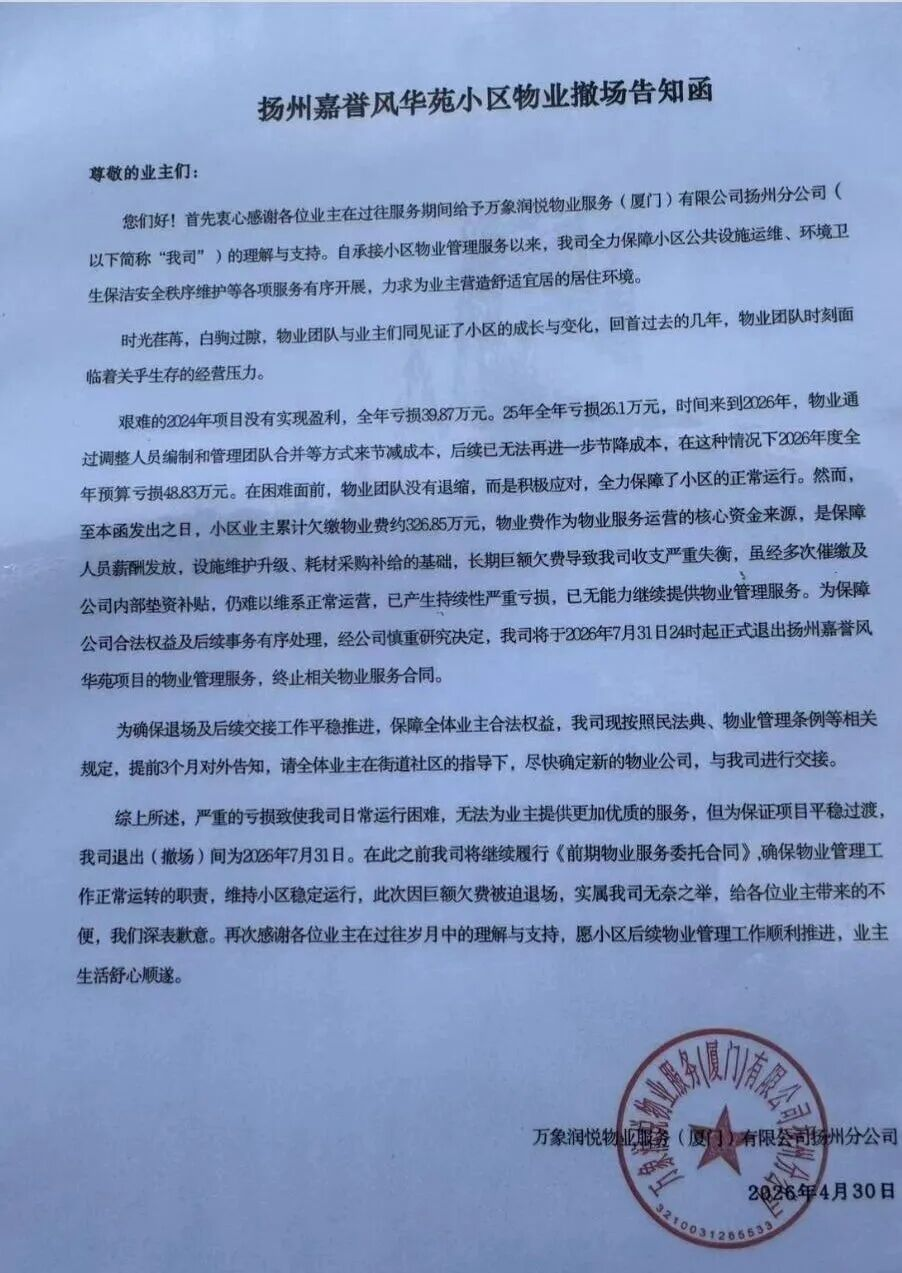
Photo | Withdrawal notice for Jiayu Fenghua Yuan community in Yangzhou
This is not an isolated phenomenon. The average collection rate of the top 500 property enterprises nationwide has fallen from 93% in 2020 to 71% in 2025, declining for four consecutive years. The industry-recognized operational warning line is 85%.
So, how did this situation come about?
From 2015 to 2024, benefiting from the rapid growth of real estate and high valuations in the capital market, property management companies expanded drastically in scale. Yalife's managed area increased 18 times, Yongsheng Services 17 times, and Country Garden Services 16 times.
At that time, the logic of the capital market was very simple: only area mattered; the larger the managed community area, the higher the market value. Around the peak in 2019, the average price-to-earnings ratio of leading property management companies listed in Hong Kong reached 42.91 times.
Top property management companies engaged in massive mergers and acquisitions, and the quality of the acquired projects varied greatly. But no one cared at the time, because the area numbers were still rising. Many developers and property management companies were essentially the same entity; developers had the ability to subsidize the property management, and the fee collection rate was relatively stable.
However, this balance was built on one premise—the continued prosperity of the property market. This premise no longer exists.
In May 2025, the area of unsold commercial housing nationwide was about 780 million square meters, hitting a historical peak for over a decade. Theoretically, the property management fees for these unsold empty homes should be paid by the developers, but the developers themselves are struggling to survive.
The impact of the property market downturn is the trigger, but the internal injuries of the property management industry were actually planted long ago.
Xiao Wang, who has been in the property management business for over twenty years, manages a community where the fee collection rate has consistently maintained around 95%, which is considered quite a good achievement in the industry.
But even so, the monthly property management fees collected for the entire community are just over 50,000 yuan. Labor, cleaning, landscaping, and maintenance almost consume all the income. It is only by the homeowners' committee subsidizing half of the public revenue that they barely maintain a meager profit.
"The profit is less than 5%," Xiao Wang said. "The company is actually making social benefits."
In a second-tier city, Xiao Wang earns a monthly salary of just over 4,000 yuan and has to bear a large amount of invisible services outside the contract—neighborhood noise disputes, floor disturbances, and bickering between owners. These logically do not belong to the duties of property management, but if he doesn't intervene, he gets complained about.
This is the real situation of a community with a good collection rate. For those with lower collection rates, the books have long been in the red.
The problem lies at both ends: income cannot go up, while costs keep rising. Labor costs account for 53% to 70% of total property management expenditures, and minimum wage standards in various regions continue to rise; elevators, pipe networks, and fire protection systems in older communities have also entered their renewal cycles, causing maintenance costs to multiply.
The gross profit margin of listed property management companies fell from nearly 30% in 2021 to about 20% in 2025, and the net profit margin fell from about 15% to around 7%.
When the numbers don't add up, exiting becomes the rational choice. In 2025, proactively withdrawing from inefficient projects has become a common action among property management companies—Country Garden Services, China Overseas Property, Color Life, Yongsheng Services, and Shimao Services have cumulatively withdrawn from a scale exceeding tens of millions of square meters.
But cost is only half the story. The other half is that long-accumulated emotions have finally found an outlet.
Yang Huirong, chairman of Judao Management Consulting Company, has been an entrepreneur in the property management field for over a decade. This year is the first time she has encountered an industry-wide retreat, which she attributes to the problems inherent in the "lump-sum system" (Bao Gan Zhi).
Driven by the lump-sum system, property management companies must bear their own profits and losses. The fees paid by owners belong to the company's revenue. Under this business model, the more services the property management provides to the owners, the lower its own profits will be.
At the same time, owners do not have the right to know the specific expenditure details of various costs; they can only monitor whether various services meet the standards, but they cannot supervise them constantly.
When the property market was booming, high housing prices and appreciation expectations suppressed owners' dissatisfaction. Once the property market goes down, housing prices shrink, and expectations disappear, the resentment accumulated over the years all comes gushing out.
"Poor service" has become a reason to refuse payment, and "opaque accounts" has become a weapon of resistance. Poor service leads to non-payment, and non-payment leads to even worse service—this cycle, after losing the support of property market dividends, has finally reached its breaking point.
After housing prices plummeted, owners who bought at peak prices suffered heavy losses, and their tolerance for property management dropped sharply. The first thing almost every newly established homeowners' committee does is to bargain with the property management. Property management fees haven't risen for over a decade, and now they are being pushed down—this cut hits the property management companies' main artery.
#03
Will communities really turn into "slums"?
In 2025, a homeowners' committee in a community in Hangzhou demanded that the property management lower its fees from 2.8 yuan to 2.2 yuan, citing "lower property management fees in the neighboring community." The property management's response was: the community has less than 800 households, the scale is small, and it is already operating with difficulty; lowering the price would mean lowering the service. The two sides could not reach an agreement, so the property management chose to withdraw.
After the property management withdrew, the community fell into chaos for a long time: elevators were left unmaintained until they stopped working, delivery drivers could only climb 28 floors to deliver food, and the water pumps in the underground garage broke down, accumulating 30 centimeters of water. The homeowners' committee urgently used public revenue to hire cleaning and maintenance units at twice the market price to rescue the situation. The bidding for a new property management failed multiple times because the fees were too low.
After the original property management retreats, when a new one evaluates whether to take over, they only look at one core thing: do the numbers add up? Managed area, number of households, collection rate, condition of equipment, and the potential for public revenue such as advertising space are all indispensable.
The hardest to find successors for are communities with a long-term collection rate below 60%, severely aging facilities, and no effective homeowners' committee. And these communities are also the most likely to become "slumified."
Next are sub-new housing projects, those with a building age of less than 5 years. Such communities generally suffer from high vacancy rates, low collection rates, and developer bad debts. Yet, this is precisely the stage when owners have just taken on mortgages and have the highest expectations for quality. Once the property management withdraws, the stark contrast is often even harder to bear than in older communities.
In response to these communities, some property management companies are exploring new paths.
Vanke Property is piloting an "owner ordering" model in Yantai, Shandong, splitting services into baseline services and optional services. The accounts are transparent and negotiated by both parties, so owners know where their money is spent. Country Garden's "Yuebaijia" brand integrates multiple surrounding older communities through regional management, using economies of scale to share rigid costs.
Yang Huirong is currently trying to help communities introduce a "trust system" model. Unlike the current lump-sum system, under the trust system, the property management fees and public revenue paid by owners belong to the owners, and the property management company only takes a proportional commission, keeping the accounts completely transparent.
In addition, owner self-governance is another path, but the threshold is much higher than imagined. The reason why successful cases become news is precisely because they are uncommon.
The successful cases circulating online—issuing red envelopes for five consecutive years, saving millions in public revenue in a single year—highly depend on the community itself having sufficient sources of public revenue, as well as owners with management experience and public spirit who are willing to invest time and energy.
For those communities where developers have fled, the homeowners' committee exists in name only, the collection rate has fallen below the bottom line, and there is no timely official intervention, turning into slums is not an alarmist exaggeration, but a reality that is already happening.
But more communities will find some kind of "barely manageable" balance amidst the chaos.
Xiaomi's community has now welcomed a new property management company. The problems left by the developer are still there, and the new property management is not perfect—not professional enough, and still lacking in communication and problem-solving skills.
But Xiaomi says: "Every time we make a request, regardless of the outcome, it feels like they are trying."
"Changing property management is a huge drain on our energy, and we are exhausted. If they can continue to do well now, it's better for them to stay."
 微信扫一扫打赏
  支付宝扫一扫打赏
Comments (0)