

In the movie Hello Mr. Billionaire, the protagonist Wang Duoyu, in an attempt to squander 1 billion yuan, partners with an insurance company to launch a "fat insurance." It costs only 1 yuan to insure, and for every kilogram of weight lost, the insurance pays out 1,000 yuan in cash, which is later increased to 10,000 yuan.
When the movie was released in 2018, people just treated it as an absurd joke. Eight years later, the movie has become reality, and businesses are actually paying you to lose weight.
Since last year, companies like JD Health, Yonghui Superstores, and Decathlon have successively launched weight-loss campaigns, offering cash, beef, and lucky draws for successful weight loss. Real life has proven to be even more exciting than the movies; to win rewards, participants have racked their brains—drinking large amounts of water before the initial weigh-in, running wrapped in plastic wrap, and some even admitting that they "gained it all back" after successfully claiming their prizes.
In real life, there is no Wang Duoyu wanting to quickly squander his wealth and doing charity under the guise of business. Businesses get traffic, participants get prizes—this doesn't seem like a farce, but rather a win-win situation.
Earning money by losing weight sounds incredibly tempting no matter how you look at it. Moreover, the ones paying you are major companies with considerable social influence.
Let's start with those giving away real money. JD Health began hosting the "Happy Weight Loss" competition in April 2025, and held its second edition this April. Prizes include cash, gold, pharmacy vouchers, and body fat scales, but the most attractive is the cash: lose 5 jin (2.5 kg) and get 100 yuan, then earn 100 yuan for every additional jin lost, capped at 1,000 yuan.
Under JD Health's rules, to get the maximum bonus, you just need to lose 14 jin to hit the cap; just like scoring 60 on a test, any extra point is useless. Looking at this year's rules, the initial weigh-in is from April 3 to April 9, and the deadline for the final weigh-in is between the 26th and 28th of the same month. This makes the maximum weight-loss cycle only 25 days.
Losing 14 jin in 25 days sounds like one of those weight-loss posts on social media, and the kind that isn't very practical.
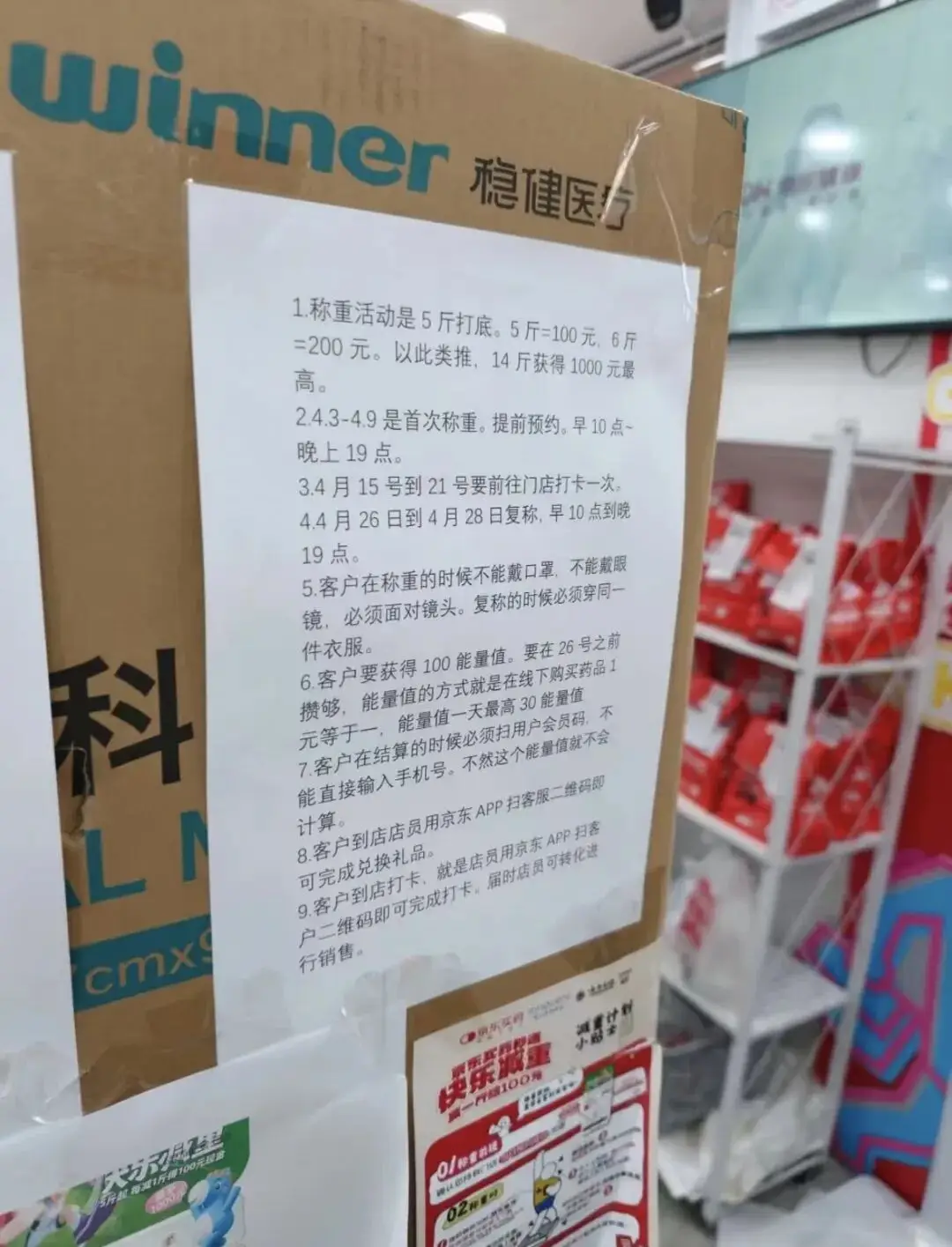
But after all, it is real hard cash, so many people still flocked to it. The process of this activity is roughly as follows: participants go to a JD Pharmacy offline store to weigh in on the initial weigh-in day. The store takes a photo to record the initial weight and uploads it to the event page. The clothes worn on the weigh-in day are also photographed for the record. Many participants noted that the clothes photographed during the initial weigh-in must also be worn on the final weigh-in day.
However, this is only the core part of the activity. In fact, during the 20-plus day weight-loss challenge, participants also have the task of posting on Xiaohongshu, and they must visit the store to check in again more than 10 days after the initial weigh-in. Therefore, this activity is not simple at all; the time and energy costs participants must invest are hard to ignore.
Yonghui has a similar event. In March of this year, Yonghui Superstores piloted the "Exchange Flab for Beef" campaign in Chengdu, and rolled it out to nearly 400 stores nationwide in April. The rule is that for every 3 jin lost, participants can exchange for 1 jin of beef, crayfish, or other fresh ingredients. In the early stages in Chengdu, 5,000 people signed up in just half a day. Yonghui's prize setting is quite clever. According to participants who successfully claimed the beef, the prize is the chilled fresh beef shank sold in the supermarket. Using a fat-loss-friendly ingredient like beef as a prize not only fits the weight-loss theme but also creates a positive psychological association for users, reducing their resistance to marketing activities.
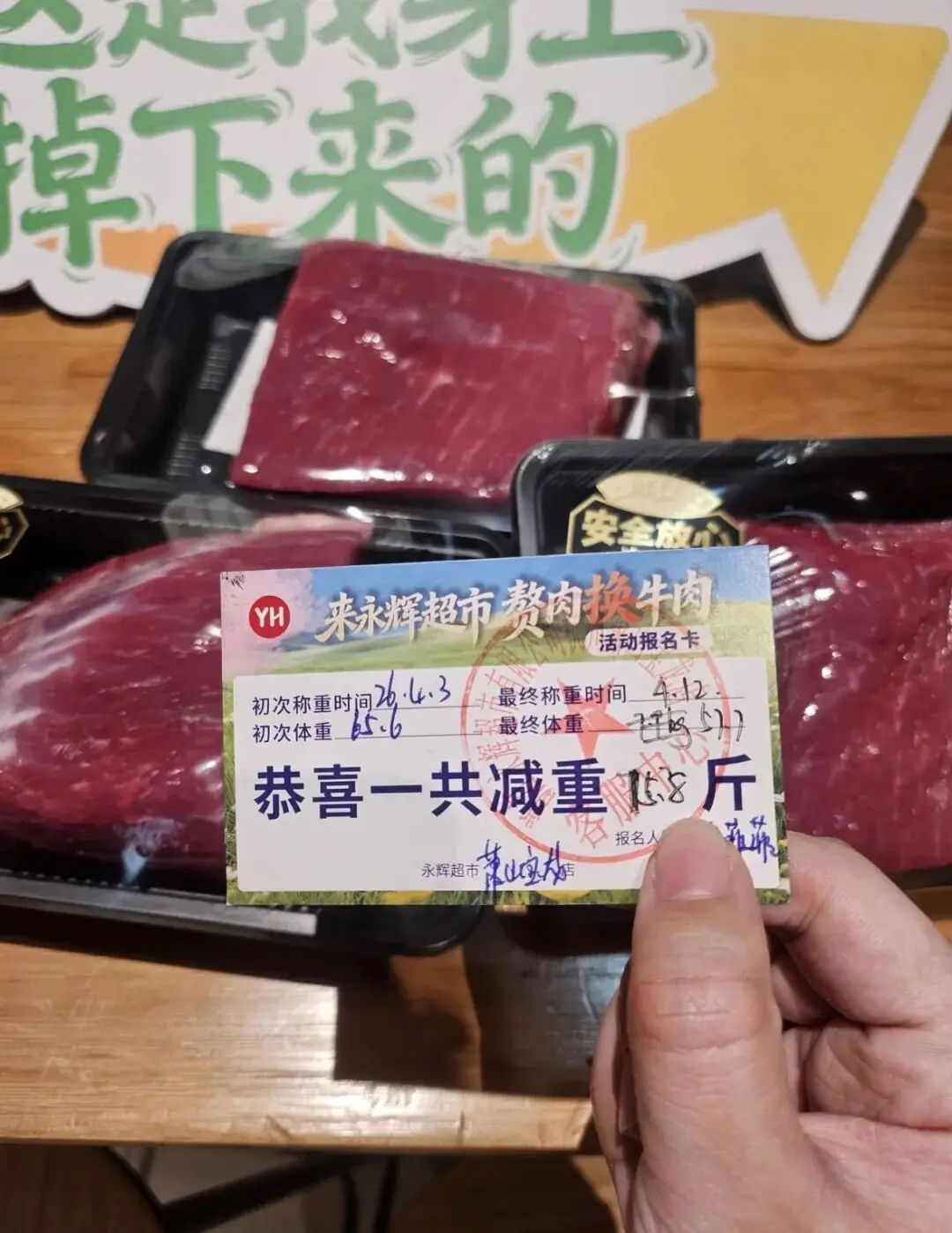
Some people even started calculating whether JD or Yonghui gives more. On May 9, the price of beef shank on Yonghui Superstores' mini-program was 72.5 yuan/jin. So, if you lose less than 5 jin, Yonghui wins, because losing 3 jin gives you a reward worth over 70 yuan. But if you hit the 5-jin threshold, JD's returns start to overtake. Overall, the greater the weight loss, the more obvious JD's cash advantage becomes, while Yonghui's model is more suitable for those with less weight to lose and who have a need to buy beef anyway.
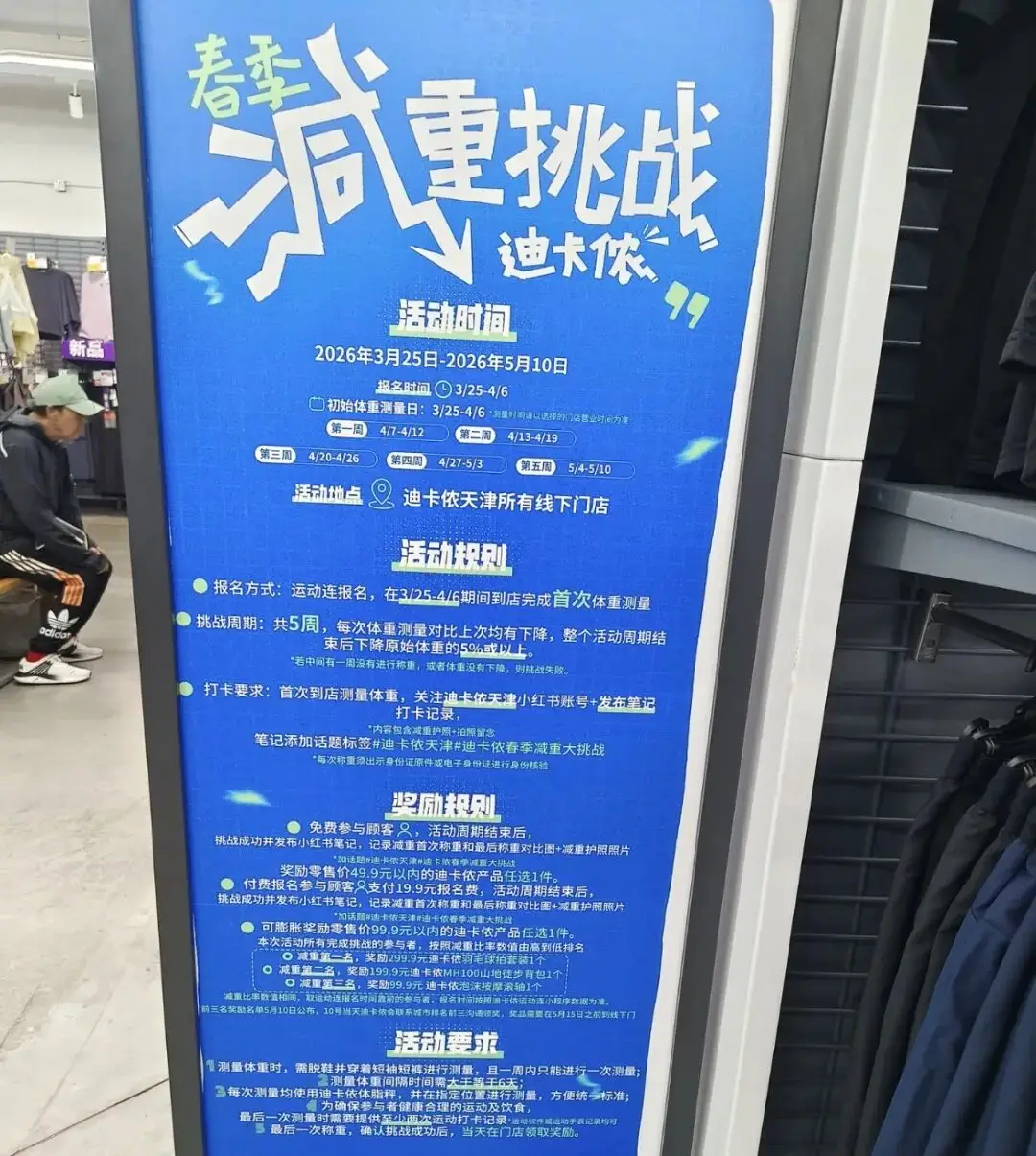
Some offline merchants have also entered the weight-loss activity track. Decathlon regularly holds a "Weight Loss Challenge" at its stores nationwide. Users can participate for free or by paying a small registration fee, but they must go to the store to weigh in and check in for four consecutive weeks. Losing 5% of body weight or meeting阶段性 weight loss targets can be exchanged for in-store products. Xidesheng ran a "Lose Weight, Win a Bicycle" campaign last year, with offline stores setting tiered rewards based on 5%, 10%, and 15% weight loss ratios, and the top loser directly winning a bicycle. Meituan also launched a "Lose Weight to Share a Million Bonus" event, but this mainly focused on an "unsatisfied or refunded" guarantee for overweight individuals, which differs slightly from the logic of other merchants' activities.
Looking at the commonalities of such weight-loss challenges, traffic is still the core orientation.
Platform-based players like JD and Meituan make posting on Xiaohongshu and sharing with hashtags mandatory for participation. It seems like a user participation process, but in reality, it uses users' social content to achieve brand diffusion and public traffic generation. For offline physical stores like Decathlon and Xidesheng, the rule design focuses more on practicality, mostly setting tiered prizes based on the percentage of weight loss. The core purpose is not simply competing over weight loss, but using it to increase store visit frequency, gather offline foot traffic, and thereby drive in-store consumption and product conversion.
On March 14, 2025, the National Health Commission announced the official launch of the three-year "Weight Management Year" action plan, one of the core elements of which is intervention and treatment for overweight and obesity. However, rather than saying that businesses are responding to the call, it is better to say that the call for weight management has given them new operational inspiration.
Operational activities for offline traffic generation are common among businesses, but the particularity of weight-loss challenges lies in their non-standardized activity content.
For example, ordinary offline challenges either compete on speed or quantity, both of which have clear and measurable standards. But when it comes to weight loss, everyone's physique is inherently different, and using only the number of jin lost as the evaluation basis makes it impossible to standardize the measurement.
For weight-loss activities like JD, Yonghui, and Decathlon that require offline weigh-ins, there are many tricks in the weighing process.
In JD Health's activity, although some stores take photos for the record during the initial weigh-in, the lower half of the pants is sometimes not visible in the frame. Many netizens discussed that if the pants weren't photographed initially, they could change into lighter quick-dry pants during the final weigh-in to reduce the weighed weight.
Some people also drink large amounts of water before the initial weigh-in to artificially inflate their starting weight. During the final weigh-in, many people adopt the methods of boxers and bodybuilders, engaging in emergency dehydration and intermittent fasting before stepping on the scale, just to achieve a better weight number. As for the weight loss process itself, methods like running wrapped in plastic wrap, or alternating between a liquid diet one day and an egg diet the next, have all been put to use.
People have also truly figured out the rules: since 1,000 yuan is the cap and 14 jin is the highest tier, "losing about 15-16 jin is enough, leaving a little margin," one participant shared on social media.
Such non-standardized weight-loss activities inherently have a lot of ambiguous space and controversial points in their rule settings.
Take Decathlon's activity rules as an example: the entire event cycle is five weeks, which not only requires the weight for each weigh-in to decrease sequentially but also requires the overall weight loss by the end of the event to reach 5% or more of the initial body weight. Once a weigh-in is missed midway, or if the weight fails to drop in a given week, the challenge is considered failed.
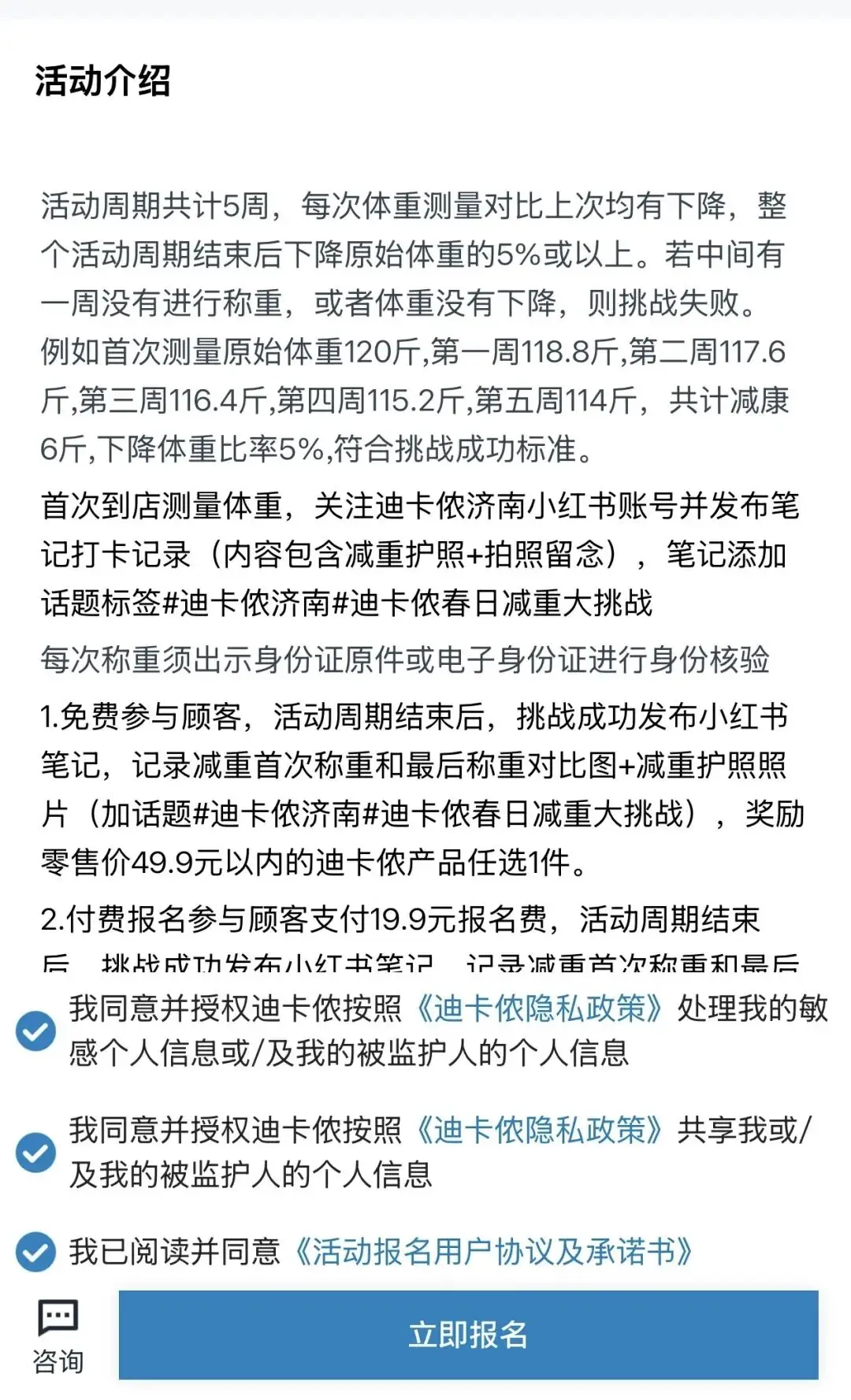
From the perspective of human physiology, it is inherently difficult for body weight to maintain a continuous linear decline. Human body weight is affected by multiple factors such as salt intake, sleep patterns, and endocrine hormones, resulting in normal fluctuations. Especially for women before and after their menstrual periods, fluctuations in estrogen and progesterone levels can cause water and sodium retention, leading to temporary water retention and bloating. A slight weight gain is a common physiological phenomenon unrelated to fat gain or loss.
From the perspective of scientific weight loss, one only needs to look at the long-term overall downward trend in weight, allowing for normal fluctuations during the process. It is not suitable to rigidly require weekly weight loss.
Similar activities basically all have a situation of blindly pursuing weight numbers, which leads to the fact that although the original intention of the activities is healthy, they do not conform to the methodology of scientific weight loss.
As a result, participants exhibit two completely different states. Some use the activity for self-discipline, insisting on going to bed early, waking up early, and eating a light diet, truly gaining a healthy lifestyle; the weight loss itself becomes less important. Others agonize over a few jin of weight, feeling disappointed if they fall just short of the target, and even resort to extreme methods like dieting or emergency dehydration to hit the weight numbers, deviating from the original intention of healthy weight loss.
For platforms like JD and Meituan, it's not just a simple competition of weight; they also set many additional tasks. Taking JD as an example, in addition to completing offline weigh-ins, participants must also purchase medicine on the platform within a specified time, publish at least four weight-loss-related notes on Xiaohongshu with designated hashtags, and successfully invite friends to sign up.
Many participants found that their related posts were often shadowbanned or hidden by the platform. People speculated that on one hand, the content had a marketing and traffic-driving nature; on the other hand, the appearance of personal information and event-related content in the notes easily triggered the platform's review mechanism, resulting in blocking. Consequently, on social media, participants scrambled to find others who also joined the activity to help check the display quantity of notes on their profiles, confirming whether the task was completed.
For participants, how many jin they lose is only one test question; social posting and referral splitting are also factored into the score. The weight-loss challenge is, at its core, still a commercial activity.
There are some very interesting paradoxes in these weight-loss challenges.
On the one hand, the general public has long become highly rational toward ordinary offline marketing activities. Simple traffic-driving activities like scanning QR codes for gifts on the streets or in subways are commonplace, and people have even developed an instinctive avoidance mindset.
But looking at weight-loss competitions, it's a completely different picture. The process of such activities is cumbersome and the threshold is not low: one must participate in weight loss, weigh in at designated offline locations, and also complete a series of additional tasks like posting on social media and referring new users. On the surface, the prize setting is very attractive, but calculating it carefully, even if you get JD's 1,000-yuan capped reward, calculated over the 20-day activity cycle, it's only 50 yuan per day. The actual return is not that high, far from enough to make people dedicate massive amounts of time and energy specifically for it.
On the other hand, in conventional operational logic, such activities have high implementation costs and long participation chains, making the actual customer acquisition efficiency less than ideal. If businesses solely wanted to acquire new customers and cultivate user repurchase, there would be no need to design such heavy and complex participation rules.
Even so, public enthusiasm for participation remains high. JD Health has held it for two consecutive editions, and Decathlon has directly made the weight-loss challenge a regular activity.
"From a cost-benefit perspective, the return of scanning a QR code for a lottery is purely economic, whereas the return of losing weight for cash is twofold: economic benefit + health benefit," Dou Donghui, an associate professor at the School of Sociology and Psychology at the Central University of Finance and Economics, analyzed.
He mentioned that this also involves a deep social psychology phenomenon: the legitimacy of suffering. "Simply taking money feels like unearned income, making people feel guilty. But if you endure the hardship of losing weight to get money, this monetary reward gains moral legitimacy." In other words, the "trouble" of having to lose weight, post, and refer new users is precisely the rationalizing cloak of this activity.
Moreover, participating in such activities has the characteristics of "social scenography" and "cyber performance." Dou Donghui explained that scanning a QR code for a prize is an individual, private behavior with no social increment. But major companies' weight-loss competitions come with community and stage attributes. The trouble cost participants pay actually buys them a ticket to participate in a cyber performance and social scenography movement.
As for the merchants' reasons, although we did not obtain specific customer acquisition data for such activities, referring to past experience, themes like sports and weight loss are inherently more suitable for connecting with real, live offline traffic.
Take Xiaohongshu's 100-day sports check-in challenge launched throughout 2025: the rules are simple and straightforward. For every ten days participants check in, they unlock a physical blind box of sports merchandise. The popularity of this event has remained high, and the related blind boxes are frequently out of stock.
The endpoint of this event is to integrate offline resources. Users can use their complete check-in records to redeem free trial classes at partnered offline fitness stores, smoothly directing online traffic into physical scenarios.
Even though weight loss is hard to standardize and the rules are prone to controversy, major businesses are still willing to join in. The core reason is that it is currently not easy to revitalize the offline real economy. A senior product manager stated that for an offline store like Decathlon, even if only twenty people participate in a weight-loss event, it has already achieved the expected effect.
"Brands don't expect such activities to immediately leverage massive performance growth; the core value is not about boosting sales, but about genuinely gathering offline popularity for the store and revitalizing foot traffic."
Similarly, JD Pharmacy and Yonghui Superstores' deployment of weight-loss challenges is essentially using this popular format to drive traffic and revitalize customer flow for their own offline scenarios.
The fat insurance in the movie was driven by Wang Duoyu's "anxiety of squandering his wealth." In reality's weight-loss challenges, obesity anxiety is mostly just a useful gimmick and excuse; behind it may lie the more urgent anxiety of physical businesses for offline traffic.
 微信扫一扫打赏
  支付宝扫一扫打赏
Comments (0)