
01
Recently, my best friend Ashuang took her child on a trip to Lijiang.
Before leaving, she told me she wanted to take advantage of the off-season in late May to find a comfortable hotel to just chill for two nights, and she didn't have high expectations for the trip.
Unexpectedly, the off-season hotels shocked her.
Not long after checking in, Ashuang started messaging me, saying the competition among Lijiang hotels right now is terrifyingly fierce. She then sent a screenshot of her booking—a family room on the edge of Dayan Old Town, accommodating two adults and one child for just over 200 RMB a night, breakfast included.
I was about to ask if a place at that price could be decent.
Ashuang immediately started gushing about how many free services the hotel offered beyond the room rate. Sitting on the lobby sofa, she watched the breakfast staff constantly making coffee for guests, cup after cup, almost without stopping.
The hotel breakfast was also abundant, with basics like milk, soy milk, steamed buns, and dumplings, alongside fresh pineapple juice, purple sweet potato buns, and Luosifen.

While eating breakfast, she lamented to me that when visiting Lijiang during the pandemic, getting an electric blanket at the same price point was considered lucky.
Back then, guests' expectations for a 200-yuan hotel were simple: a room to sleep in and hot water for a shower were basically acceptable. Returning a few years later, not only was the room decor exquisite, but the breakfast and service were also quite good, yet the price had actually dropped.
Ashuang later chatted with the hotel owner and learned that the renovation alone cost 170,000 RMB per room. She couldn't help but wonder inwardly if they could actually make money.
The owner frankly stated that there are too many hotels in Lijiang now, and since his place doesn't have a view of Jade Dragon Snow Mountain, he can only compete on renovation and service.
After hearing this, I casually opened Ctrip and browsed around, finding that she wasn't exaggerating. A large number of hotels rated above 4.5 were priced at only 100-200 RMB including breakfast, with good locations, many right on the edge of the ancient town.
Even five-star hotels had relatively approachable prices. Recently, resort hotels like Banyan Tree and InterContinental were around 1,300 to 1,400 RMB. The only hotel on Jade Dragon Snow Mountain, Jumeirah Purevend, was a bit more expensive at around 2,300 RMB.
Later, I shared Lijiang's current room rates in a travel industry reader group, and many hotel industry friends said it was completely normal; this year is just particularly hard to sell.
A reader from Baotou said that based on his observation, local foreign-invested five-star hotels haven't been able to hold firm on prices this year. The local Shangri-La and Marriott listed rooms for 399 RMB a night after Qingming, and remained under 500 RMB after May Day. One night's accommodation costs less than a single afternoon tea at a Shanghai five-star hotel.

Another friend from Chengdu shared the recent prices of high-star hotels there: Ritz-Carlton at 950 RMB, St. Regis at 864 RMB, and Shangri-La at 798 RMB. These five-star, gold-diamond luxury brands on OTAs are all under 1,000 RMB.
On the flip side, an owner of a mid-range chain hotel in Lijiang privately complained to me that off-season business is exceptionally tough this year. The hotel has already slashed prices in half, yet the occupancy rate remains under 50%.
He recalled that after May Day last year, a 30% price drop started generating volume. This year, for some reason, prices have dropped, but there are still no orders. Even the outlook for the summer vacation is uncertain.
Clearly, this early summer of 2026 is colder than many hotel owners imagined.
02
The intense competition among domestic hotels is not new, so why did it suddenly reach a tipping point this year?
A few days ago, Lao Zhou, a hotel owner running a mid-range chain in a prefecture-level city in East China, shared a rather interesting experience with me.
Lao Zhou said that in mid-March this year, he specifically treated his employees to a celebration dinner.
That day, Ctrip took the lead in disabling the price adjustment assistant on the merchant backend. Lao Zhou said it would automatically scan competitors' prices across the web and forcibly change the hotel's room rates. For years, hoteliers had been complaining bitterly about it.
Ctrip's move made it the first OTA platform in China to voluntarily take down such a tool.
Seeing the news, Lao Zhou thought it was a tremendous boon; after all, pricing power had returned.
But two months later, the first thing he said to me on the phone was, "It's not just competitive; it's more competitive than ever."
According to him, when the price adjustment assistant was still active, at least he had a rough idea of the surrounding hotels' prices, like holding a measuring stick.
Now, it's worse: if the neighbor drops by 50 RMB, he has to drop by 80 RMB. The whole street has turned into a game of chicken, just waiting to see who can't hold on first.
The removal of the tool did not bring pricing back to rationality; instead, it made the market disorder even more glaring.
For today's increasingly fierce domestic hotel and travel industry, perhaps any tool is just an amplifier; the true source lies in supply and demand.
The 2026 China Hotel Investment White Paper shows that by last year, the total number of hotels in the country had exceeded 400,000, with 84,000 mid-range and above hotels in operation, providing 9.07 million rooms.
However, market demand has not risen. Data released by the Ministry of Culture and Tourism for this year's May Day shows that per capita spending decreased by 3.4 RMB compared to the same period last year. It might not seem like much, but multiplied by the total volume of 325 million trips, it means 1.1 billion RMB evaporated into thin air.
It is worth mentioning that this is another decline in domestic May Day per capita consumption after two consecutive years of growth.
If supply and demand are old problems, what truly makes 2026 different is a new variable entering the battlefield: transportation costs.
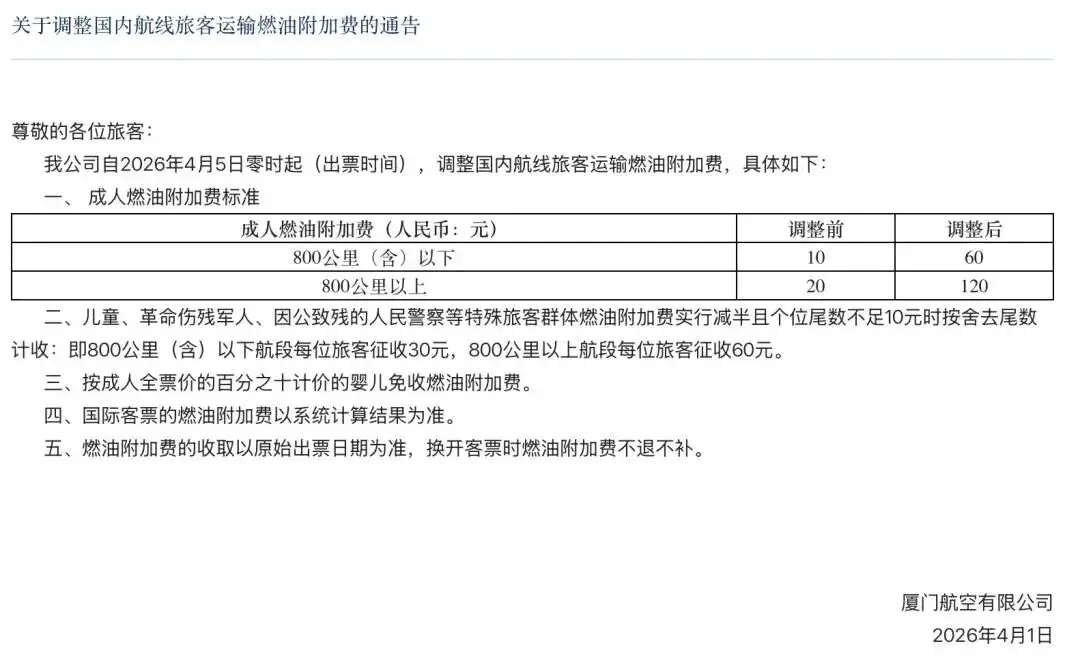
Starting April 5th, the fuel surcharge for domestic flight segments under 800 kilometers jumped from 10 RMB to 60 RMB, and for over 800 kilometers from 20 RMB to 120 RMB—a fivefold increase. Almost simultaneously, six major high-speed rail lines in the central and western regions raised prices by about 20%.
Starting May 16th, domestic flight fuel surcharges will continue to rise.
To do a simple calculation: even before mid-May, a family of three flying round-trip from Beijing to Lijiang would have to fork out an extra 720 RMB just for fuel surcharges.
But consumers' travel budgets are essentially bounded boxes; if more money is spent on transportation, spending on accommodation and experiences has to take a backseat.
Therefore, the portion of the consumer budget squeezed into the pockets of airlines and railway systems is ultimately being paid for by hotels and scenic spots.
Travel review data released by Tongcheng Travel for this year's May Day also showed that booking popularity for county-level destinations surged 128% year-on-year, and booking popularity for high-quality county hotels grew 76% year-on-year, outpacing the platform's overall growth.
It's evident that rising transportation costs are pushing tourist flows toward short-distance and suburban areas.
This is highly disadvantageous for long-haul hotel destinations like Lijiang that require long flights to reach. However, for mid-range chain hotels in county towns around the Yangtze River Delta and Pearl River Delta, it barely counts as a structural advantage.
So, when the Lijiang hotel owner said they have no choice but to compete fiercely, it's no exaggeration. When three forces pull in the same direction simultaneously, none of the nearly ten thousand hotels in Lijiang can remain unscathed.
03
The off-season is too agonizing, and many hotel owners are hoping for the summer vacation to arrive quickly.
Especially in long-haul tourist destinations like Lijiang, Dali, Sanya, Qingdao, Changbaishan, and Chengdu, the annual summer family travel army can indeed alleviate many owners' anxieties about empty rooms.
But thinking about it carefully, when an industry pins its annual profit expectations on just two months, it already indicates a problem with its normalized ability to generate blood.
After all, whether the peak season can cover the losses depends on how much is lost in the off-season. This off-season after May Day is longer than in previous years.
In fact, the biggest difference between this current fierce competition and the past is that the rules have changed.
Previously, hotels competed on location and hardware, assuming a good location trumped everything. Now, hotels in many tourist destinations are actually competing on the feeling of being cared for during the guest's stay.
The boutique guesthouse in Lijiang where Ashuang stayed provides free Luosifen and iced Americanos. Feeding the guests is secondary; the main point is making guests feel they are getting great value for their money.

The terrifying part lies here: premium service cannot be manufactured from reinforced concrete.
If consumers get used to enjoying 2,000 RMB worth of service for 800 RMB, trying to raise room rates back up will be as difficult as getting someone used to Luckin Coffee to accept Starbucks again.
Therefore, for many long-haul resort destination hotels, they need to rethink what exactly they are selling.
If the standard answer is still expecting guests from afar to stay a few extra nights, then sorry, many guests have already been diverted to the suburbs by soaring fuel surcharges. As for those who remain, their length of stay is also being compressed.
The correct response for hotels can no longer be simply lowering room rates.
A smarter strategy might be to bring out-of-stay segments into their own ecosystem, getting one guest to spend more money at the hotel. This is more profitable than getting two guests to spend a little each.
Some tourist destination hotels will increasingly become part of the destination itself, with guests booking a night specifically for the hotel, or even changing their itinerary for it.
As for city luxury hotels already locked in by price, the real proposition for the next stage is how to reduce costs.
Once ADR (Average Daily Rate) is locked in, maintaining single-store gross profit at a reasonable level will become the real problem hoteliers need to solve in the next phase.
Ashuang said that on checkout day, the Lijiang hotel owner seemingly casually complained, "If we don't do this, we won't survive this year."
But this year is just the beginning. The hotel that laughs last may not be the one that cuts prices the most ruthlessly.
In the domestic hotel market over the next two to three years, a counterintuitive phenomenon may emerge: those who ultimately survive will actually be the hotels that first exit the price war and rethink what they are truly selling.
 微信扫一扫打赏
  支付宝扫一扫打赏
Comments (0)