
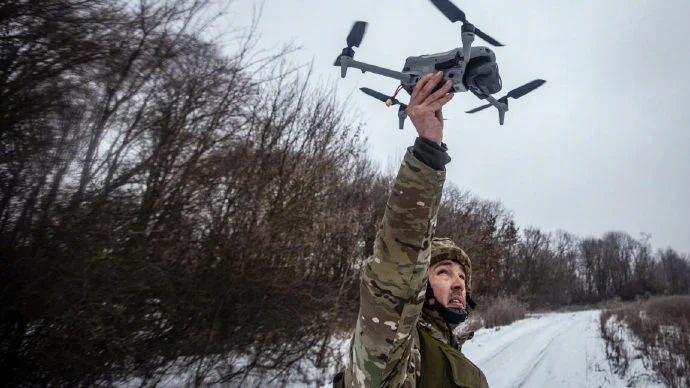
@Steed的围脖:Two years ago, on the Ukrainian frontline, several quadcopter drones flew to a designated area and activated a program called "Terminator Mode." Without human pilots controlling them or real-time video feeds, they searched for targets and launched attacks on their own. Afterwards, a human-operated drone flew to survey the scene and discovered the bodies of two Russian soldiers.
This was revealed by Kohanovsky, CEO of drone manufacturer Aero Center, in an interview with New Scientist at an event held at the Ukrainian Embassy in London. He emphasized that this test was unrelated to his current company and was only conducted once.
Conducted only once—this detail is crucial.
Because the problem with this mode is obvious: drones fly into an area and attack whatever they see, unable to distinguish between friend and foe, or between military and civilian targets. You must ensure in advance that there are no friendly forces or civilians in that area, which makes it almost impossible to normalize on a chaotic frontline. Representatives of defense companies attending the same event also explicitly stated that the Ukrainian government prohibits the use of AI autonomous decision-making in the final phase of an attack, and a Ukrainian military commander stated that his unit's drone operations always involve humans making critical control judgments. According to the U.S. Department of Defense's definition, weapons that, once activated, can select and engage targets on their own without further human intervention are lethal autonomous weapon systems. Those quadcopters from two years ago indeed crossed that line.
Machines killed people on their own, but this did not become a routine operation.
However, while "fully autonomous" systems haven't yet proliferated, "semi-autonomous" ones are already everywhere.
Both Ukraine and Russia are heavily using FPV (First-Person View) drones on the frontline. Pilots wear VR goggles and control the drones from their perspective to crash them into targets. This operation relies on the human pilot's judgment and reaction speed. But here's the problem: the Russian military has deployed extensive electronic warfare systems that can jam the communication links between drones and their operators, and use GPS jamming to divert weapons that rely on satellite navigation off target.
When the human remote control signal is cut off, the drone becomes scrap metal. What to do? Let AI take over navigation.
This is exactly what Ukraine is doing. According to a report written by Bondar, a former Ukrainian government advisor, for the Washington-based think tank Center for Strategic and International Studies (CSIS), AI-driven autonomous navigation has boosted the strike success rate of Ukrainian drones from 10%-20% to 70%-80%. This leap is not an incremental improvement; it's a qualitative change.
Ukraine already possesses the technology and manufacturing capacity to launch over 5,000 drone strikes per month against Russian targets 20 kilometers away, according to data from the Ukrainian Ministry of Defense. These medium- and long-range strike drones must rely on autonomous navigation because they can lose communication with their operators at any time during flight. AI is not just a nice-to-have; it's a strict necessity.
Russia isn't sitting idle either. In 2025, the Russian military is launching hundreds of drones at Ukrainian cities every night, including the Shahed series, initially provided by Iran and later produced domestically in Russia. Early Shahed drones flew on pre-programmed routes and were far from intelligent. However, improved models, such as the Geran-2, have been found equipped with smuggled Nvidia Jetson Orin microcomputers, giving them onboard video processing and autonomous target recognition capabilities, allowing them to re-select targets mid-flight.
To intercept these drones, Ukraine has developed its own low-cost interceptor drones. Some interceptor systems can autonomously fly to the predicted interception point and lock onto incoming targets, but human operators must still perform the initial target selection and issue the attack command, and can abort the attack at any time.
A clear trend is taking shape: rather than making a single leap to fully autonomous killing like "Terminator Mode," navigation, target recognition, and other tasks are being handed over to AI one by one, with humans stepping back to the final loop to make the ultimate decision. Ukraine's approach is to train small AI models using limited data, run them on cheap, small chips, and then stuff these AI modules into FPV drones, long-range strike drones, and even the turrets of unmanned ground vehicles.
Fully autonomous killing machines have, so far in this war, only left behind that one unrecorded test. But every single component required to build them is already on the assembly line.
 微信扫一扫打赏
  支付宝扫一扫打赏
Comments (0)