
Becoming a teacher might be the most natural career choice Chinese parents plan for their children—it's stable, respectable, has a good reputation, comes with winter and summer vacations, and offers a permanent establishment (bianzhi). In the matchmaking market, it's even more useful than a higher degree.
But as the saying goes, only the wearer knows if the shoe fits; those who do the job know the reality. Preparing lessons, teaching, and grading homework is already exhausting enough. Once you become a homeroom teacher, you match wits with students during the day and navigate parent group chats at night, risking complaints at the slightest misstep.
When you finally struggle to the end of the month and look at your paycheck, you almost want to ascend to nirvana. It is genuinely busy, and the pay is really not as much as one imagines.
Even so, being a teacher remains an "iron rice bowl" that many people squeeze their heads trying to get. It's just that now, getting this bowl of rice is getting harder and harder.
Preschool Education Ebbs, and Primary School Teachers Can't Hold On Either
The first to feel the chill were kindergarten teachers.
Today's preschool teachers can all sing and dance like idols, and are masters of music, chess, calligraphy, and painting. During the day, they sing and dance with the kids, do crafts, and tell stories; after school, they have to shoot videos, write children's growth records, and reply to parents' messages...
Facing the crying and rolling "little demons," they sometimes have better methods than the parents. But no matter how capable the teachers are, they are helpless against the reality of staff reductions.
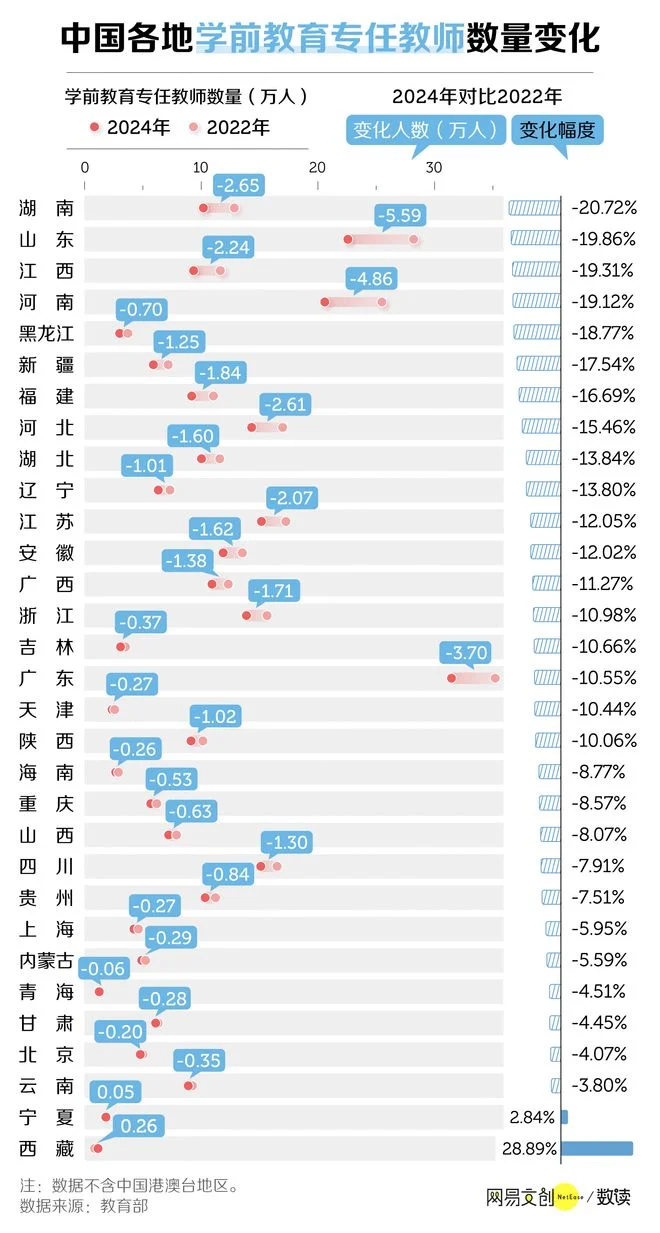
Ministry of Education data shows that in 2022, the number of full-time preschool teachers nationwide climbed to a historic peak. In just two short years, it dropped from 3.244 million in 2022 to 2.832 million in 2024, with over 400,000 preschool teachers leaving their posts [1].
This ebbing tide has swept almost the entire country, leaving only Tibet and Ningxia with still-growing numbers of preschool teachers, while all other regions are declining.
Among them, Hunan, Shandong, and Jiangxi are the three provinces with the highest proportional decrease in preschool teachers, all dropping by more than 19%. However, in terms of absolute numbers, Shandong, Henan, and Guangdong—populous provinces with the largest preschool education scales—are the ones suffering the most severe losses.
If kindergartens were the first domino to fall, primary schools would be next.
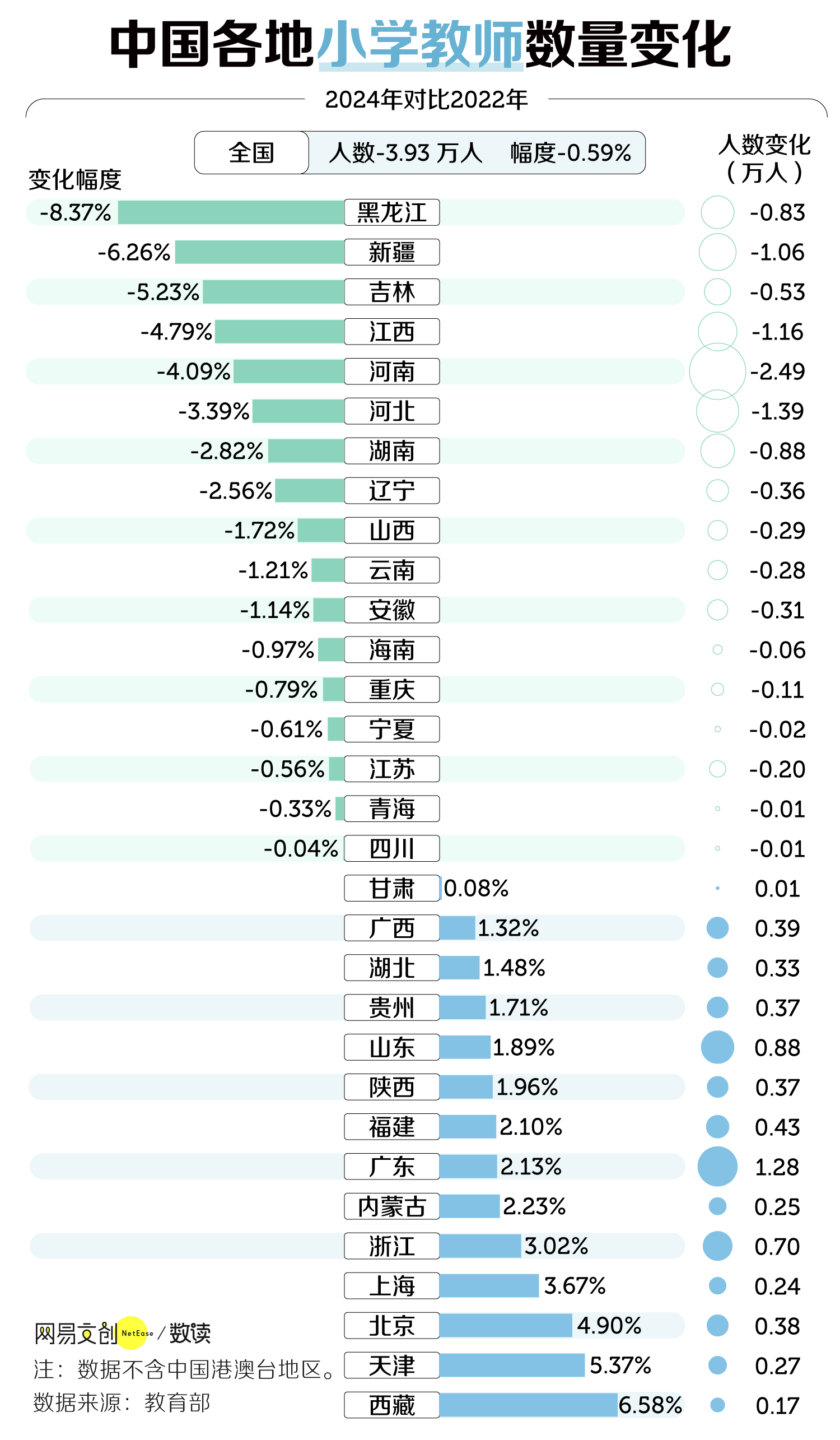
Many people used to say that being a primary school teacher was definitely more secure than working in a kindergarten; after all, no matter how few children there are, they still have to go to primary school. But this notion was quickly slapped in the face by reality. In 2024, the number of full-time primary school teachers nationwide declined for the first time in many years, decreasing by 66,000 compared to the previous year [1].
As of 2024, the number of primary school teachers has decreased in 17 provincial-level administrative regions nationwide, with Heilongjiang, Xinjiang, and Jilin seeing the most obvious declines.
If you consult local statistical yearbooks, you'll also find that teacher attrition in the Northeast has actually been going on for over 20 years. The number of primary school teachers in Heilongjiang and Jilin began decreasing as early as 1998 and 2000, respectively [2][3].
Of course, there are still 14 regions where the number of primary school teachers is surging forward. But this may be because adjustments in the education system lag half a beat behind demographic changes. From staff quota approval to recruitment and hiring, to teacher turnover, everything takes time to complete [4].
Therefore, although the teacher scale in some places appears to still be expanding, it's actually just that the change in student enrollment hasn't fully transmitted to the recruitment side yet.
Compared to changes in the number of teachers, the reduction in schools actually came earlier and is more easily noticed by ordinary people.
Many people returning to their hometowns will find that the village kindergarten still has a sign hanging, but there are no longer children attending classes. Or a once-lively primary school has disappeared, its gate locked and its playground overgrown with grass.
Indeed, the number of primary schools nationwide has been continuously declining since 2021, decreasing by 21,600 by 2024. Kindergartens, after peaking in 2021, dropped rapidly, with an even larger number disappearing [5].
School Enrollment Is Decreasing
Teachers disappearing from schools, in the final analysis, is because there are fewer children.
For a long time, the Chinese education system faced the problem of continuously increasing student numbers. School expansions, teacher recruitment, and adding classes were all to accommodate more and more children.
But with the decline in the birth rate, this change is gradually transmitting up the age chain. A study published in the Population Journal in 2024 predicted that the student enrollment scale at all educational stages nationwide will, after a brief rise, enter a period of continuous decline [6].
Specifically, the number of full-time teachers in primary schools, junior high schools, senior high schools, and higher education is expected to become surplus around 2024, 2031, 2035, and 2037, respectively [6].
The most obvious change at present has already appeared in kindergartens.
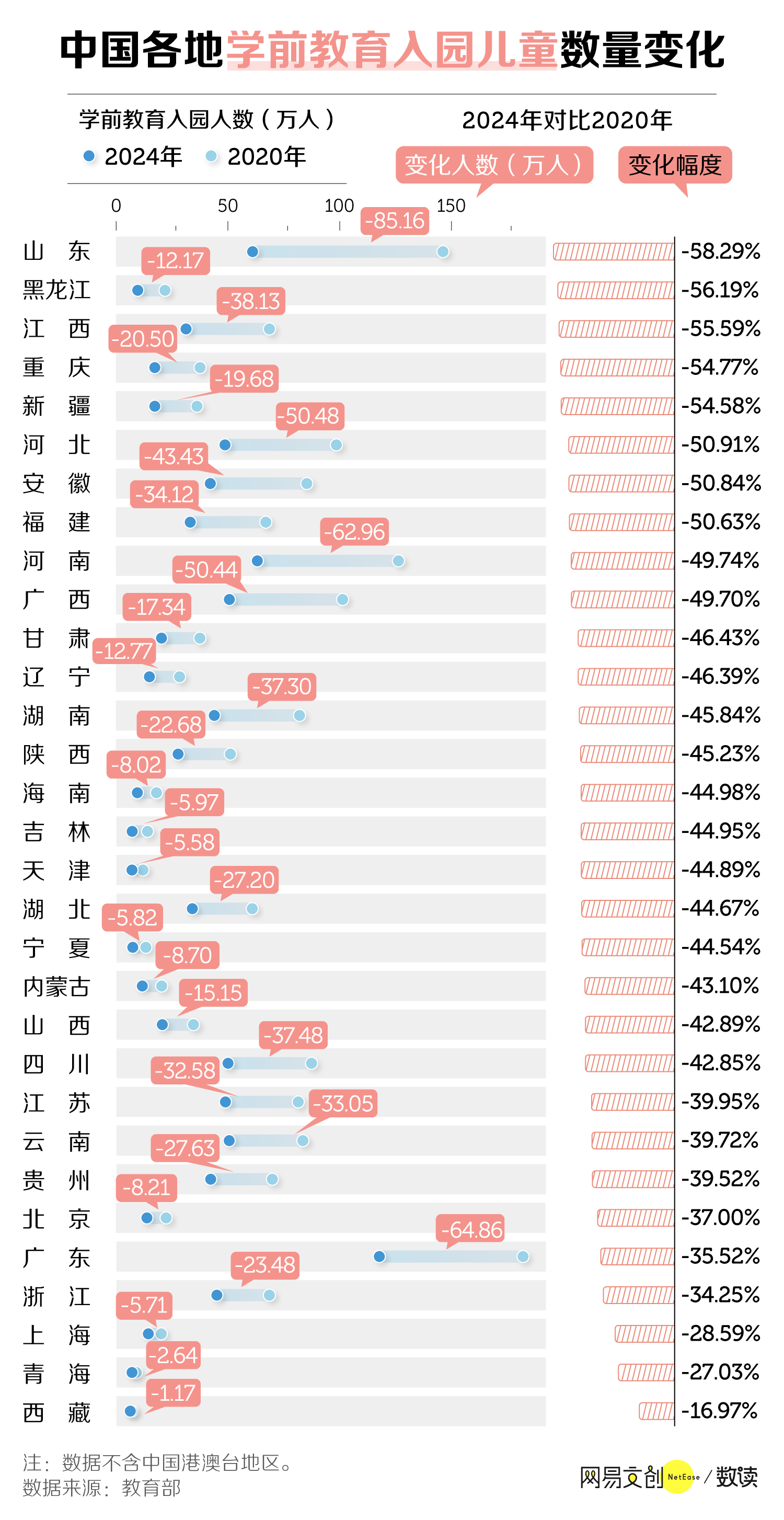
After the brief birth peak brought by the two-child policy passed, kindergarten enrollment numbers generally fell across various regions. Between 2020 and 2024, the number of children enrolled in kindergartens in Shandong, Heilongjiang, Jiangxi, and other places decreased by over 50%, meaning the enrollment scale shrank by more than half.
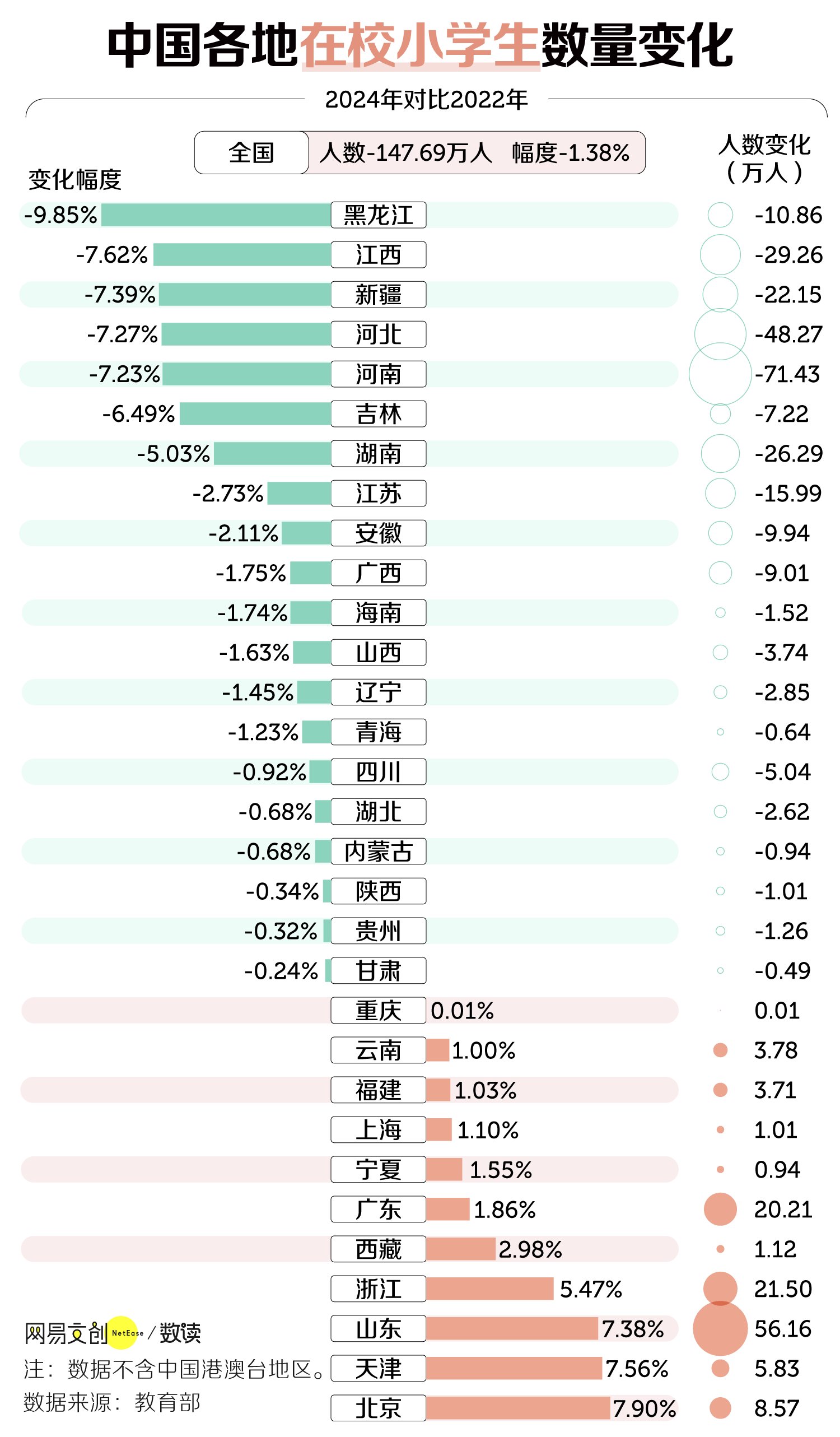
Primary schools are also seeing fewer students and quieter classrooms. Although there were still over 100 million primary school students nationwide in 2025, enrollment numbers have been declining for two consecutive years starting in 2024 [7][8].
Looking closely at primary school enrollment across regions, comparing 2024 with 2022, the declines in Heilongjiang, Jiangxi, Xinjiang, and other places are the most prominent. Heilongjiang saw a decrease of nearly 10% over the two years, ranking first. In absolute numbers, Henan saw a decrease of over 710,000 primary school students, the most in the country.
However, this "continuous decline" hasn't happened synchronously across the country.
In regions with continuous population inflow like Beijing, Shanghai, Guangdong, and Zhejiang, primary school enrollment scales are still growing. A large number of migrant children following their parents into these local cities has offset the impact of the declining birth rate to a certain extent.
Shandong's situation is somewhat different. Influenced by the two-child policy, Shandong's birth rate ranked first nationally for two consecutive years in 2016 and 2017 [9][10].
When this batch of "two-child babies" entered primary school, there was a noticeable increase in enrollment. In 2024, the number of primary school students in Shandong reached 8.1678 million, an increase of 561,600 compared to 2022, ranking among the top nationally [11][12].
While eastern regions are worrying about how to push their kids into good schools, western regions are still struggling to ensure that children without schools have a place to go.
Tibet is a special case. The local consolidation rate of nine-year compulsory education only first exceeded 97% in 2022 and is still continuously improving [13]. An increasing number of school-age children completing compulsory education keeps the local enrollment scale growing.
In most provinces, however, as student sources continue to shrink, schools that cannot recruit students can only head towards closure and merger.
Tenured public school teachers who are lucky might be transferred to surrounding schools or switch to logistics and management. But for those contract and temporary teachers without tenure, the day the school closes is often the last time they stand at the podium.
Normal University Students Are Still Being "Mass-Produced"
Classrooms have lost their former playful and noisy scenes, and school gates and playgrounds have become increasingly empty. Surprisingly, however, normal university departments are getting livelier year by year.
From 2019 to 2023, the national enrollment of undergraduate normal students increased from 428,800 to 592,300, a rise of 38.16% over five years. In the same period, the enrollment of undergraduate and graduate students majoring in education—who may also be teacher reserves—increased by 34,800 and 21,600, respectively.
Although some top universities have become alert and adopted more cautious countermeasures—for instance, East China Normal University stopped enrolling publicly funded normal students in the preschool education undergraduate major in 2025 [14].
But more universities are still maintaining the training scale of the past decade or more, and the inertia of normal education expansion has not easily stopped.
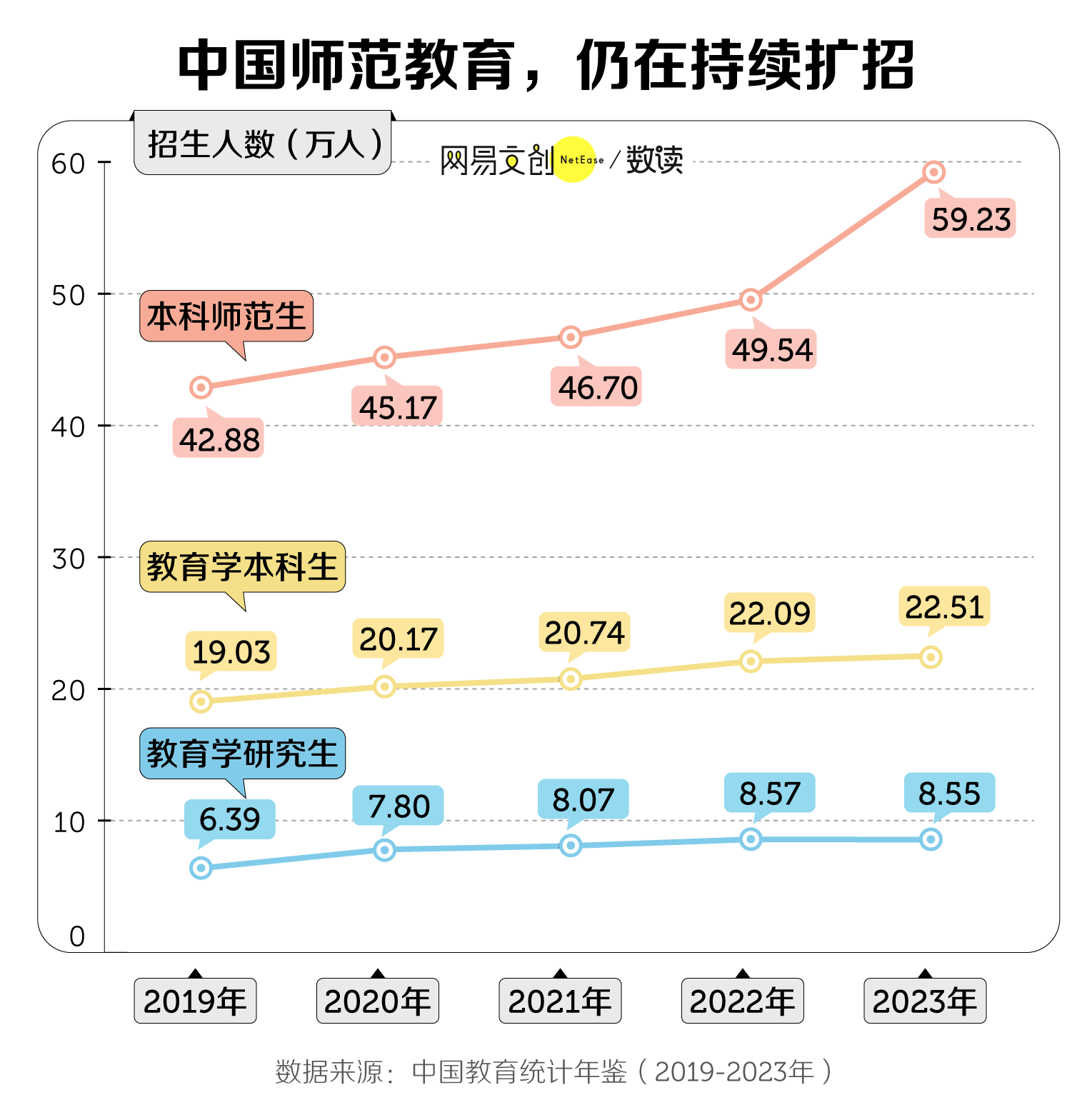
Thus, a contradictory scene has emerged: on one hand, some schools are being closed and merged because they cannot recruit students; on the other hand, more and more normal graduates are stepping out of campus only to find no podium left for them.
Even the "Special Post Plan," which has long been tasked with supplementing grassroots teachers, has seen a significant reduction in its recruitment scale, dropping from 105,000 in 2020 to 21,000 in 2025 [15][16].
When jobs become fewer, competition naturally becomes fiercer. Once upon a time, an undergraduate degree was advantageous enough for school recruitment in many places. But today, for teaching positions in popular areas, master's and even doctoral degrees are gradually becoming the standard.
This is also evident from data released by the Ministry of Education. From 2021 to 2024, the proportion of full-time preschool teachers nationwide with undergraduate and graduate degrees rose from 29.07% to 43.02%; for primary school teachers, it rose from 70.31% to 81.35%. Teachers with college diplomas or below are being rapidly replaced.
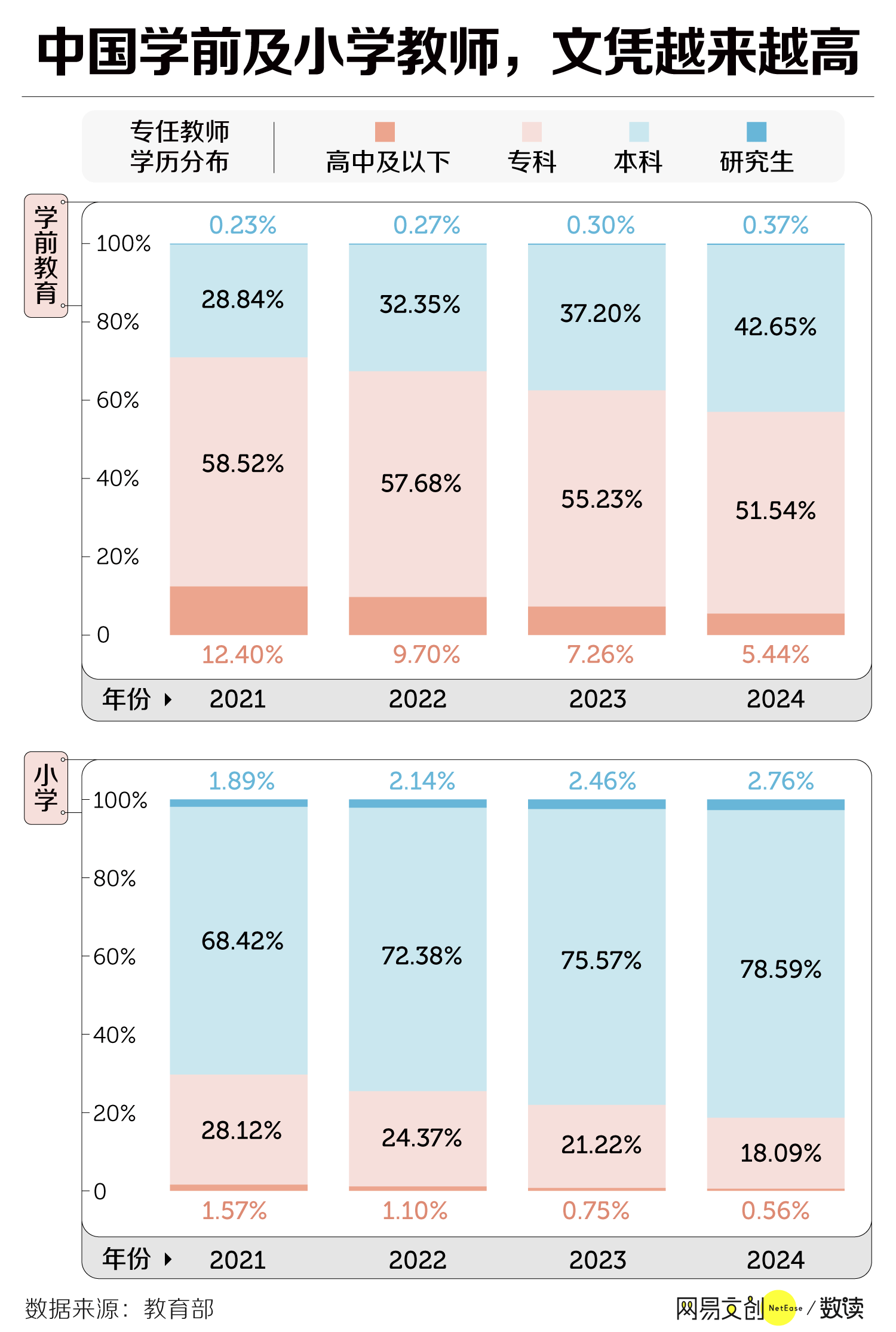
For schools, this certainly means that the overall educational level of teachers is continuously improving.
But for many normal graduates, it means another kind of pressure. Holding the same teacher qualification certificate, having gone through the same internships, trial lectures, and exam prep, whether they can enter a school increasingly depends on their degree, university tier, and recruitment quotas.
Many people take the teacher qualification exam, then the teacher recruitment exam, and then have to take the graduate school entrance exam, only to still have to take the public establishment exam. A ticket to the podium has its threshold continuously raised through layer after layer of screening.
Some people also pin their hopes on "small-class teaching." If the number of students in each class decreases, theoretically, more teachers would be needed, which could alleviate some of the job pressure.
Indeed, the latest Outline for Building an Educational Powerhouse (2024-2035) also mentions promoting the high-quality and balanced development of compulsory education and advancing small-class teaching in an orderly manner [17].
But the reality is not that simple. Small-class teaching isn't just splitting a class of 50 into two classes of 25. Classrooms need to increase, equipment needs to increase, and logistics and management staff also need to increase. The educational cost per student will rise significantly, which is evidently no easy task.
Therefore, in the foreseeable future, it will be difficult for teachers to return to the era where graduating from a normal university meant not worrying about work. They study how to educate the next generation, but they have to face their own first lesson in reality first.
 微信扫一扫打赏
  支付宝扫一扫打赏
Comments (0)