

On June 5, a 70,000-word resignation post about DingTalk on Alibaba's internal network struck a chord with countless workers.
In the post, product manager You Su reflected on the reasons for the failure of DingTalk ONE, revealing that the project team endured long hours of high-intensity overtime, working from 9 AM to 11 PM, and once having only a day and a half off in a single month.
On June 8, Ma Ruila, former Vice President of DingTalk and head of AI products, published an article on his personal WeChat official account in response to You Su's resignation post.
As the situation continued to ferment, today, Jack Ma and Joe Tsai jointly published an article titled "Compassion, Righteousness, and Growth Are the True Alibaba Culture" to respond.
According to Mao Zai's understanding, Jack Ma stated that the DingTalk team's management methods mentioned in the post are by no means Alibaba's culture.
He emphasized that mutual respect, treating people as human beings, and having compassion and righteousness are the cultural cornerstones of Alibaba. He bluntly stated that innovation in the AI era relies on employees' passion and creativity, not high-pressure control and mechanical execution.

DingTalk Vice President Officially Announces Resignation
Says He Felt Heartbroken After Reading "Inside DingTalk"
Ma Ruila's article mimics the format of "Inside DingTalk," but it is full of emotion, as if speaking out for the employees.
He stated that although he was not clear about the internal details of the ONE project, he understood the atmosphere You Su described.
In a high-pressure environment, employees put in effort but did not get the desired results; work was just a continuous cycle of reporting, iterating, and yielding no effects.
In the article, Ma Ruila quoted Jack Ma's famous saying, "Customers first, employees second, shareholders third," and asked in return, "When an organization enters a state of extreme high pressure, does 'employees second' mean they rank second, or does it mean employees must always yield and take a backseat?"
After the 70,000-word long post sparked heated discussions, he chatted with a former colleague about the matter. What made him angry was that this colleague said he did not appreciate such a person, did not agree with the way the hot post was published, and believed that every company has its own problems.
Ma Ruila said that after spending three hours reading "Inside DingTalk," his mind could not calm down for a long time; he just felt heartbroken.
He mentioned that even as a Vice President of DingTalk, whenever he posted on Alibaba's internal network and it reached the top of the trending list, HR would call him immediately to ask him to delete the post.
Ma Ruila thus questioned, "What is the meaning of Alibaba's internal network?" Is it to speak the truth in a relatively safe place, or is it that once the truth becomes a hot post, the person who posted it is put on trial first?
Aside from these highly emotional contents, some parts also corroborated the authenticity of the descriptions in "Inside DingTalk."
For example, high-intensity working hours and attendance checks at work, where even the vice president is no exception. There was a period of time when he worked 7 days a week, starting at 9 AM and returning home at 2 AM every day.
He bluntly stated: "I really want to live a few more years."
At the same time, Ma Ruila officially announced in the article that he had left DingTalk in mid-May.
Ma Ruila's real name is Wang Jiamin. He previously founded the collaborative office platform "Wolai." After Wolai was wholly acquired by DingTalk in 2023, he joined Alibaba as Vice President of DingTalk, responsible for the R&D of DingTalk's AI product line, and led the launch of AI Tables, among other products.
Currently, DingTalk officials have not made any response to these two articles.

Former DingTalk ONE Product Manager Posts
Leaving Work at 11 PM Criticized by Wu Zhao as Too Early
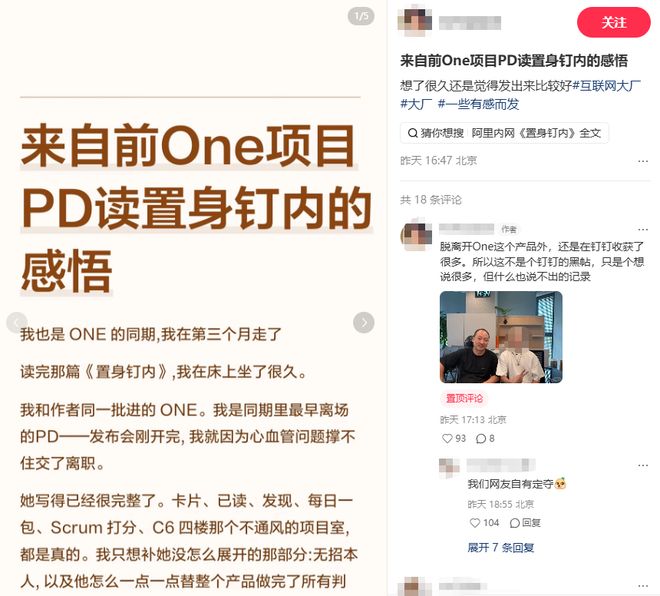
Shortly after Ma Ruila's response post, a former DingTalk employee who was also a product manager for ONE alongside You Su, posted on Xiaohongshu to show support.
He said he entered the ONE project in the same batch as You Su. Unlike You Su, who held on until the end before resigning, he was the earliest product manager to leave. Due to cardiovascular issues, he handed in his resignation right after the product launch.
In the post, he first confirmed the authenticity of the ONE project-related details mentioned in "Inside DingTalk," such as cards, read receipts, and the daily package, and then supplemented more content related to DingTalk CEO Wu Zhao.
One night, he left work at 11 PM. The next morning at a meeting, Wu Zhao said in front of everyone: "You're a product manager, and you leave at 11 PM? Do you need me to buy you a camp bed and put it in the project room?"
For the next several days, Wu Zhao actually brought HR along to check who was present and who wasn't in the project room after midnight.
The author stated that during his last week before resigning, he went home at midnight every day.
Regarding the internal issues of the ONE project team, he also expressed views consistent with You Su's, but wrote more bluntly: Wu Zhao stands on the sender's side, and his perception of work is defaulted as the universal perception; "Wu Zhao is satisfied" is synonymous with "users are satisfied."
The team valued demands that could yield immediate results and rewarded short-term efforts, but chose to repeatedly delay things that were correct but long-term.
The author posted a previous photo of himself and Wu Zhao in the office in the comments section, which basically confirmed his identity.

Feishu Closely Chasing DingTalk
Wu Zhao Overhauls Attendance Immediately Upon Return
In the domestic collaborative office market, DingTalk, Feishu, and Enterprise WeChat are the industry's big three.
In terms of user scale, DingTalk far exceeds the other two, with over 800 million users, 26 million enterprise organizations, and over 200 million monthly active users, ranking first in the industry.
However, in terms of commercialization, the gap between Feishu and DingTalk is narrowing. Feishu's user scale is less than 15% of DingTalk's, but due to its high proportion of high-end enterprise clients and stronger willingness to pay, it has captured nearly 70% of DingTalk's revenue.
In March last year, DingTalk founder Wu Zhao returned to serve as DingTalk's CEO. In 2014, he led the team to start the DingTalk project and subsequently witnessed DingTalk grow into China's largest enterprise communication application.
In 2021, Wu Zhao left DingTalk due to internal strategic disagreements and chose to start a business. Returning to DingTalk after 4 years, he has only one goal: in the AI era, ensure DingTalk's position as the industry leader.
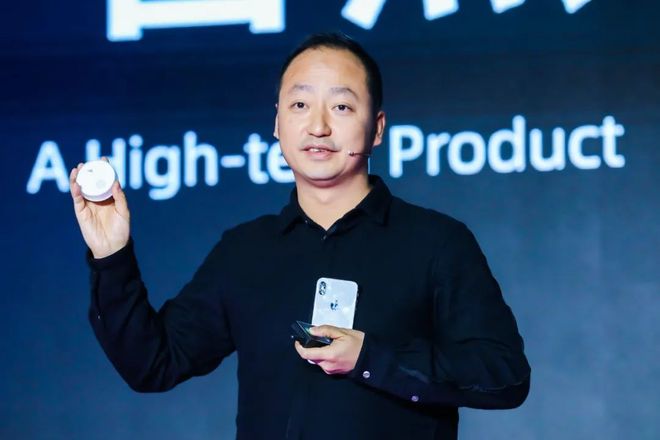
Upon taking office, Wu Zhao began vigorously rectifying attendance at DingTalk: requiring employees to hold morning meetings at 9 AM and summary meetings at 9 PM; banning the use of WeChat, Weibo, and Xiaohongshu during work hours; requiring technical staff to write code themselves and learn Python; and when others ask to add their WeChat, they must say, "Sorry, I only use DingTalk."
To promote the "New DingTalk," Wu Zhao established more than ten innovation groups, and the original groups were disrupted and reorganized. Some employees revealed that many people eventually resigned after the adjustments.
After such drastic reforms, in August 2025, DingTalk presented its first answer sheet since Wu Zhao's return—AI DingTalk 1.0, announcing DingTalk's comprehensive shift to AI.
A total of more than 10 AI products were launched, including DingTalk ONE, the "AI Table" that can automatically generate applications, and the first AI recording hardware "DingTalk A1," etc.
The day after the launch, over 70,000 people lined up to apply for DingTalk ONE, but the popularity did not last, and the peak daily active users of DingTalk ONE were only 3 million.
At the same time, the talent war between Feishu and DingTalk has become increasingly fierce.
Several retail consumer brands such as Insta360 and Haoxianglai migrated from DingTalk to Feishu. Feishu CEO Xie Xin once publicly stated, "The number of clients poached from DingTalk is very small, basically companies whose names you can't even remember."
With Feishu in relentless pursuit on one side and internal employee dissatisfaction on the other, DingTalk remains in turmoil a year after Wu Zhao's return.
 微信扫一扫打赏
  支付宝扫一扫打赏
Comments (0)