
Author | Wen Shijun
Editor | Sun Chunfang
Produced by | Prism · Tencent Xiaoman Studio
Huang Guangyu back then certainly never imagined that the Gome he built with his own hands would one day no longer bear the Huang surname.
He was once the most undisputed king in the Chinese business jungle. Coming from a Chaoshan farming family, with no elite university degree or dazzling resume, he conquered territories during the era of roaring real estate, capital, and consumerism. He transformed a street-side appliance store in southern Beijing into a nationwide commercial empire.
After leveraging the backdoor listing of Gome Electrical Appliances (0493.HK) with massive capital, the Gome system swallowed up several listed companies, including Zhongguancun and Sanlian Commercial, building a vast capital map.
In 2004, at the age of 35, Huang Guangyu topped the list of China's richest for the first time. He subsequently claimed the crown again in 2005, 2006, and 2008, ranking first four times.
In those years, he was like a fierce beast constantly charging forward. Some revered him, some feared him, and some imitated him. But no one could ignore him.
At that time, Huang Guangyu told a reporter interviewing him: "The Kunpeng spreads its wings, aiming for the highest heavens." He built the Gome system's headquarters, "Pengrun Building," near Sanyuanqiao on Beijing's Third Ring Road, and his preferred title was President of Pengrun Investment Co., Ltd. Well-known Beijing real estate projects like Pengrun Garden, Gome First City, and Tomorrow First City became the marks he left during that era of expansion.
But now, the very foundation of the Gome system has fallen.
According to a transaction announcement disclosed by Gome Retail (0493.HK, formerly Gome Electrical Appliances) on June 5, 2026, the largest shareholder of this once-glorious listed company is now the former creditor Jinboding Investment Management Co., Ltd., holding a 29.61% stake; founder Huang Guangyu and his wife directly hold only 6.74%.
The stock price is even more dismal. Since 2026, its share price has hovered around HK$0.01 per share, with a total market capitalization of less than HK$1 billion. In contrast, in February 2021, when Huang Guangyu's sentence officially ended, the market was full of expectations, and the company's market cap once surged above HK$50 billion.
Why did the market value evaporate by 98% in just five years, reducing Gome Retail to a mere penny stock?
Early Release: The Return of the Richest Man
On the night of November 17, 2008, 39-year-old Huang Guangyu was taken away by the Beijing Municipal Public Security Bureau for investigation.
Just over a month before the incident, on the 2008 rich list, he had just topped China's richest for the fourth time with a fortune of 43 billion yuan.
Nearly two years after the investigation, on August 30, 2010, the Beijing High Court made its final ruling: Huang Guangyu was sentenced to 14 years in prison and fined a total of 800 million yuan for the combined crimes of illegal business operations, insider trading, and corporate bribery. His wife Du Juan's sentence was commuted on final appeal from 3 years and 6 months of imprisonment to 3 years of imprisonment with a 3-year suspension, meaning she did not have to serve time in prison.
The actual sentence was not that long. According to the criminal ruling of the Beijing Second Intermediate Court [(2015) Er Zhong Xing Jian Zi No. 1634], Huang Guangyu received two sentence reductions during his imprisonment: 10 months reduced in June 2012, and another 11 months reduced in May 2016, moving his statutory release date forward to February 16, 2021.
The actual release came even earlier. On June 24, 2020, the Beijing First Intermediate Court announced: based on the recommendation of the penalty execution organ, it legally ruled to grant Huang Guangyu parole, with the parole testing period ending on February 16, 2021.
However, from being taken away in 2008 to being released on parole in 2020, times had changed and life had its ups and downs; this man, who had become a billionaire at a young age, had already passed the age of knowing his destiny (50 years old).
The fierce beast was out of the cage, and the market was full of expectations. After the parole news was made public, when the market opened on the afternoon of June 24, 2020, the entire Gome system was in the red: Gome Retail surged by 20%, Gome Financial Technology soared by over 60%, and Zhongguancun, *ST Meixun, and *ST Jintai (controlled by the Huang brothers) all hit the daily limit.
On February 16, 2021, the parole testing period expired, and Huang Guangyu's penalty was legally deemed fully served. Two days later, on February 18, having officially returned to the frontline, he said at an internal executive meeting:
"We will strive to use the next 18 months to restore the company to its original market position."
At 52 years old, Huang Guangyu was still at an age where much could be achieved in the business world. His ambition remained, but the commercial jungle before him was no longer what it was when he temporarily left the stage.
Missing the Express Train, Left Out of the Card Game
If one were to select the most legendary entrepreneurs in contemporary Chinese business history, Huang Guangyu would undoubtedly have a place.
In May 1969, a second son named Huang Junlie was born to a farming family in Fenghu Village, Tongyu Town, Chaoyang County, Shantou City, Guangdong Province. In 1985, without finishing junior high school, Huang Junlie left home to make his way in the world. In the "jianghu," he adopted a new name: Huang Guangyu—illuminating the past and enriching the future, the ambition of a youth.
The young Huang Guangyu was a lucky man who caught the express lane of his era. He eliminated middlemen in home appliances to lower prices, leveraged market dominance to force manufacturers to concede profits, used supplier payment terms to continuously open stores and expand, then used mergers to consolidate peers and went public to rapidly inflate his scale, becoming the leader of China's home appliance retail industry.
However, more than a decade in prison caused this once-speeding runner to miss the next express train of industry iteration.
During his imprisonment, rumors of Huang Guangyu "commanding from behind bars" never ceased. Gome insiders once revealed to the media that there was indeed a special "green channel"—through the transfer of prison documents, Huang Guangyu was able to remotely control company decisions. His wife, Du Juan, acting as the actual manager and strategy executor, kept the Gome empire running.
This remote management model was ultimately unable to replace the acumen of frontline decision-making, nor could it make drastic reform decisions in the rapidly iterating competition of e-commerce. In other words, although the Gome system dabbled in e-commerce, it ultimately failed to secure a seat at the core card table.
By the time Huang Guangyu returned, the window of opportunity had closed. The once-dominant offline retail tactics had long lost their power under the impact of the e-commerce wave, live-streaming sales, and instant delivery. Coupled with the impact of the pandemic, Gome Retail, lacking an online traffic portal, found the path to "restoring its original market position" far from smooth.
Huang Guangyu tried to use thunderous methods to recreate his past success.
Abandoning years of conservative tactics, Huang Guangyu's opening move was to rename the Gome App to "Zhen Kuaile" (Really Happy). His strategy was clear and beautiful: through massive investment, he hoped to gain an independent traffic portal; then, combined with "10,000 stores on the cloud, 10,000 people live-streaming," and叠加 his most adept low-price strategy, he would use high subsidies to conquer the live-streaming track.
But this copycat approach was still a soulless, defensive transformation, essentially aimed at recreating the glory he once possessed, and it came at a heavy cost.
The Heavy Cost of "Recovery"
Reality was ultimately cruel.
The channel dominance of physical stores that once made home appliance manufacturers tremble had long vanished, and the "Zhen Kuaile" APP appeared clumsy and fragile in the face of top e-commerce platforms like JD.com, Alibaba, and Pinduoduo, whether in terms of scale, supply chain, subsidy power, or algorithmic technology.
Upstream home appliance brands were also building their own online channels one after another, and even "bosses" were personally stepping into live-streaming sales, which left the "middleman" Huang Guangyu with very limited room to maneuver.
Full-staff live-streaming, turning sales floors into live-stream rooms, looked impressive, but it was actually just superficial excitement. Huang Guangyu tried to use massive offline manpower to fill the gap in online traffic, but this essentially continued the "people looking for goods" model of offline retail: the traditional store logic of trying to push products to users.
This is completely different from the prevailing "goods looking for people" logic of current e-commerce—massive supply, massive users, relying on algorithms to push products to interested people, and even reverse-customizing products based on data.
Ultimately, the vigorous full-staff live-streaming turned into a commercial experiment that consumed massive labor costs, leading to collapsed morale and employee attrition. Of course, the investment of real money was indispensable, which further exacerbated Gome's cash flow crisis.
Clues can be seen from the financial data: in 2021, Gome Retail's revenue was 46.9 billion yuan, a year-on-year increase of 5.39%, which at first glance seemed like a "good start" after Huang Guangyu's return. But in 2021, total operating expenses also reached 50.9 billion yuan, up 6.20% from 48 billion yuan in 2020. Revenue growth couldn't keep up with cost growth; this was growth at a cost.
The cash flow pressure finally erupted in 2022, and Gome Retail began to delay the settlement cycles for supplier payments. Using payment terms to revitalize funds or even expand scale is not uncommon in the retail sector, and it was once a habitual tactic used by Huang Guangyu to expand his territory. But the situation was different now; having lost channel dominance, Gome Retail no longer had bargaining chips with upstream home appliance manufacturers.
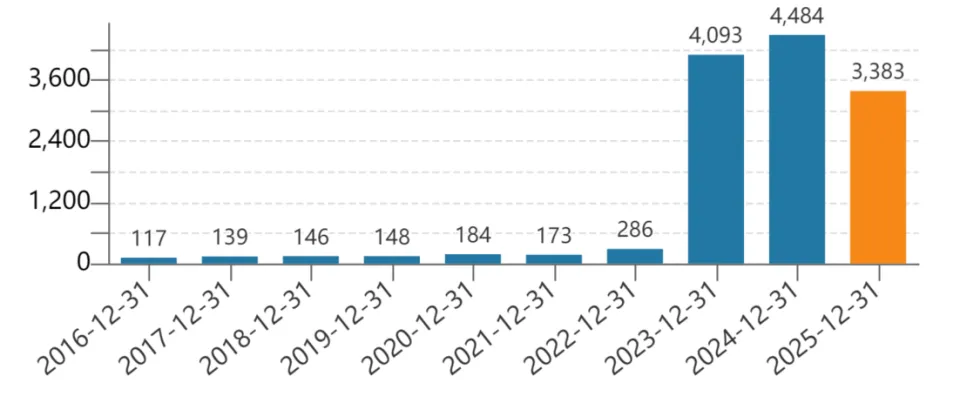
Gome Retail's accounts payable turnover days: from over a hundred days to 12 years. Data source: Wind
In April 2022, Galanz-controlled "Whirlpool" was the first to show its cards, publicly demanding Gome Retail to pay 82.358 million yuan in arrears and choosing to "cut off supply." This toppled the first domino:
Wait-and-see sentiment intensified, and multiple brands subsequently followed suit by reducing or stopping supplies. This created a vicious cycle: insufficient supply led to declining revenue, exacerbating financial pressure and worsening payment arrears, which in turn prompted more suppliers to stop supplying. To cut costs, Gome Retail had to close stores and lay off employees, forcing the contraction of its once-dominant offline channels.
All of this formed a terrifying sinking spiral.
Old Soldiers Never Die, They Just Fade Away
Clearly, the outbreak of the liquidity and supply chain crisis in 2022 meant that Huang Guangyu's 18-month revival plan had completely failed. In January 2023, the "Zhen Kuaile" APP was renamed back to the "Gome" App.
On April 3, 2023, Gome Retail announced a delay in releasing its annual report due to the liquidity crisis, and its stock was simultaneously suspended. Months later, the 2022 financial report belatedly arrived on July 14: a full-year loss of 20.5 billion yuan, with overdue unpaid debts of 16.2 billion yuan; that year, over 700 stores were closed, and the workforce was halved.
Although the capital chain crisis was the essence, it is somewhat ironic that this king of retail met its end with no goods left to sell. In 2020, Gome Retail's inventory value was still nearly 8.4 billion yuan, but by the end of 2025, only 60 million yuan remained—the "shelves" were 99% cleared out.
Having no goods to sell directly led to the collapse of revenue and profit. Gome Retail, which once sold over 70 billion yuan a year, saw its revenue shrink to just over 500 million yuan by 2025, less than a single quarter's sales of an ordinary Sam's Club store. The profit side continued to bleed, setting a record for massive losses in 2022. Even in 2025, when revenue was nearly zero, Gome Retail still lost 5.9 billion yuan—from 2021 to 2025, Gome Retail's total losses amounted to 52.3 billion yuan.
Huang Guangyu began talking about "strategic hibernation," but he was not accustomed to lying flat.
In 2023, he tried to regain the offline entry point through "unmanned retail" and "opening 10,000 community supermarkets in three years." In 2024, he set his sights on the automotive track, becoming a "new force in car sales," and quickly converted Gome Electrical Appliances' top-selling store at Xibahe on Beijing's Third Ring Road into "Gome Auto Market." In 2025, he launched his own brand "Gome Zhizao" (Gome Smart Manufacturing), while simultaneously entering the hydrogen energy industry chain through his personally controlled Pengrun Investment.
But none of this created much of a ripple in the market, nor did it stop Gome Retail's continuous bleeding, leading to its change of ownership in 2026.
Some say that his wife Du Juan held the empire together, but once Huang Guangyu came out, he lost it all. But this is only a surface phenomenon. To be fair, Huang Guangyu's business acumen and execution ability remain as sharp as ever. It's just that the era when offline channels reigned supreme is long gone, and in today's retail landscape where giants clash, Huang Guangyu's energy is no longer enough to shake the overall situation.
Knowing he is on a downhill path, yet still wanting to "struggle" a few more times before exiting, is the true fate of this rugged, ambitious hero.
 微信扫一扫打赏
  支付宝扫一扫打赏
Comments (0)