

Today, the Haidian District Market Supervision Bureau in Beijing announced that it is investigating Auntie Chen for passing off roast duck legs as roast goose legs.
There must be something about the area near the Old Summer Palace. 166 years ago during the Second Opium War, the British and French forces ran rampant near this garden; and in recent days, Auntie Chen, who substituted duck for goose, also started her business near this very garden.
Actually, this matter is not complicated at all. Auntie Chen has been struggling in Beijing for 20 years. She started a barbecue business in 2011, began focusing on roast goose legs in 2016, and her business location was always near the southwest gate of Peking University.
What really made Auntie Chen go viral was in November 2023, when she moved her stall from PKU to the gate of Tsinghua University. Friends familiar with Beijing's geography know that PKU is sandwiched between Tsinghua and Renmin University. Having the stall there was convenient for students from all three universities, but moving it to Tsinghua meant a longer walk. This even sparked dissatisfaction among Renmin University students at the time, prompting their cafeteria to urgently launch its own roast goose legs.
The students even collectively questioned the cafeteria, saying it was one thing that the legs didn't taste as good as Auntie's, but each leg was also one yuan more expensive.
Auntie Chen's real name is Chen Xiufeng. A roast goose leg cost around 15 yuan. With her popularity among students, her business quickly expanded to dozens of universities.
Auntie Chen simply switched to a pre-order delivery system, covering a community of nearly 100,000 people. She even rented a dedicated kitchen in Changping specifically to make goose legs. Nearby residents said this kitchen was not open to the public, but they all knew the legs were sold to students at Tsinghua and PKU.
If business had continued to develop like this, just as Wanchai Ferry could become the Dumpling Queen, there was no reason why the prestigious university goose leg couldn't claim the throne. But unexpectedly, Auntie had great ambitions and directly marched into the dense area of liberal arts workers in Beijing:
Guomao.
The corporate slaves in the Guomao CBD have seen it all and eaten it all. Within three days, they reported Auntie Chen. Auntie Chen is also a straightforward person; she directly admitted that she had been selling duck legs all along, and the time she actually sold goose legs was only:
Two months.
According to her, her regular customers all knew she was selling duck legs, and 'Goose Leg Auntie' was like a registered trademark, so there was no fraud.
Alright, alright, so the ranks of Jinmailang Hand-pulled Noodles, Qianhe Zero-Added, Dezi Free-range Chicken, and Yihao Native Pig have gained a new member, right?
But wait, I remember that on Women's Day in 2024, PKU specifically invited Auntie to give a speech. Auntie recounted how she purchased ingredients, prepared the goose legs, and roasted them, doing everything personally:
Because I don't trust others to do it.
Students, Auntie Chen was dropping hints for you back then! She specifically emphasized two key points: first, trust, and second, food safety.
The question was so obvious, yet no one thought one step further. Students, calm down for a moment; I'm saying this for your own good.
On e-commerce platforms, a frozen duck leg costs 2 yuan, while a frozen goose leg costs 14-15 yuan, a price difference of up to 5 times. Even if you haven't noticed the price, you must know that duck and goose legs are not the same thickness, right?
The average leg bone diameter of an adult duck is 3.4 mm, while that of an adult goose is 5.8 mm. If you can't tell the price apart, can you not tell the thickness apart either?
Furthermore, China is the world's largest breeder of waterfowl. Ducks have a 1:1.8 meat-to-feed ratio and a 40-day marketing period, making them widely popular among farmers and consumers.
Last year, China marketed a full 4.3 billion ducks. Deducting the 50 million exported, the national average is that every person eats 3 ducks a year.
In contrast, there were only 600 million geese. A goose has two legs, so that's 1.2 billion legs a year. Most of these are eaten by southerners, with Sichuan and Guangdong provinces alone consuming over 160 million. If Auntie Chen really used goose legs, it would mean that a single sole proprietorship consumed 0.2% of China's total goose production.
Students, where is your ability to do math word problems?
Of course, this can't entirely be blamed on the students. PKU and Tsinghua only enroll a little over a hundred kids from the Guangdong area each year, and that even includes medical students not on the main campus.
You see, the downside of having so few Guangdong kids is showing, isn't it? They have to learn to distinguish between geese and ducks from a young age.
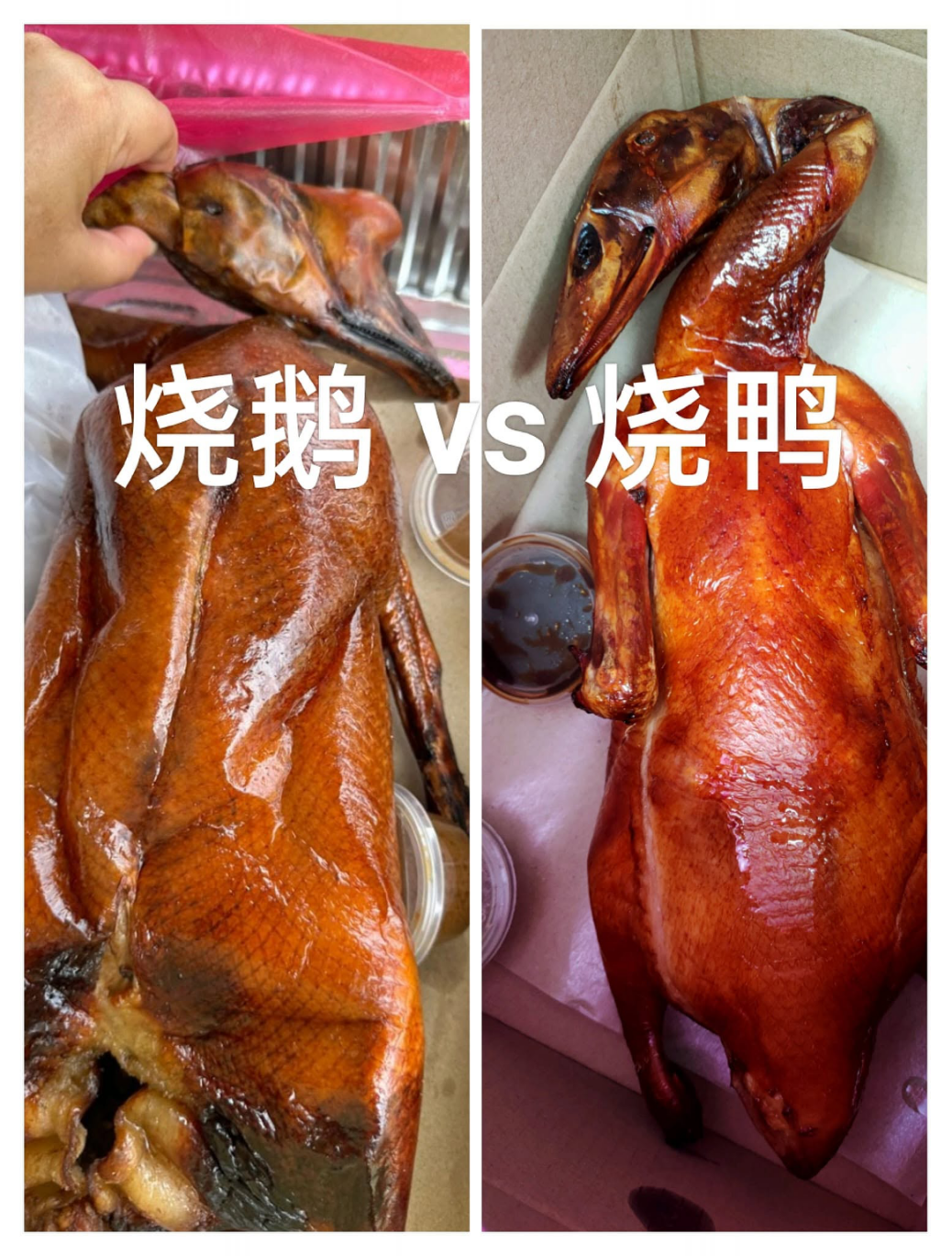
If there really are no Guangdong kids, getting a few Fujian kids would work too. Three years ago, a Zhihu user proved from a cost perspective that Auntie's legs couldn't possibly be goose legs, but was questioned by many netizens. I took a look; this user is from Fujian and has lived in Guangdong for a long time.
Taking a step back, if any student who went to buy 'goose legs' had treated a nearby Guangdong classmate to one, they wouldn't have been scammed for over a decade.
According to an interview by Jiemian News, many college students reflected that the legs roasted by Goose Leg Auntie actually tasted quite ordinary. But they couldn't resist the fact that Beijing has so little good food, let alone such a street stall full of worldly atmosphere.
So various circumstances contributed to Auntie Chen's commercial success, and the suddenly awakened students began to show off their academic prowess.
Someone did the math for Auntie Chen: assuming she has 20 distribution stalls in Beijing, and each stall sells 100 duck legs a day. The monthly revenue would reach 960,000 yuan, the monthly gross profit would be 690,000 yuan, and the annual revenue would exceed 7 million, with some even saying over 8 million.
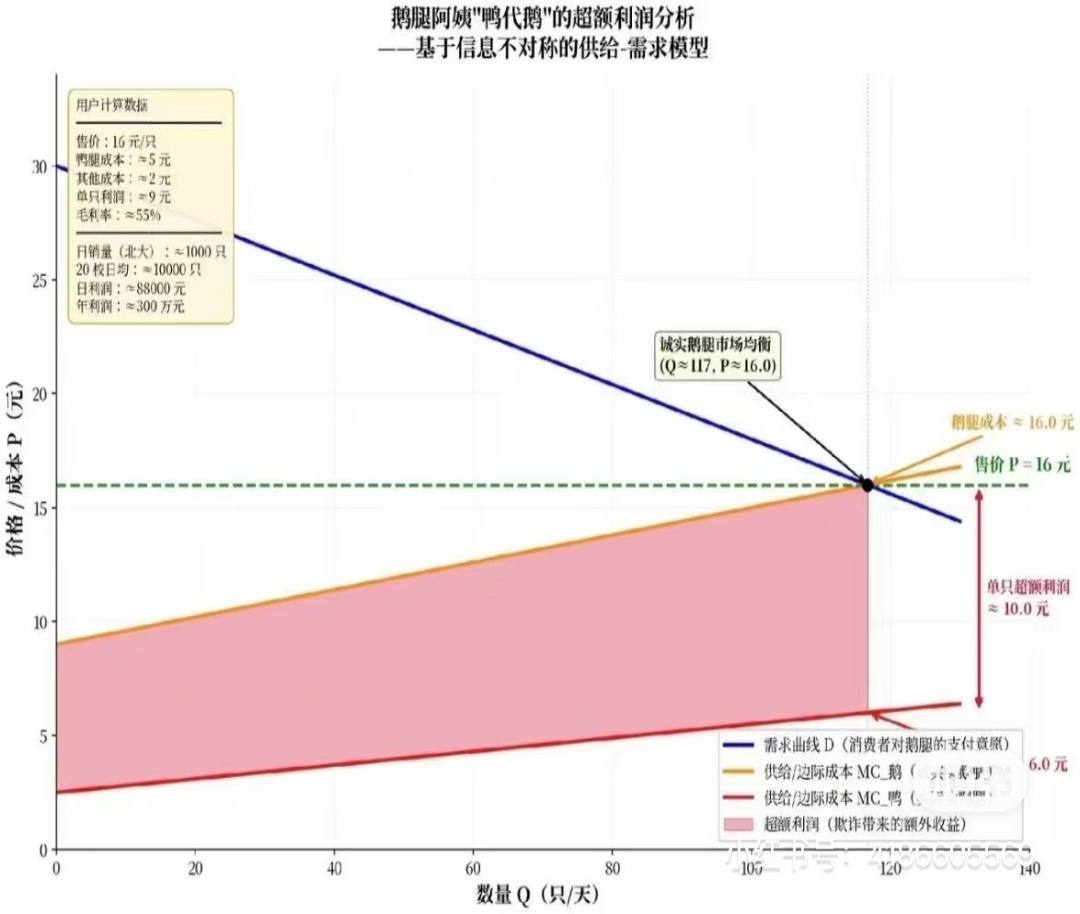
However, Auntie Chen's son denied the claims of getting rich overnight, stating that their household income was around 50,000 yuan, with daily sales of about 500, reaching 1,000 at most.
Let's calculate based on the median of 750. Auntie Chen's husband said their duck legs were of good quality, with a purchase price of 4-5 yuan. Let's tentatively calculate based on this price. Assuming food raw materials account for about 40% of the total cost, Auntie's cost is around 11 yuan. The net profit per duck leg is 5 yuan; at 750 a day, that's an annual net profit of 1.3 million.
But many students reported that Auntie's duck legs often had an unidentifiable green liquid. Stay calm, this isn't the duck turning into a zongzi.
According to popular science from Guokr, this is caused by one of the spoilage bacteria on duck meat, Pseudomonas, breaking down sulfur-containing amino acids in the meat, producing hydrogen sulfide that reacts with the heme of myoglobin to form green sulfmyoglobin. Simply put, we see it turn green. Therefore, if calculated based on a 2-yuan frozen duck leg, Auntie's profit is far higher than what was stated above.
Students, you learn book knowledge from your teachers, but when it comes to society, you still have to learn from the working people.
Source: Planet Business Review
 微信扫一扫打赏
  支付宝扫一扫打赏
Comments (0)