
@Steed的围脖: On a luxury expedition cruise ship, 8 people were infected and 3 died; the pathogen is hantavirus.
When this news broke in early May, nerves around the world nearly snapped at the same time. Many still vividly remember the 2020 Diamond Princess incident—another cruise ship, another deadly virus, and passengers trapped in an enclosed space. That time, over 700 people contracted COVID-19, making it the most shocking cruise ship event of the early pandemic.
But this time, the WHO, the European Centre for Disease Prevention and Control, and the US CDC were almost unanimous in their message: the risk to the public is extremely low.
A virus with a mortality rate of 30% to 40%, yet experts say there's no need to panic? How can both of these facts be true simultaneously?
The answer lies in how this virus spreads.
Hantaviruses are a large family found worldwide, but they share a common trait: they are transmitted almost exclusively from rodents to humans. The route of infection is also quite primitive: rodent urine and feces dry up and mix into dust, and humans can contract the virus by inhaling it. A typical scenario is cleaning a rodent-infested warehouse or garage without a mask; one sweep of a broom can send the virus airborne. Last year, the wife of American actor Gene Hackman, pianist Betsy Arakawa, also died of hantavirus; investigators found a severe rodent infestation in her home.
For the human world, hantavirus is essentially a dead end. It spreads from rodents to humans, and humans are the end of the line; the transmission chain stops there.
But there is one exception.
Within the entire hantavirus family, one and only one virus has been proven to spread from person to person: the Andes virus, abbreviated as ANDV, which is primarily found in Argentina. And the virus on this cruise ship, confirmed through genetic testing, is exactly that.
Person-to-person transmission of the Andes virus requires a very strict condition: close and prolonged contact, and the source patient must already be symptomatic. An outbreak of 34 infections occurred in southern Argentina between 2018 and 2019, which is the most well-documented case on record. In that outbreak, the starting point of the transmission chain was a feverish patient who attended a birthday party for 90 minutes. Out of about 100 guests, only the 5 people sitting right next to him were infected. Later, the wife of another infected person attended her husband's funeral while feverish, leading to 10 more infections.
The key data is here: during the same outbreak, 82 healthcare workers at a hospital had contact with symptomatic patients, 45 of whom worked in the ICU or emergency department. Of these 45, only a few used protective equipment like N95 masks. The result: none of the 82 were infected.
That Argentine outbreak also provided another crucial piece of information: when health authorities ordered the isolation of patients and close contacts after the 18th case, the virus's basic reproduction number (R0) dropped from 2.12 to 0.96. Dropping below 1 meant the transmission chain began to naturally shrink. As soon as the measures were implemented, the outbreak was halted.
Another set of data comes from the United States. In 2018, a woman was diagnosed with the Andes virus after returning from a trip to Argentina and Chile. During the onset of her illness, she took two commercial flights. The US CDC identified 53 contacts, successfully reached and monitored 51 of them, and after the full 42-day incubation period, not a single person was infected.
These two sets of figures show that the person-to-person transmission efficiency of the Andes virus is extremely low. It is not the flu, nor COVID-19; it does not float around in ventilation systems to infect an entire building. It requires face-to-face, close-range, prolonged intimate contact, and transmission almost exclusively occurs when the infected person already has a fever and is visibly unwell.
Now, back to this ship.
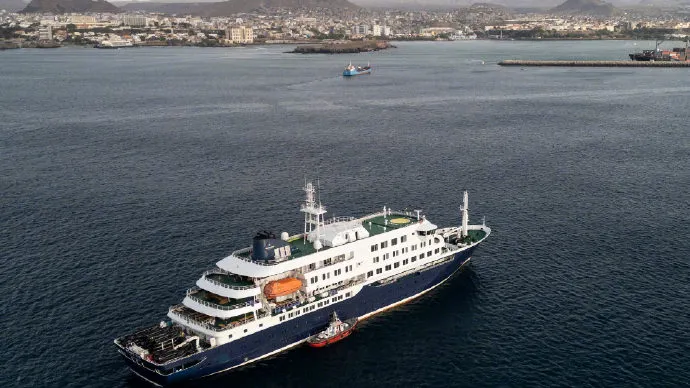
The MV Hondius departed from Ushuaia, the southernmost tip of Argentina, on April 1, planning to pass through Antarctica and various islands in the South Atlantic. The first patient was a Dutch man who developed symptoms on April 6 and died on board on April 11. At the time, no one suspected hantavirus because his respiratory symptoms looked similar to many other diseases. His wife disembarked on April 24 at Saint Helena with her husband's remains. She was already symptomatic and her condition worsened during a flight to Johannesburg, South Africa; she collapsed at the airport on April 26 and subsequently died. It wasn't until May 4 that her test results confirmed hantavirus.
Before boarding the ship, this Dutch couple had been birdwatching in Argentina, Chile, and Uruguay, passing through areas that are the habitat of the Andes virus host, the long-tailed colilargo. They most likely encountered environments contaminated with rodent excreta during their trip.
Afterward, more cases gradually appeared on the ship. The third patient sought medical attention on April 24, was evacuated from Ascension Island to South Africa on April 27, and is currently in the ICU but improving. The fourth patient fell ill on April 28 and died on board on May 2. The ship arrived in Cape Verde around May 4; after doctors boarded, they found three more symptomatic individuals who were evacuated to the Netherlands. Two are hospitalized in stable condition, and one is now asymptomatic and currently in Germany. The eighth case is a Swiss man who disembarked at Saint Helena; upon learning of the outbreak, he proactively sought medical care in Zurich and was confirmed to be infected with the Andes virus.
As of May 8, none of the remaining 147 passengers and crew on board were symptomatic, and all were required to stay in their cabins. The ship departed from Cape Verde on the evening of May 6, heading for the Canary Islands—a voyage of three to four days—and Spanish authorities have agreed to assist with receiving them.
Meanwhile, the 30 passengers who disembarked at Saint Helena on April 24 came from at least 12 countries, 6 of them from the US; health authorities are tracking and monitoring them one by one.
The WHO is developing a brand-new disembarkation protocol; a hantavirus outbreak on a cruise ship of this scale has never happened before, so there are no ready-made plans to follow. The incubation period for the Andes virus can be up to 7 to 42 days, and the last onboard onset was April 28, so it will take time to completely rule out risks. However, the WHO currently does not recommend that everyone isolate for the full 42 days; instead, it advises daily temperature checks and active symptom monitoring, because existing evidence shows that person-to-person transmission only occurs during the symptomatic phase.
Researchers worldwide are eager to get the genomic data of this virus strain to see if any mutations have occurred that could explain this unprecedented cruise ship outbreak. But the WHO's assessment remains measured: the biggest anomaly of this outbreak is simply that it occurred on a ship. The behavior pattern of the virus itself is not noticeably different from previously recorded person-to-person outbreaks of the Andes virus.
Researchers of the 2018-2019 outbreak made an interesting comparison: when looking at the virus from a super-spreader who infected 10 people and an infected person who transmitted it to no one, the genetic sequences were almost identical. The difference lay not in the virus, but in the people—where the sick person went, how many people they saw, and how long they stayed when they were ill.
The cruise ship simply brought all these unfavorable conditions together: an enclosed space, close contact, frequent social activities, and the fact that the early death was not identified as hantavirus, missing the earliest window for isolation.
The virus hasn't gotten stronger. This time, the virus simply boarded a ship and encountered an environment suited for its transmission.
~~~~~~
The image shows an aerial view of medical personnel boarding the cruise ship MV Hondius, anchored outside the port of Praia, the capital of Cape Verde, on May 6, 2026. Image source: AFP
 微信扫一扫打赏
  支付宝扫一扫打赏
Comments (0)