
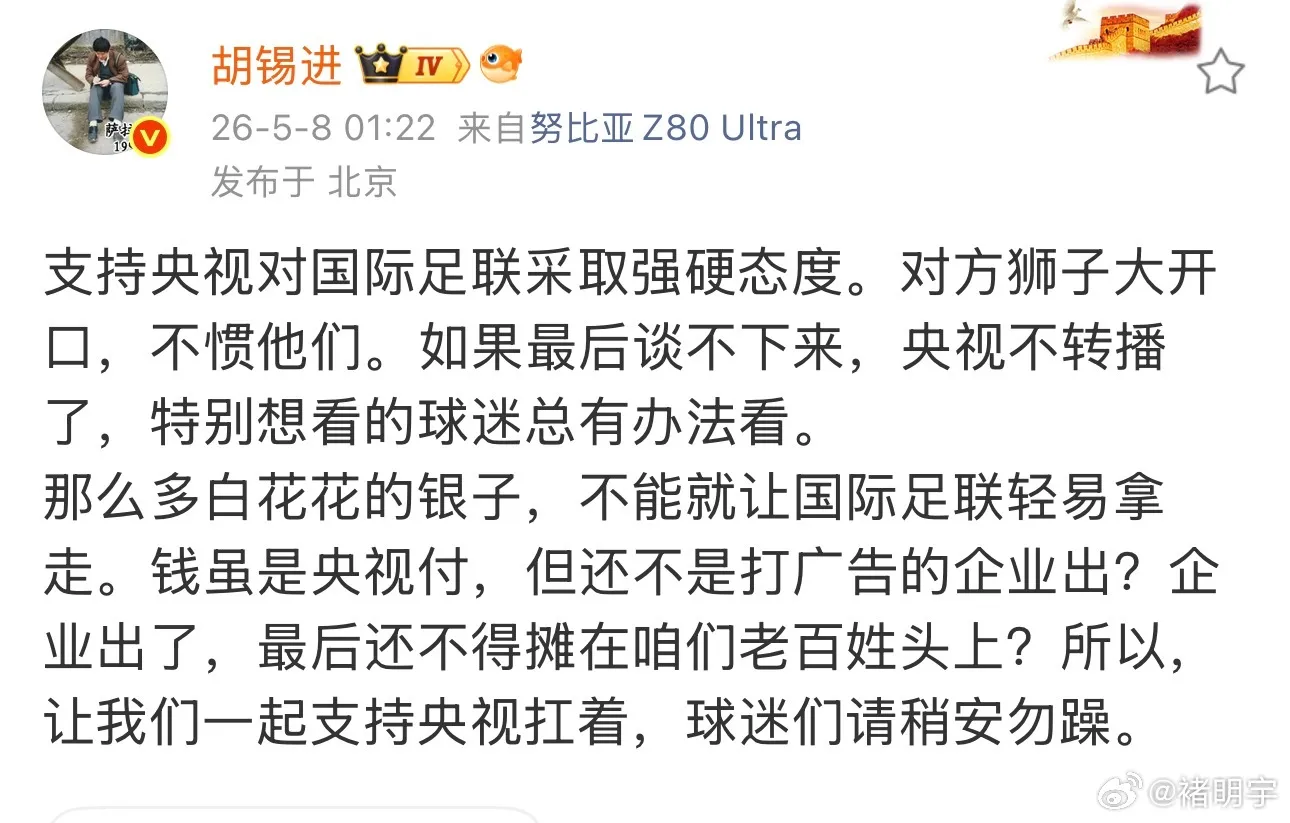
@Chu Mingyu: The biggest problem with Hu Xijin's type of argument is that he forcefully frames a standard commercial copyright negotiation into a moral narrative of "guarding the people's purses."
The problem is, CCTV buying the World Cup broadcasting rights has never been about whether "hard-earned silver" will be made by FIFA, but whether this copyright fee can be recouped through advertising, broadcasting, platform traffic, brand exposure, and derivative commercial value.
This is called ROI—Return on Investment, not national integrity.
According to Hu Xijin's logic, it seems that as long as the price is high, it's an exorbitant demand; as long as you don't buy it, you're saving money for the people. But in the real world, many things CCTV has done over the years are essentially commercial purchases.
Olympic broadcasting rights must be bought, NBA broadcasting rights must be bought, European Championship rights must be bought, and popular TV dramas require copyright fees; even the reruns of Empresses in the Palace didn't just fall from the sky.
Nobody says: We can't let Sun Li walk away with our hard-earned silver! So why is it that when it comes to FIFA, suddenly it's "the people's money must not be squandered"?
There are always people who like to politicize and moralize market issues.
Haha, if we're really talking about "expensive," then the Chinese entertainment industry over the past decade is what you'd call truly "sky-high."
Public records show that during the peak of China's "traffic era" from 2016 to 2021, the salaries of many stars had entered absurd territory: Zheng Shuang was reported to have earned 160 million yuan for filming a drama in two months; the salaries for many traffic actors in TV dramas long hovered between 50 million and 100 million yuan.
Even though there are salary caps now, do those foundation-wearing stars really earn less? Do those illiterate livestreamers reading scripts off-screen easily make hundreds of millions? Compared to the World Cup broadcasting rights, which of these "hard-earned silvers" holds more value for the people?
To be honest, I can't even tell these caked-up traffic stars apart, yet they can make over a hundred million shooting a generic period romance, reciting numbers instead of lines, relying on green screens, dubbing, and AI skin-smoothing. Meanwhile, the World Cup, one of the most influential sports events in the world, held once every four years with billions of global viewers—suddenly, a copyright fee of a few hundred million dollars becomes "hard-earned silver" that isn't worth spending or that we can't afford?
That's a bit of dark humor.
Moreover, CCTV buying the World Cup is never charity. What CCTV really considers is: how much advertising can be sold; whether corporate sponsorships are worth it; whether user traffic is worth it; whether new media distribution is worth it; how much sports consumption it can stimulate; and whether it can boost the platform's influence.
Essentially, there is no difference between this and iQIYI buying The Knockout, Tencent buying the NBA, or Youku buying Empresses in the Palace.
The problem with Hu Xijin's argument is that it deliberately blurs the boundary between commercial pricing and moral right and wrong.
Of course FIFA wants to sell high, and of course CCTV wants to push the price down; this is called market bargaining. It's just like when you buy a house, buy advertising, or purchase TV drama copyrights.
Negotiations breaking down is normal;
negotiations succeeding is also normal.
But there's no need to frame it as: FIFA wants to make money off the Chinese, while CCTV is shielding the people from the capitalist sickle.
Because in the past decade in China, a large part of what truly drained the "hard-earned silver" from the Chinese people was precisely that "traffic industry" propped up by capital.
At least the World Cup features real football. Some people act in dramas and don't even speak their own lines.
Oh right, in the comments of many netizens, there is another particularly absurd logical flaw:
They describe the expensive copyright for the Chinese region as being ripped off by FIFA, without realizing on the other hand: the very reason why China's broadcasting rights are more than ten times more expensive than India's precisely proves that China's commercial market is more mature and more valuable than India's.
The pricing of sports copyrights has never been based on population size, but is comprehensively determined by: advertising value, per capita consumption capacity, brand investment capability, corporate sponsorship budgets, platform monetization ability, purchasing power, market maturity, and so on.
To put it bluntly:
FIFA is not selling "football," but rather selling the "commercial value of audience attention."
And Chinese audiences are much more valuable than Indian audiences. This is not embarrassing; it shows that our economic strength is awesome!
In other words: the Chinese market is expensive not because China is at a disadvantage, but because China is valuable!
This is just like how office rent in Lujiazui, Shanghai, is higher than in Mumbai, Moutai's advertising fees are higher than those of Indian spirits, and China's Spring Festival box office is higher than the annual box office of many countries...
Mr. Hu Xijin's phrase: We can't let FIFA easily take away our hard-earned silver. It sounds like guarding wealth for the people, but from a business logic perspective, it seems more like an expression completely alien to a market economy.
Because in a normal market: "expensive" itself is a reflection of value.
Haha, besides, is $300 million really that expensive? It's merely the salary of a few pretty-boy actors for some lousy period romances.
I've said so much; I wonder if the idiots can understand it.
 微信扫一扫打赏
  支付宝扫一扫打赏
Comments (0)