
This article is from the WeChat Official Account: APPSO, Author: Discovering Tomorrow's Products
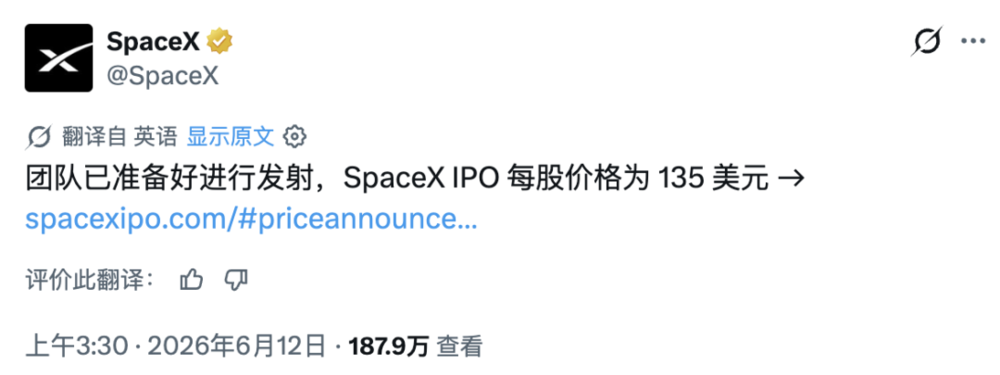
Just now, SpaceX finalized the largest IPO in human history at a price of $135 per share.
Selling 555.6 million shares and raising $75 billion, its valuation skyrocketed directly to $1.77 trillion. If underwriters exercise the "over-allotment option" to sell an additional 83.3 million shares, the deal size could grow to about $86 billion.
What does this mean?
The previous record holder was Saudi Aramco, which went public on the Riyadh exchange in 2019 and raised $25.6 billion. SpaceX's move is more than double that.
When the market opened this Friday, it became the seventh most valuable publicly traded company in the US, worth more than JPMorgan Chase, Berkshire Hathaway, Meta, and even Musk's own Tesla (doge).
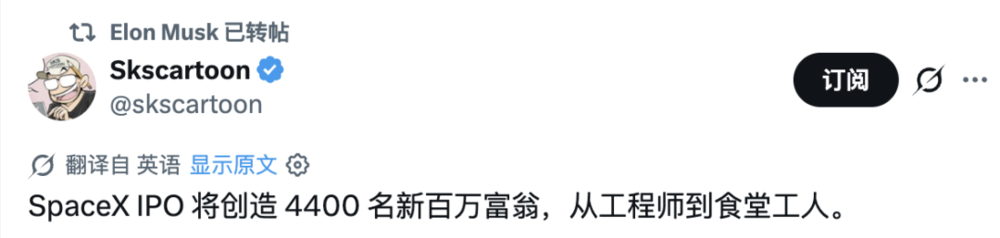
According to estimates by the equity trading platform Hill.com, this listing is expected to create about 4,400 new millionaires within SpaceX, with about 400 current and former employees seeing their holdings reach or exceed $100 million.
As for Musk himself, thanks to this IPO, his net worth surged by about $275 billion, reaching approximately $970 billion, just a stone's throw away from a trillion. If the stock price hits $140, he will officially become humanity's first trillionaire on paper.
But the most absurd part is Old Musk's issuance posture—completely unconventional.
When a normal company goes public, it goes on a "roadshow."
Investment banks take the CEO around the world to meet investors, throw out a price range, listen to feedback, and then slowly finalize the price. But Musk went straight for the ignore-all-defense approach—$135 a share, take it or leave it.
He even crazily "exploited a bug" on the NASDAQ, leaving a massive 30% of the share allocation for the retail army.
Even the timing of the price announcement was very "Musk."
Most companies choose to make official announcements after the 4 PM close, lest any macro news or market fluctuations affect the stock price during trading hours. SpaceX insisted on dropping the price with a "free-writing prospectus" at just past 3 PM Eastern Time, while the US stock market was still open, only issuing a press release half an hour later.
And there's no need to worry about SpaceX slipping out of Musk's control after going public, because this man still holds a staggering 82% to 84% of SpaceX's voting rights (figures vary slightly depending on the source).
So the question is, is SpaceX really worth this price?
Let's look at its assets first. SpaceX currently relies on three main businesses: building rockets, Starlink satellite internet, and the AI sector that just merged with xAI.
Starlink is now the revenue pillar, used by millions of consumers, businesses, and government clients across 164 countries and regions globally. The rocket business is even fiercer; over the past three years, more than 80% of the stuff humans sent into orbit was launched by them.
Sounds wonderful, right? But once you open the financial statements, the tone shifts dramatically.
In the first three months of this year alone, SpaceX lost $4.3 billion. Counting from the beginning of 2023, cumulative losses have reached a whopping $13 billion, primarily burned by AI.
What about revenue? $4.7 billion in the first quarter of this year. But in the same period, Meta made $56.3 billion in a single quarter, and its market cap is only $1.4 trillion. They earn ten times more than you, yet their valuation isn't as high (eating melon.jpg).
So where does the confidence for that $1.77 trillion come from? The answer: AI and the sea of stars.
But whether this pie can actually be eaten depends entirely on a bunch of technologies that don't even exist yet: launching AI data centers into space, building robot factories on the moon, and sending humans to settle on Mars. It's like a sci-fi movie coming to life—they're just asking if you believe it.
To make the AI story complete, Musk made a series of aggressive moves this year.
In February, he folded his xAI into SpaceX, and the post-merger valuation instantly spiked to $1.25 trillion, with the original SpaceX portion also valued at $1 trillion; in April, he announced spending $60 billion to acquire the AI coding company Cursor, forcibly entering a track he had never touched before.
Even more interesting is the computing power trade.
Last month, SpaceX signed a big contract with Anthropic, selling its excess AI computing power to them; then, following the same playbook last week, it started supplying computing power to Google too, raking in up to $2.17 billion a month.
Can't beat them in a fight, but sure selling happily (doge).
And this computing power business is poised to become SpaceX's largest source of revenue.
But the problem lies here too. The main force of SpaceX's AI business is xAI, and its chatbot Grok is clearly overshadowed by OpenAI and Anthropic in both the consumer and enterprise markets.
Although the SpaceX IPO remains controversial, the venture capital circle truly hit the jackpot this time.
Peter Thiel's Founders Fund, which bet on it for nearly two decades and invested $600 million across several rounds for about a 3% stake, is now worth over $50 billion;
a16z secured the largest single return in its history, exceeding $10 billion; Sequoia entered at the end of 2019, and its 1.5% stake is now worth over $20 billion.
And a host of early investors/institutions like Valor, DFJ Growth, 137 Ventures, and Thrive all made a fortune.
Ultimately, this IPO is a bet not just on a company, but on Elon Musk himself.
Believers are betting on the sea of stars and a future that hasn't yet arrived; skeptics are keeping their eyes on the money-burning financial statements and unverified grand promises.
When the market opens tonight, the market will provide the first answer.
 微信扫一扫打赏
  支付宝扫一扫打赏
Comments (0)